Essayer OR - Gratuit
SILENT FAMINE
Down To Earth
|January 16, 2024
For the past 50 years, the country has introduced high-yielding rice and wheat varieties at breakneck speed to achieve food security. A study led by scientists with the Indian Council of Agricultural Research (ICAR) has for the first time looked at the food value of these modern-bred grains, and delivers some dire warnings: the food grains that we eat have lost food value; instead they are accumulating toxins. Worse, by 2040, the grains will become so "impoverished" that they would worsen the country's growing burden of non-communicable diseases.

YOU ARE what you eat, or, rather, what you grow to eat. Imagine an entire population eating something that has little food value-something that is devoid of nutrients such as a host of vitamins which are essential for growth, disease prevention and maintaining overall health and well-being. "This is the future we are hurtling towards," says Sovan Debnath, a soil scientist at the Indian Council of Agricultural Research (ICAR) under the Union Ministry of Agriculture and Farmers Welfare.
In November 2023, Debnath and 11 other scientists from ICAR, Bidhan Chandra Krishi Viswavidyalayaanother premier agricultural research institute in West Bengal-and the National Institute of Nutrition in Telangana published a seminal study that says the Green Revolution has helped India achieve food security, but by compromising its nutritional security. In a first, the study reports that breeding programmes focused on developing high-yielding varieties have altered the nutrient profiles of rice and wheat, two major staple food grains of India, to the extent that their dietary significance to the population has diminished. While chasing yield, the plant genetics have been tinkered with so much that they no longer do the fundamental job of delivering nutrition from the soil to the grains.

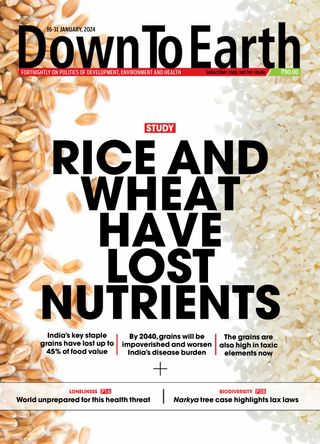

Cette histoire est tirée de l'édition January 16, 2024 de Down To Earth.
Abonnez-vous à Magzter GOLD pour accéder à des milliers d'histoires premium sélectionnées et à plus de 9 000 magazines et journaux.
Déjà abonné ? Se connecter
PLUS D'HISTOIRES DE Down To Earth

Down To Earth
THE GREAT PIVOT
China's moves to transition to clean energy offer critical lessons to India

4 mins
March 01, 2026

Down To Earth
COAL V CORRIDOR
A proposal to mine coal along a corridor that links two tiger reserves in central India is a step away from getting final clearance. The move could affect movement and genetic diversity of tiger populations in the region
8 mins
March 01, 2026

Down To Earth
India's challenging AI predicament
Hobbled by lack of innovation and AI skills in its crucial technology sector, India is focusing on a ruinous plan to host data centres
4 mins
March 01, 2026
Down To Earth
China to implement zero tariffs across Africa
CHINA ON February 14 announced that it will implement zero tariffs for imports from all the 53 African nations it has diplomatic relations with, starting from May 1.
1 min
March 01, 2026
Down To Earth
Poverty, sans the threshold
MEASUREMENT OF poverty is a fundamental exercise, needed to direct development programmes.
2 mins
March 01, 2026

Down To Earth
A bridge across forever
For two decades, a Chhattisgarh village remains stuck in a loop of building temporary river crossings to access markets and sell forest produce
4 mins
March 01, 2026
Down To Earth
Liveable cities need a new model
CRY FOR my Delhi. This is my city—my family records many generations who have lived here.
3 mins
March 01, 2026

Down To Earth
Real impacts of the changing seasons
This refers to the article \"1,500 days, and an alarm for new climate\" (1-15 December, 2025).
1 mins
March 01, 2026

Down To Earth
‘It’s a systematic effort by US to dismantle climate policy’
The US, the world's largest historical emitter of greenhouse gases, has overturned its “endangerment finding”, the legal foundation for regulating emissions under the Clean Air Act since 2009.
4 mins
March 01, 2026
Down To Earth
Amazon turned carbon source in 2023 drought
EXTREME DROUGHT and a prolonged heatwave in 2023 pushed parts of the Amazon rainforest from acting as a carbon sink to becoming a carbon source for three months, according to a February 13 study published in the journal AGU Advances of the American Geophysical Union.
1 min
March 01, 2026
Listen
Translate
Change font size