Poging GOUD - Vrij
Millet might
Down To Earth
|September 16, 2022
Odisha's mission to bring millets back to its fields and plates can succeed with greater marketing support and promotion beyond tribal areas

SUPPLY creates its own demand. This theory, believed to have been proposed by the early 19th-century French economist Jean-Baptiste Say, may sound like a foolhardy view to the modern ear, but this is how India lost the diversity of its food basket to Green Revolution. In the 1960s, as the country was struggling to feed itself, the focus was to rapidly increase the production of two crops-wheat and rice. This shaped an Indian diet where rice and wheat became the staple food, eventually reducing the demand for other traditional cereal grains like millets. Assessments in recent decades show that while the Green Revolution has not helped address the nutritional security of India, it has turned the country into the world's biggest extractor of groundwater. Heavy reliance on chemical inputs has degraded soil, polluted water sources and is harming farmers' health.
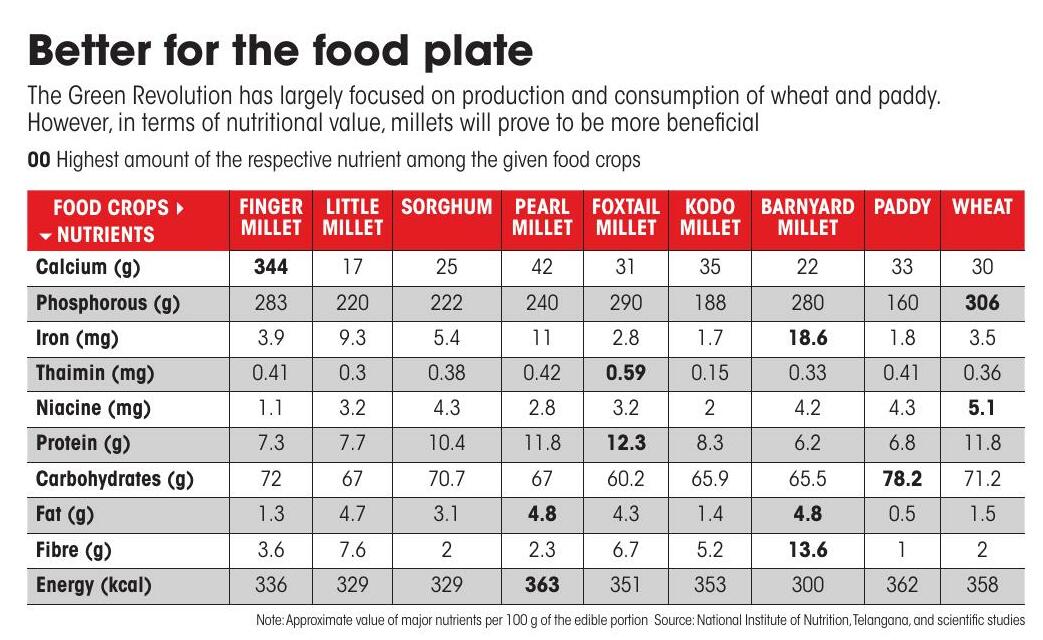
Fifty years later, as Odisha tries to improve nutritional security and promote sustainable agricultural practices, Say's law has come in handy. In 2017, the state launched the Odisha Millet Mission (OMM), which aims to bring millets back to its fields and food plates by encouraging farmers to grow the crops that traditionally formed a substantial part of the diet and crop system in tribal areas. This highly varied group of small-seeded cereal crops not only require less water, farm inputs and are more resilient to climate vulnerability, but rich in nutrients like calcium, iron and protein (see 'Better for the food plate').


Dit verhaal komt uit de September 16, 2022-editie van Down To Earth.
Abonneer u op Magzter GOLD voor toegang tot duizenden zorgvuldig samengestelde premiumverhalen en meer dan 9000 tijdschriften en kranten.
Bent u al abonnee? Aanmelden
MEER VERHALEN VAN Down To Earth

Down To Earth
GREAT NICOBAR DILEMMA
In the fragile ecosystem of Nicobar, strategic development must align with constitutional commitment to protect environment, indigenous dignity

3 mins
March 16, 2026
Down To Earth
CATCH BY THE ROOTS
Sabai grass could be a game-changer for the marginalised economies of West Bengal's dry uplands. All it needs is an efficient market strategy
4 mins
March 16, 2026

Down To Earth
POWERING TRANSITION
India's renewable ambitions are rising rapidly, with half of its installed power capacity now coming from non-fossil sources. Yet the gap between capacity and generation remains wide. The experiences of two pioneering states, Karnataka and Tamil Nadu, which together generate over a fifth of the country's renewable energy, offer crucial lessons for accelerating the transition, reports PUJA DAS from Bengaluru, Chennai, Mumbai and New Delhi
16 mins
March 16, 2026
Down To Earth
At core of survival
Water scarcity defines life in a village inside Sariska Tiger Reserve's critical habitat, as debates over its relocation drag on
5 mins
March 16, 2026

Down To Earth
What's on your plate
An upcoming digital tool can help people learn about the origin of their meals and make climate-positive food choices
2 mins
March 16, 2026

Down To Earth
'Bad environment can never be good economics'
The Supreme Court of India and even the high courts were once very active and took a proactive role in protecting the environment; unfortunately, that is no longer true
4 mins
March 16, 2026
Down To Earth
Things fall apart
IN THE past year, the world has counted more missiles and bombs than hours.
2 mins
March 16, 2026

Down To Earth
Universities in crisis, innovation is stifled
Political control and skewed policies have led to unrest in academia, stifling creativity and meaningful research
4 mins
March 16, 2026

Down To Earth
SPARK IN THE GAME
The Reserve Bank of India's restored recognition of Default Loss Guarantees re-enables credit flow into last-mile electric mobility
3 mins
March 16, 2026

Down To Earth
Ushering in new eras
An appraisal of the state of biodiversity conservation, pollution reduction and climate adaptation regimes in India
3 mins
March 16, 2026
Translate
Change font size