Poging GOUD - Vrij
CATCH BY THE ROOTS
Down To Earth
|March 16, 2026
Sabai grass could be a game-changer for the marginalised economies of West Bengal's dry uplands. All it needs is an efficient market strategy
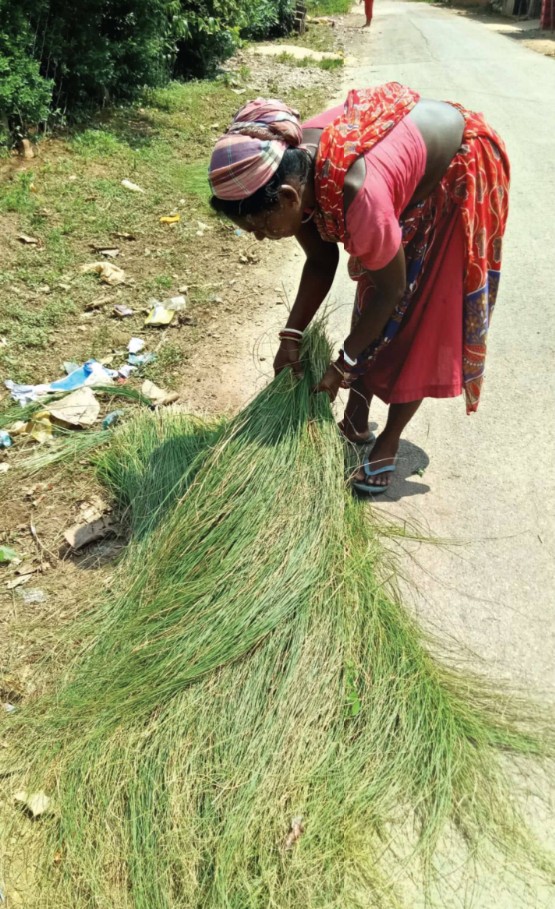
IN THE red lateritic uplands of western West Bengal, where sal forests sway over undulating terrain and agriculture survives on uncertain monsoons, an unassuming grass quietly sustains the rural economy.
For thousands of households across the districts of Jhargram, Bankura and Purulia, it has long been a steady source of livelihood. Locally called sabai or babui, and Eulaliopsis binata in scientific nomenclature, the perennial grass grows in dense clumps and thrives where most crops struggle. It flourishes on degraded, rain-fed uplands, often dismissed as “marginal” and unproductive. It withstands drought, tolerates light frost and requires little beyond seasonal rainfall and minimal labour. Waterlogging can destroy it, but in the dry tropical climate of eastern India excess moisture is rarely the problem.
Nowhere are the ecological resilience and economic potential of this hardy grass more evident than in Jhargram. Four of its blocks—Nayagram, Gopiballavpur-I, Binpur-II and Jhargram—account for 85 per cent of sabai grown in the state. A field-based study was conducted between 2019 and 2025 by researchers from Raja Narendralal Khan Women’s College in Midnapore. The study found that 42 per cent of rural households in districts of Jhargram, Bankura and Purulia depend wholly or partially on sabai-related activities, such as rope-making and the weaving of baskets, mats and home décor.
For generations people in these rural areas have relied on minor forest produce to supplement subsistence farming. Sabai was gathered casually and woven into ropes for household use or sold in local markets for modest returns. Over time the practice has evolved into a semi-organised rural enterprise that now plays a central role in the survival of nearly 65 per cent households in marginalised pockets of these districts, while supplementing the earnings of others during lean agricultural months or periods of crop failure.

Dit verhaal komt uit de March 16, 2026-editie van Down To Earth.
Abonneer u op Magzter GOLD voor toegang tot duizenden zorgvuldig samengestelde premiumverhalen en meer dan 9000 tijdschriften en kranten.
Bent u al abonnee? Aanmelden
MEER VERHALEN VAN Down To Earth

Down To Earth
GREAT NICOBAR DILEMMA
In the fragile ecosystem of Nicobar, strategic development must align with constitutional commitment to protect environment, indigenous dignity

3 mins
March 16, 2026
Down To Earth
CATCH BY THE ROOTS
Sabai grass could be a game-changer for the marginalised economies of West Bengal's dry uplands. All it needs is an efficient market strategy
4 mins
March 16, 2026

Down To Earth
POWERING TRANSITION
India's renewable ambitions are rising rapidly, with half of its installed power capacity now coming from non-fossil sources. Yet the gap between capacity and generation remains wide. The experiences of two pioneering states, Karnataka and Tamil Nadu, which together generate over a fifth of the country's renewable energy, offer crucial lessons for accelerating the transition, reports PUJA DAS from Bengaluru, Chennai, Mumbai and New Delhi
16 mins
March 16, 2026
Down To Earth
At core of survival
Water scarcity defines life in a village inside Sariska Tiger Reserve's critical habitat, as debates over its relocation drag on
5 mins
March 16, 2026

Down To Earth
What's on your plate
An upcoming digital tool can help people learn about the origin of their meals and make climate-positive food choices
2 mins
March 16, 2026

Down To Earth
'Bad environment can never be good economics'
The Supreme Court of India and even the high courts were once very active and took a proactive role in protecting the environment; unfortunately, that is no longer true
4 mins
March 16, 2026
Down To Earth
Things fall apart
IN THE past year, the world has counted more missiles and bombs than hours.
2 mins
March 16, 2026

Down To Earth
Universities in crisis, innovation is stifled
Political control and skewed policies have led to unrest in academia, stifling creativity and meaningful research
4 mins
March 16, 2026

Down To Earth
SPARK IN THE GAME
The Reserve Bank of India's restored recognition of Default Loss Guarantees re-enables credit flow into last-mile electric mobility
3 mins
March 16, 2026

Down To Earth
Ushering in new eras
An appraisal of the state of biodiversity conservation, pollution reduction and climate adaptation regimes in India
3 mins
March 16, 2026
Listen
Translate
Change font size