Prøve GULL - Gratis
The Reptile Sexpocalypse
Scientific American
|January 2026
The sex of many turtles, crocodilians, and other reptiles is determined by the temperature at which their eggs incubate. Global warming could doom them
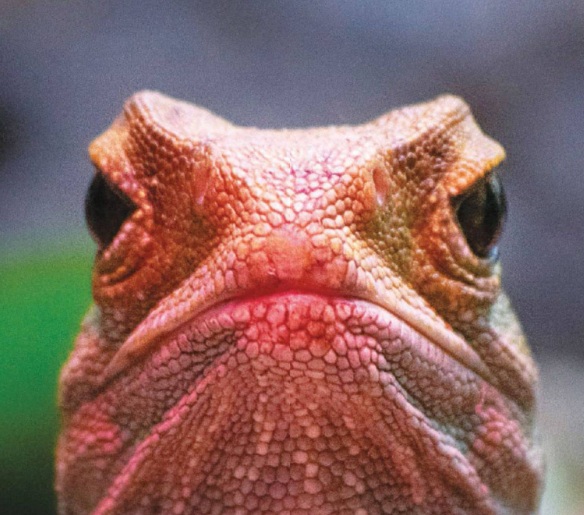
The tuatara, a reptile found only on small islands in New Zealand, is facing a dangerous combination of habitat restriction and skewed sex ratio.
UNDER NO LIGHT BUT THE STARS, a green sea turtle hauls herself out of the surf and onto the familiar sand of Alagadi Beach on the northern coast of Cyprus. She doesn't notice any predators as she makes her way up the beach; tonight will be the night.
When the turtle reaches a satisfactory spot, she nestles into the warm sand and begins excavating a deep pit. Nothing can distract her; she's gone into a kind of trance. She pushes out 100 wet, leathery eggs into the pit. The turtle won't move until she has completed her task, even if humans creep close to measure her shell and tuck a temperature logger in among her eggs. She finishes laying in about 20 minutes, but her work isn't done. Still focused, she spends another few hours laboriously scooping the sand over her eggs. Then she turns around and crawls back into the ocean.
In about two months her babies will emerge from that sand and make a mad dash to the water. They'll have to fend for themselves—their mother is done caring for them. She'll never know the curious fate that befalls her offspring: nearly all of the hatchlings will be female.
Many reptiles differ from typical vertebrates in that their sex is not determined by their genes. They lack sex chromosomes such as the X and Y inside human cells. Instead the temperature of their nest pushes them toward becoming male or female.
For green sea turtles, if the temperature is about 29 degrees Celsius (84 degrees Fahrenheit) during a critical mid-incubation window, the babies will hatch as a half-and-half mix of females and males. But the hotter the nest, the more they will skew female. In the dark sand of Alagadi Beach, the eggs incubate at a toasty 33 or 34 degrees C, resulting in broods that are overwhelmingly female.


Denne historien er fra January 2026-utgaven av Scientific American.
Abonner på Magzter GOLD for å få tilgang til tusenvis av kuraterte premiumhistorier og over 9000 magasiner og aviser.
Allerede abonnent? Logg på
FLERE HISTORIER FRA Scientific American

Scientific American
Probiotic Hope and Hype
Despite their popularity, supplements with billions of \"good\" microbes help only a few illnesses, research shows

3 mins
January 2026

Scientific American
Mondays Really Are More Stressful
The start of the workweek can be a biologically measurable stressor, with consequences for long-term health that can stretch into retirement
4 mins
January 2026

Scientific American
Tiny Display
An e-paper breakthrough brings extremely high-resolution color
2 mins
January 2026

Scientific American
Fine-Feathered Snack
A bat's tracker documents a dramatic midair hunt
2 mins
January 2026

Scientific American
OUR ROBOTIC PICTURE
Will mechanical helpers ever be commonplace at home, at work and beyond?
11 mins
January 2026

Scientific American
"Use Your Words" Can Be Good for Kids' Health
Writing or expressing feelings can help adults mentally and physically. Kids are no different
5 mins
January 2026

Scientific American
Distant Diplomacy
Unrelated species “talk” and understand one another to avoid threats
2 mins
January 2026

Scientific American
Behind the Nobel
A 2025 winner reflects on the mysterious T cells that won him the prize
5 mins
January 2026

Scientific American
A Suite of Killers
Heart ailments, kidney diseases and type 2 diabetes actually may be part of just one condition. It's called CKM syndrome
10 mins
January 2026

Scientific American
Static Launch
Tiny worms leap toward their fruit fly hosts with an electric “tractor beam”
3 mins
January 2026
Listen
Translate
Change font size