Prøve GULL - Gratis
Inside Asteroid Family Trees
Scientific American
|January 2026
Asteroid origins can be hard to trace
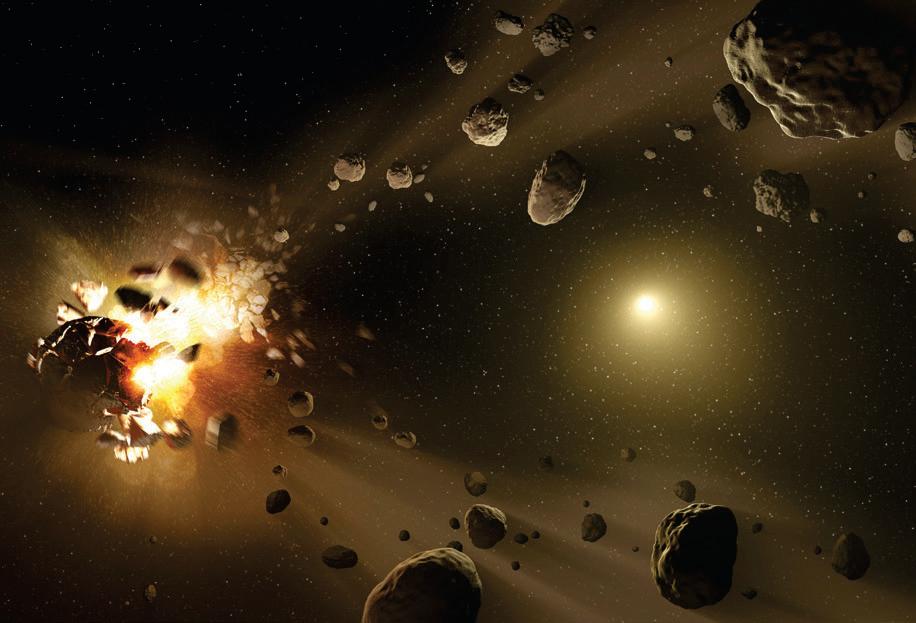
WE'VE ALL SEEN THIS HAPPEN in a science-fiction movie: our plucky heroes jump into their ramshackle spaceship and escape the bad guys by flying through the treacherous asteroid belt, where huge rocks tumble and spin so close together that the crew has to constantly dodge, duck, dip and dive to avoid being smashed to atoms.
It's exciting, but it's wrong: asteroids so close together would grind one another to dust in short order, making it extremely unlikely that you'd ever find such a situation near a star. In our solar system, the odds are pretty good that you could stand on the surface of an asteroid and not even be able to see another one! Big ones tend to be many millions of kilometers apart.
Yet they do interact if they are given enough time. Even in the sprawling main asteroid belt between the orbits of Mars and Jupiter, collisions are inevitable. In fact, we've managed to see some small asteroid smashups; bigger rocks are far more rare, so larger collisions are proportionally less common. But they do still happen—spacecraft reconnaissance of large asteroids shows that they are riddled with ancient impact craters. And when two space rocks go “bump” in the main belt, their high orbital speeds mean they can have collision velocities far higher than that of a rifle Shrapnel is inevitable because big impacts blow lots of asteroidal real estate out into space.
What happens to that ejected debris? In many cases, these fragments stay on much the same orbital path as the parent asteroid, although they gradually separate from it because of slight velocity differences. After millennia the ejecta might be clear across the sun from its source. You might think this outcome must be problematic for anyone trying to track down different types of asteroids to figure out how they all fit together—and it is! But this problem of orbital mechanics provides its own solution.

Denne historien er fra January 2026-utgaven av Scientific American.
Abonner på Magzter GOLD for å få tilgang til tusenvis av kuraterte premiumhistorier og over 9000 magasiner og aviser.
Allerede abonnent? Logg på
FLERE HISTORIER FRA Scientific American

Scientific American
Probiotic Hope and Hype
Despite their popularity, supplements with billions of \"good\" microbes help only a few illnesses, research shows

3 mins
January 2026

Scientific American
Mondays Really Are More Stressful
The start of the workweek can be a biologically measurable stressor, with consequences for long-term health that can stretch into retirement
4 mins
January 2026
Scientific American
Tiny Display
An e-paper breakthrough brings extremely high-resolution color
2 mins
January 2026
Scientific American
Fine-Feathered Snack
A bat's tracker documents a dramatic midair hunt
2 mins
January 2026

Scientific American
OUR ROBOTIC PICTURE
Will mechanical helpers ever be commonplace at home, at work and beyond?
11 mins
January 2026

Scientific American
"Use Your Words" Can Be Good for Kids' Health
Writing or expressing feelings can help adults mentally and physically. Kids are no different
5 mins
January 2026
Scientific American
Distant Diplomacy
Unrelated species “talk” and understand one another to avoid threats
2 mins
January 2026
Scientific American
Behind the Nobel
A 2025 winner reflects on the mysterious T cells that won him the prize
5 mins
January 2026

Scientific American
A Suite of Killers
Heart ailments, kidney diseases and type 2 diabetes actually may be part of just one condition. It's called CKM syndrome
10 mins
January 2026
Scientific American
Static Launch
Tiny worms leap toward their fruit fly hosts with an electric “tractor beam”
3 mins
January 2026
Listen
Translate
Change font size