
Magzter GOLDで無制限に
10,000以上の雑誌、新聞、プレミアム記事に無制限にアクセスできます。
50 years of the European Space Agency
BBC Sky at Night Magazine
|May 2025
As Europe's organisation for space exploration marks five decades since its foundation in May 1975, Anita Chandran looks at key moments in its history
-

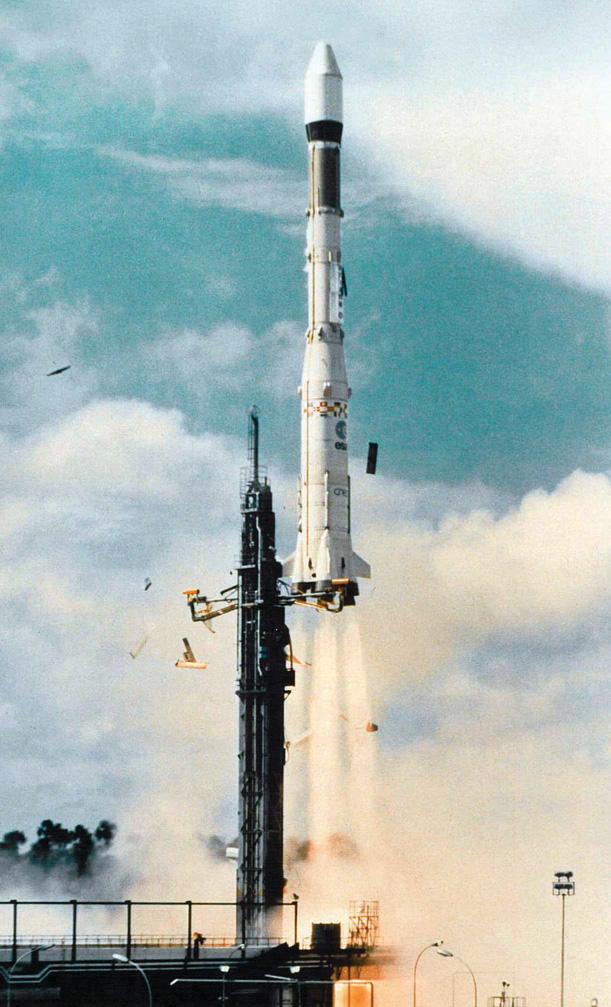
In 2025, the European Space Agency (ESA) will reach a significant milestone: its 50th birthday. For the last five decades, ESA has brought together European countries for sustainable and collaborative space exploration, launching missions like the Cassini-Huygens probe in 1997, which ranged as far as the rings of Saturn.
ESA emerged from the need for a multinational European space programme, particularly to compete with the strength of research being produced by the USA and Soviet Union after World War Two. The organisation can trace its roots back to two separate European space agencies set up in the 1960s: the European Launch Development Organisation (ELDO), which sought to develop a launch system; and the European Space Research Organisation (ESRO), which focused on developing spacecraft. In 1975, ELDO and ESRO were merged into what is now ESA, composed then of just 10 member states.
Since its formation, ESA missions have shaped our understanding of space and advanced the technology we use for astronomy. Its first mission, Cos-B, which launched in 1975 and aimed to study gamma radiation emitted from astronomical objects, operated for four years longer than planned. Only a handful of gamma-ray sources were known before Cos-B. ESA's Integral, launched in 2002, has now taken up its mantle, investigating gamma-ray bursts by detecting not only gamma rays, but X-rays and visible light.

このストーリーは、BBC Sky at Night Magazine の May 2025 版からのものです。
Magzter GOLD を購読すると、厳選された何千ものプレミアム記事や、10,000 以上の雑誌や新聞にアクセスできます。
すでに購読者ですか? サインイン
BBC Sky at Night Magazine からのその他のストーリー
BBC Sky at Night Magazine
MOONWATCH
January's top lunar feature to observe

2 mins
January 2026
BBC Sky at Night Magazine
Speed up your processing workflow
How to use Photoshop's Actions tool to drastically cut your processing time
3 mins
January 2026
BBC Sky at Night Magazine
Chasing Canada's polar lights
With solar maximum peaking and a new Moon promising dark skies, Jamie Carter travels to Churchill, Manitoba to hunt the Northern Lights - and dodge polar bears – in Canada's far north
7 mins
January 2026

BBC Sky at Night Magazine
Beyond Pluto: The search for the hidden planets
Could one – or even two - undiscovered planets lurk at the edges of our Solar System? Nicky Jenner explores how close we are to finding the elusive 'Planet 9'
6 mins
January 2026
BBC Sky at Night Magazine
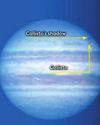
Jupiter moon events
Jupiter is a magnificent planet to observe.
2 mins
January 2026

BBC Sky at Night Magazine
What samples from space have taught us
Alastair Gunn explains what scientists have learnt in the 20 years since the first unmanned mission brought materials back from alien worlds
3 mins
January 2026
BBC Sky at Night Magazine
The Milky Way as you've never seen it before
This is the largest low-frequency radio colour image of our Galaxy ever assembled
1 min
January 2026
BBC Sky at Night Magazine
Merger of ‘impossibly' massive black holes explained
Scientists discover how enormous, fast-spinning black holes can exist after all
1 mins
January 2026
BBC Sky at Night Magazine
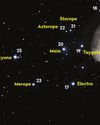
Lunar occultation of the Pleiades
BEST TIME TO SEE: 27 January from 20:30 UT
1 min
January 2026
BBC Sky at Night Magazine
The Universe's expansion may be slowing down
New study suggests current theories of dark energy could be wrong
1 mins
January 2026
Listen
Translate
Change font size