Essayer OR - Gratuit
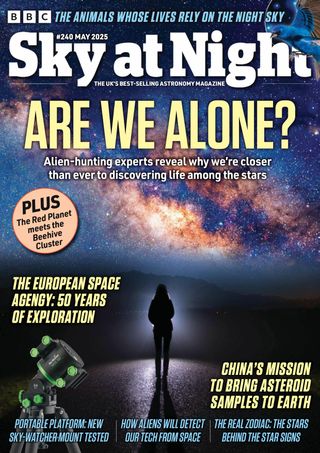
50 years of the European Space Agency
BBC Sky at Night Magazine
|May 2025
As Europe's organisation for space exploration marks five decades since its foundation in May 1975, Anita Chandran looks at key moments in its history
-

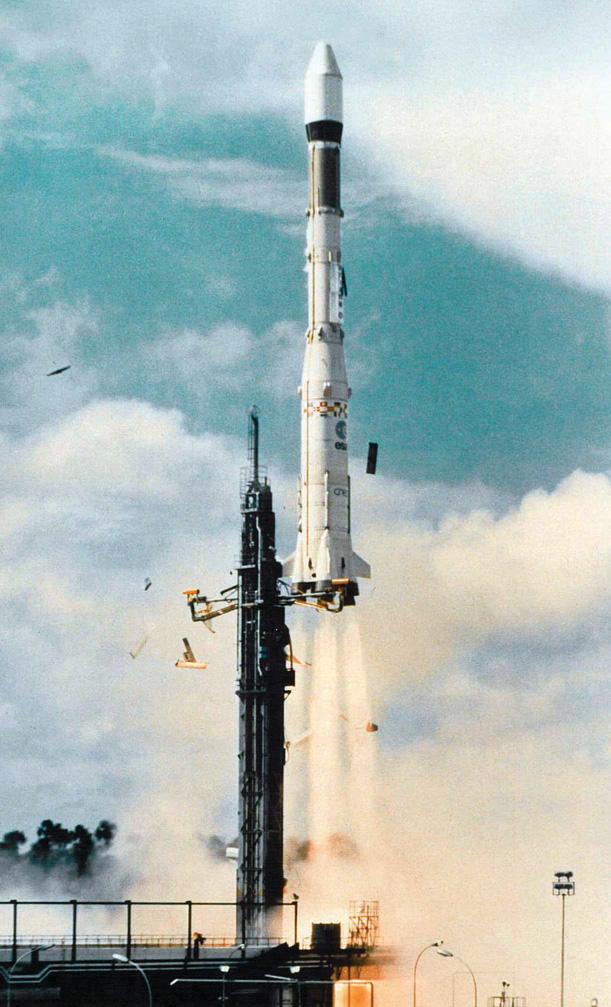
In 2025, the European Space Agency (ESA) will reach a significant milestone: its 50th birthday. For the last five decades, ESA has brought together European countries for sustainable and collaborative space exploration, launching missions like the Cassini-Huygens probe in 1997, which ranged as far as the rings of Saturn.
ESA emerged from the need for a multinational European space programme, particularly to compete with the strength of research being produced by the USA and Soviet Union after World War Two. The organisation can trace its roots back to two separate European space agencies set up in the 1960s: the European Launch Development Organisation (ELDO), which sought to develop a launch system; and the European Space Research Organisation (ESRO), which focused on developing spacecraft. In 1975, ELDO and ESRO were merged into what is now ESA, composed then of just 10 member states.
Since its formation, ESA missions have shaped our understanding of space and advanced the technology we use for astronomy. Its first mission, Cos-B, which launched in 1975 and aimed to study gamma radiation emitted from astronomical objects, operated for four years longer than planned. Only a handful of gamma-ray sources were known before Cos-B. ESA's Integral, launched in 2002, has now taken up its mantle, investigating gamma-ray bursts by detecting not only gamma rays, but X-rays and visible light.

Cette histoire est tirée de l'édition May 2025 de BBC Sky at Night Magazine.
Abonnez-vous à Magzter GOLD pour accéder à des milliers d'histoires premium sélectionnées et à plus de 9 000 magazines et journaux.
Déjà abonné ? Se connecter
PLUS D'HISTOIRES DE BBC Sky at Night Magazine
BBC Sky at Night Magazine
New moons found around Jupiter and Saturn
And we think we know why Jupiter has more big moons than its neighbour

1 min
June 2026
BBC Sky at Night Magazine
Q&A WITH A STAR DIMMING EXPERT
Extraordinary flickering in a distant star has led astronomers to the wreckage of two planets colliding. We meet one of the team behind the rare discovery
3 mins
June 2026
BBC Sky at Night Magazine
Don't let stars overpower your images
How to use Siril freeware to turn down the stars and turn up delicate details
3 mins
June 2026

BBC Sky at Night Magazine
Chasing UFOs on the web
Robert Pateman investigates how the internet has changed the way we view and report on UFO sightings
6 mins
June 2026

BBC Sky at Night Magazine
Under southern SKIES Stargazing in Australia's Warrumbungles
Ten years after Australia gained its first International Dark Sky Park, Yvette Cook finds out exactly why Warrumbungle National Park is a world-class astrotourism destination
7 mins
June 2026
BBC Sky at Night Magazine
Pick the perfect eyepiece
How to choose the right match for your target, telescope and sky conditions
3 mins
June 2026
BBC Sky at Night Magazine
What's really at the heart of our GALAXY?
Colin Stuart investigates the radical claim that our Milky Way's central supermassive black hole may not exist after all
7 mins
June 2026

BBC Sky at Night Magazine
A new way to find advanced alien life
Model could find patterns across multiple planets that reveal life - whatever form it takes
1 mins
June 2026
BBC Sky at Night Magazine
Star-forming region captured in amazing clarity
Piercing the dust clouds allows astronomers to see little-known, youthful massive stars
1 min
June 2026
BBC Sky at Night Magazine
RVO Horizon 102 tabletop Dobsonian
An affordable, easy, carry-anywhere telescope that makes learning the sky a pleasure
4 mins
June 2026
Listen
Translate
Change font size