試す 金 - 無料
Speed up your processing workflow
BBC Sky at Night Magazine
|January 2026
How to use Photoshop's Actions tool to drastically cut your processing time
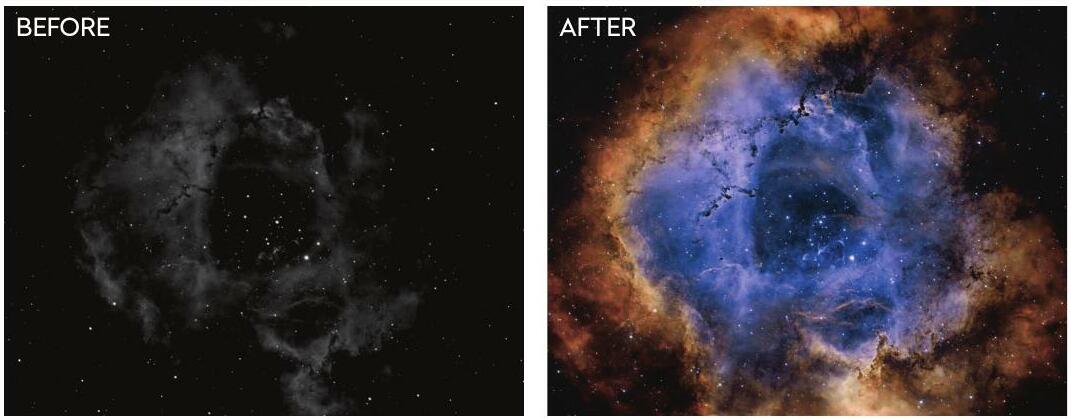
There's a lot to master in astrophotography processing. Pulling fine detail from noise and coaxing out faint colour is rewarding, but it can also be very time-consuming. Today, editing software ranges from manual hands-on options that let you tweak every pixel, to AI-powered tools that make sweeping image-wide enhancements.
Adobe Photoshop remains a favourite, thanks to its extensive functionality for both deep-sky and landscape images. An often-overlooked feature, however, is its 'Actions' tool. Actions let you record a full sequence of edits, save them and apply them to other images with a single click. No more repeating the same fiddly hue adjustment or adding the same watermark over and over again. An action turns a laborious workflow into one quick, automated step, meaning more time under the stars, fewer hours on the laptop and a greater number of impressive final images to admire and share.
In this guide, we create an action for a common workflow that many monochrome imagers perform: combining separate hydrogen-alpha (Ha) and oxygen (OIII) narrowband frames into a single bi-colour image. We'll add Ha to the red channel, and OIII to the blue and green channels, producing a classic narrowband look. We'll guide you through using narrowband images of the Rosette Nebula (NGC 2237) as an example.

このストーリーは、BBC Sky at Night Magazine の January 2026 版からのものです。
Magzter GOLD を購読すると、厳選された何千ものプレミアム記事や、10,000 以上の雑誌や新聞にアクセスできます。
すでに購読者ですか? サインイン
BBC Sky at Night Magazine からのその他のストーリー
BBC Sky at Night Magazine
The Giant Leap: Why Space is the Next Frontier in the Evolution of Life
“Earth is the cradle of humanity, but one cannot live in the cradle forever,” wrote Konstantin Tsiolkovsky in 1911.

1 mins
February 2026
BBC Sky at Night Magazine
Tele Vue Nagler Type-7 series eyepieces
These premium optics were inspired by Apollo - and deliver a giant leap to your views
4 mins
February 2026
BBC Sky at Night Magazine
Once Upon a Time in Space
While the Space Race of the Cold War years was ultimately a geopolitical contest between the USA and the Soviet Union, the rivalry sparked rapid innovation and inspired multiple generations to look skyward.
1 mins
February 2026
BBC Sky at Night Magazine
The Multiverse: When One Universe Isn't Enough
The concept of a 'multiverse' – the idea that our Universe may be just one of many – is widespread in science fiction and a common thread of online discussions.
1 mins
February 2026
BBC Sky at Night Magazine
Q&A WITH A GAMMA RAY SPECIALIST
In 2025, astronomers detected a blast from space that lasted seven hours. Now they're uncovering the strange processes behind the exceptional outburst
3 mins
February 2026
BBC Sky at Night Magazine
Astronomy Photographer of the Year
The world-leading astrophotography competition returns. Could your image take the top prize of £10,000?
2 mins
February 2026
BBC Sky at Night Magazine
MOONWATCH
February's top lunar feature to observe
2 mins
February 2026
BBC Sky at Night Magazine
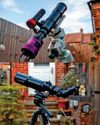
NOVAStar Scarlet A62Q 62mm f/8.4 quadruplet achromatic refractor
Well-built and capable, this beginner scope punches well above its bargain price
4 mins
February 2026
BBC Sky at Night Magazine
STAR OF THE MONTH
Rasalas, Leo the Lion's metal-rich crown
1 min
February 2026
BBC Sky at Night Magazine
Comet 24P/Schaumasse
Having reached perihelion on 8 January, comet 24P/ Schaumasse is now fading. Starting the month at a small-telescope-friendly mag. +10.5, it dims throughout February to below 12th magnitude.
1 min
February 2026
Listen
Translate
Change font size