
Vuélvete ilimitado con Magzter GOLD
Obtenga acceso ilimitado a más de 9000 revistas, periódicos e historias Premium por solo
The Hazards of Putting Ethics on Autopilot
MIT Sloan Management Review
|Summer 2024
Research shows that employees who are steered by digital nudges may lose some ethical competency. That has implications for how we use the new generation of AI assistants.

The generative AI boom is unleashing its minions. Enterprise software vendors have rolled out legions of automated assistants that use large language model (LLM) technology, such as ChatGPT, to offer users helpful suggestions or to execute simple tasks. These so-called copilots and chatbots can increase productivity and automate tedious manual work. But if they are not thoughtfully implemented, they risk diminishing employees’ decision-making competency, especially when ethics are at stake.
Our examination of the consequences of “nudging” techniques, used by companies to influence employees or customers to take certain actions, has implications for organizations adopting the new generation of chatbots and automated assistants. Companies implementing generative AI agents are encouraged to tailor them to increase managerial control. Microsoft, which has made copilots available across its suite of productivity software, offers a tool that enterprises can customize, thus allowing them to more precisely steer employee behavior. Such tools will make it much easier for companies to essentially put nudging on steroids — and based on our research into the effects of nudging, that may over time diminish individuals’ own willingness and capacity to reflect on the ethical dimension of their decisions.
AI-based nudges may be particularly persuasive, considering the emerging inclination among individuals to discount their own judgments in favor of what the technology suggests. At its most pronounced, this abdication of critical thinking can become a kind of techno-chauvinistic hubris, which discounts human cognition in favor of AI’s more powerful computational capacities. That’s why it will be particularly important to encourage employees to maintain a constructively critical perspective on AI output and for managers to pay attention to opportunities for what we call
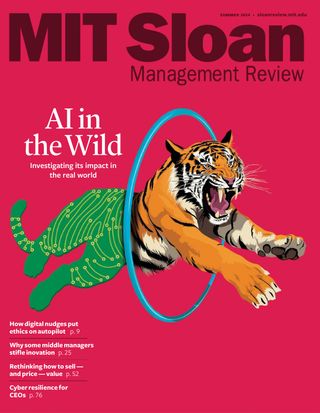

Esta historia es de la edición Summer 2024 de MIT Sloan Management Review.
Suscríbete a Magzter GOLD para acceder a miles de historias premium seleccionadas y a más de 9000 revistas y periódicos.
¿Ya eres suscriptor? Iniciar sesión
MÁS HISTORIAS DE MIT Sloan Management Review

MIT Sloan Management Review
Assess What Is Certain in a Sea of Unknowns
Understanding what won't change clarifies what might — and strengthens decision-making in volatile times.

13 mins
winter 2026

MIT Sloan Management Review
Ask Sanyin: Why Is It So Hard to Pull the Plug on a Project?
We're finding it difficult to wind down projects that no longer serve our priorities.
2 mins
winter 2026

MIT Sloan Management Review
Integrate Sustainability and Innovation to Find New Opportunities
Five common innovation practices can help leaders pursue sustainability as a growth strategy.
12 mins
winter 2026

MIT Sloan Management Review
The Case for Quiet Corporate Activism
Leaders concerned that they will be penalized for championing sustainability and diversity can still sustain their commitments.
11 mins
winter 2026

MIT Sloan Management Review
The Perils of Algorithmic Pricing
Some revenue management systems based on algorithms may lead to unintended collusion and antitrust violations.
9 mins
winter 2026

MIT Sloan Management Review
Broadening Future Perspectives at the Bank of England
Leaders at the U.K’s central bank sought to broaden their thinking about future risks and opportunities. Here’s how they built longer-term horizon-scanning capabilities and what they learned along the way.
9 mins
winter 2026

MIT Sloan Management Review
How Nesting Changes Platform Strategy
Should your platform host another platform — or be hosted by one? Here's how to think through the choices.
14 mins
winter 2026
MIT Sloan Management Review
Are You an Authentic Leader or an Authentic Jerk?
Leaders who are true to their values can inspire trust and respect, but not if \"being yourself\" becomes the problem.
13 mins
winter 2026

MIT Sloan Management Review
How to Make Scenario Planning Stick
Developing future scenarios can deepen leaders’ strategic insights. Establishing scenario planning as an ongoing capability and reaping its full benefits require linking it to other processes.
16 mins
winter 2026

MIT Sloan Management Review
A Faster Way to Build Future Scenarios
This streamlined approach to scenario planning incorporates AI and helps managers navigate future uncertainties more efficiently.
13 mins
winter 2026
Listen
Translate
Change font size