
استمتع بـUnlimited مع Magzter GOLD
احصل على وصول غير محدود إلى أكثر من 9000 مجلة وصحيفة وقصة مميزة مقابل
يحاول ذهب - حر
The Hazards of Putting Ethics on Autopilot
Summer 2024
|MIT Sloan Management Review
Research shows that employees who are steered by digital nudges may lose some ethical competency. That has implications for how we use the new generation of AI assistants.

The generative AI boom is unleashing its minions. Enterprise software vendors have rolled out legions of automated assistants that use large language model (LLM) technology, such as ChatGPT, to offer users helpful suggestions or to execute simple tasks. These so-called copilots and chatbots can increase productivity and automate tedious manual work. But if they are not thoughtfully implemented, they risk diminishing employees’ decision-making competency, especially when ethics are at stake.
Our examination of the consequences of “nudging” techniques, used by companies to influence employees or customers to take certain actions, has implications for organizations adopting the new generation of chatbots and automated assistants. Companies implementing generative AI agents are encouraged to tailor them to increase managerial control. Microsoft, which has made copilots available across its suite of productivity software, offers a tool that enterprises can customize, thus allowing them to more precisely steer employee behavior. Such tools will make it much easier for companies to essentially put nudging on steroids — and based on our research into the effects of nudging, that may over time diminish individuals’ own willingness and capacity to reflect on the ethical dimension of their decisions.
AI-based nudges may be particularly persuasive, considering the emerging inclination among individuals to discount their own judgments in favor of what the technology suggests. At its most pronounced, this abdication of critical thinking can become a kind of techno-chauvinistic hubris, which discounts human cognition in favor of AI’s more powerful computational capacities. That’s why it will be particularly important to encourage employees to maintain a constructively critical perspective on AI output and for managers to pay attention to opportunities for what we call
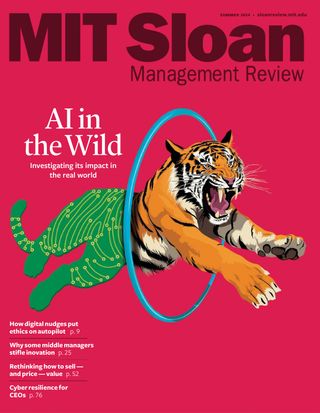

هذه القصة من طبعة Summer 2024 من MIT Sloan Management Review.
اشترك في Magzter GOLD للوصول إلى آلاف القصص المتميزة المنسقة، وأكثر من 9000 مجلة وصحيفة.
هل أنت مشترك بالفعل؟ تسجيل الدخول
المزيد من القصص من MIT Sloan Management Review

MIT Sloan Management Review
A Smarter Approach to Measuring Customer Experience
Many companies collect more customer experience data points than they need or can use effectively. Here's how to focus on the metrics that matter.

10 mins
Spring 2026

MIT Sloan Management Review
Why Digital Dexterity Is Key to Transformation
To make headway with digital transformation, executives are redefining the challenge: Build a workforce to take advantage of new technologies.
17 mins
Spring 2026

MIT Sloan Management Review
Ask Sanyin: What Makes a 'Listening Tour' Meaningful?
I've just stepped into a new leadership role and was advised to embark on a \"listening tour.\"
2 mins
Spring 2026

MIT Sloan Management Review
Build Business Advantage With Real-Time Decision-Making
Stop running your business on yesterday's data. Real-time data, empowered employees, and agile systems can lead to higher margins.
11 mins
Spring 2026

MIT Sloan Management Review
Balancing Innovation and Risk in the Age of AI
Monica Caldas is executive vice president and global CIO of Liberty Mutual Insurance.
2 mins
Spring 2026

MIT Sloan Management Review
Turn Customer Complaints Into Innovation Blueprints
You can reframe client grievances as an opportunity instead of a burden. At one Swiss hospital, complaints have become a pipeline for improvements to the customer experience.
6 mins
Spring 2026

MIT Sloan Management Review
The Eight Core Principles of Strategic Innovation
A company's future depends on the new directions it explores and develops today — and that requires different structures and capabilities from incremental innovation.
14 mins
Spring 2026

MIT Sloan Management Review
What AI Can Teach Us About Designing Better KPIs
Machine learning research offers four proven strategies to prevent people from gaming measures of organizational performance.
12 mins
Spring 2026

MIT Sloan Management Review
THREE THINGS TO KNOW ABOUT Learning by Hiring
LEADERS WHO RECOGNIZE THAT OUT-siders can be major drivers of innovation often seek to bring new knowledge into their organizations by making external hires.
2 mins
Spring 2026

MIT Sloan Management Review
Validating LLM Output? Prepare to Be ‘Persuasion Bombed’
Research demonstrates how generative AI ramps up the rhetorical pressure on users who question the AI's output.
8 mins
Spring 2026
Listen
Translate
Change font size