
Go Unlimited with Magzter GOLD
Get unlimited access to 10,000+ magazines, newspapers and Premium stories for just
Try GOLD - Free
Coding with a fluid mind
PCQuest
|October 2025
From peer reviews to test coverage, Al is transforming the developer's journey. Let's explore how fluidic intelligence reshapes coding, testing, and beyond, turning developers into orchestrators of agility, security, and innovation

When Ganesh Sahai, Chief Technology Officer, Nagarro, describes the role of AI in software development, he doesn't talk about machines replacing coders. Instead, he speaks of “fluidic intelligence,” a way of working where AI disrupts not just how code is written but how the entire software development life cycle evolves. From requirement gathering to delivery, from refactoring to testing, AI is shifting developers away from repetitive work toward higher-value thinking. The story is not about losing jobs but about expanding horizons.
From breakthroughs to fluid intelligence
Innovation at Nagarro has always been about breaking patterns. What once was a theme of “thinking breakthrough” has now matured into “fluidic intelligence,” an approach focused on adapting with the times and embedding intelligence into every layer of work.
In this context, AI is not treated as a gimmick but as a disruptive technology that cuts across the entire development life cycle: business analysts, UI/UX designers, programmers, testers, CI/CD engineers—all are touched by it. Dedicated programs train teams on tools such as GitHub Copilot, Windsurf, and Cursor, with equal attention paid to the sensitive issues of intellectual property and data privacy. Once the guardrails are clear, the real adoption begins, with developers learning to work alongside AI as partners.
Code by prompt, edited by humans
AI's biggest value lies in context. Large language models are trained on multiple programming languages and coding patterns, making them versatile across domains.
But while they can generate a bubble sort algorithm on demand, true usefulness emerges only when prompts are crafted with precision.
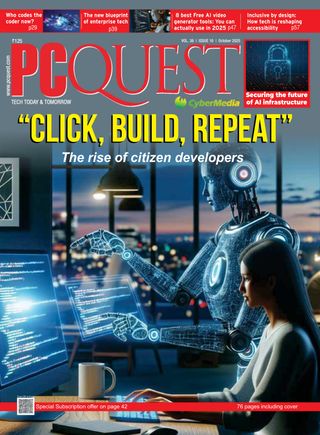

This story is from the October 2025 edition of PCQuest.
Subscribe to Magzter GOLD to access thousands of curated premium stories, and 10,000+ magazines and newspapers.
Already a subscriber? Sign In
MORE STORIES FROM PCQuest

PCQuest
Rewiring enterprise intelligence for the age of autonomy
As Al-driven autonomy disrupts traditional enterprise systems, organizations must rebuild their data, architecture, and culture to keep up with real-time, goal-oriented agents

4 mins
February 2026

PCQuest
Your college could be the next esports hotspot
India's esports future isn't being built in stadiums, it's brewing in college hostels, campus corridors, and crowded dorm rooms. Campus tours are quietly turning underdogs into contenders, and you won't believe where the real talent is rising
4 mins
February 2026

PCQuest
Beyond the login Why identity security must think beyond MFA
Identity breaches don't end at the login screen. As cyberattacks evolve, the real defense lies in risk-aware, continuous identity enforcement, not just more gates
3 mins
February 2026

PCQuest
Are hackers targeting Windows first while Macs fly under the radar in India?
Hackers in India aren't picking favorites, they're hunting both Windows and Macs, just differently. One gets hit like a piñata, the other like a sniper target. Your OS won't save you; your strategy might
3 mins
February 2026

PCQuest
Why data privacy in 2026 is all about resilience
Forget hackers. The real 2026 privacy battle isn't who breaks in. It's about who bounces back. In this exclusive look, we unpack why the future of data security is about comeback strategies, not breach prevention
5 mins
February 2026

PCQuest
Rethinking identity Inside the real risks behind modern cybersecurity
More tools don't mean more security. As enterprises stack up identity platforms and legacy systems, blind spots grow. The key isn't more tech; it's smarter alignment with real-world threats.
3 mins
February 2026

PCQuest
Cracking the identity code in cybersecurity
Modern identity security isn’t about who you are. It’s about how, where, and why you connect. The game has changed, and static credentials are no longer enough. This is the rise of real-time, risk-aware access
4 mins
February 2026

PCQuest
Designing for failure, building for trust: Decoding India's digital backbone
When digital platforms operate at population scale, failure isn't an option. From resilient hybrid architectures to security as a living system, this deep dive explores the invisible infrastructure keeping India's digital economy always-on and attack-ready
5 mins
February 2026

PCQuest
Who is accountable when Al goes rogue?
When AI starts making decisions on its own, who gets blamed when things go wrong? A rogue bot, a deleted database, and a boardroom scramble, welcome to the age where accountability can't be outsourced to algorithms
3 mins
February 2026

PCQuest
Top business laptops defy 2026 price surge
Business laptops are getting pricier, but a few models still punch above their weight in 2026. From Al-ready specs to dust-fighting fans, here's what still \"slaps\" before the Silicon Tax kicks in and your fleet turns into fossils
3 mins
February 2026
Listen
Translate
Change font size