Try GOLD - Free
SageMath: A First Look at Public-Key Cryptography
Open Source For You
|August 2025
In the last article in this SageMath series (published in the March 2025 issue of Open Source For You), we concluded our discussion on symmetric-key encryption. As promised, this article will focus on public-key cryptography (PKC). However, before diving into that, we will briefly examine some recent developments in the field of quantum computing. We will also introduce the concept of cryptanalysis to understand how these emerging trends could have potentially catastrophic implications for cybersecurity.
-

A few months ago, I had a d éjà vu moment when Microsoft announced the development of a quantum computing chip. It reminded me of an earlier experience: while I was writing a series of articles on artificial intelligence for OSFY, something historic happened. On 30th November 2022, ChatGPT was made publicly available. I started experimenting with it immediately and managed to publish an article featuring ChatGPT in the January 2023 issue of OSFY. I still proudly claim — though I have no concrete proof — that this was the first mention of ChatGPT in a printed magazine in India.
Fast forward to the present: I am now writing a series on SageMath and currently focusing on cybersecurity. And right on cue, along comes an invention that could potentially upend many foundational aspects of cybersecurity as we know it.
Majorana 1: A milestone in quantum computing?
Microsoft’s new quantum chip, named Majorana 1, is being hailed as a breakthrough. The chip is said to support quantum superposition and entanglement at room temperature, making room-temperature qubits a practical reality — something that, until now, seemed decades away.
The chip is named after Ettore Majorana, a brilliant Italian physicist often described as “the next Einstein.” Majorana mysteriously disappeared in 1938 at the age of 31, and his legacy includes the theoretical concept of Majorana fermions — particles that are their own antiparticles. Microsoft’s approach to topological quantum computing is believed to leverage ideas inspired by these fermions, which are thought to provide enhanced stability against quantum decoherence — one of the key challenges in building scalable quantum systems.


This story is from the August 2025 edition of Open Source For You.
Subscribe to Magzter GOLD to access thousands of curated premium stories, and 10,000+ magazines and newspapers.
Already a subscriber? Sign In
MORE STORIES FROM Open Source For You

Open Source For You
The Role of Open Source in Building Modern Data Infrastructure
It's no secret that open source is emerging as the backbone of modern data infrastructure. Here’s a list of the core open source technologies used to deploy this infrastructure, along with some real-world examples and a brief on why open source matters.

3 mins
December 2025

Open Source For You
The Whispering Machines: How Open Source is Bringing Intelligence to the Tiniest Devices
Built on open source frameworks, TinyML is enabling complex machine learning models to run on the microcontrollers embedded in connected devices, bringing artificial intelligence to the very edge of the network.
3 mins
December 2025

Open Source For You
Setting Up Snort to Secure Your Network
Snort is a popular, open source intrusion detection system that monitors traffic in real time to detect malware. Here’s a detailed explanation of how to set it up on Ubuntu and test it by generating traffic from another system.
7 mins
December 2025

Open Source For You
When AI Meets DevOps to Build Self-Healing Systems
Traditional DevOps, with its rule-based automation, is struggling to work effectively in today’s complex tech world. But when combined with AlOps, it can lead to IT systems that predict failures and solve issues without human intervention.
7 mins
December 2025

Open Source For You
How to Automate Java Code Modernisation
This short guide illustrates that automating Java code modernisation with Python and OpenAI API is not just possible-it's remarkably effective.
5 mins
December 2025

Open Source For You
The Quest to Build a Quantum Computer
The road to large-scale quantum computing is long and hard, with incremental advances paving the way. But the destination is in sight.
12 mins
December 2025

Open Source For You
Job Opportunities: What's Hot in the Cloud Space?
If there's one field that refuses to slow down, it's cloud computing. Even as automation and AI reshape roles, cloud adoption continues to surge. From startups deploying microservices overnight to enterprises migrating decades of legacy systems, cloud remains the engine of digital transformation. For professionals, this means one thing: skills that live in the cloud won't come down anytime soon.
2 mins
December 2025

Open Source For You
Securing Client Identity with Post-Quantum Cryptography
Here's a quick tutorial on how to build a secure, real world client-server model that establishes client identity by using CRYSTALS-Dilithium, a post-quantum cryptography algorithm.
3 mins
December 2025
Open Source For You
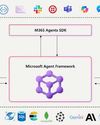
Unlocking the Power of Multi-Agent Solutions with the Microsoft Agentic Framework
The Microsoft Agentic Framework is rapidly emerging as a cornerstone for developers, architects, and technology leaders seeking to build dynamic, intelligent systems powered by multiple collaborating agents. In an era where automation, distributed intelligence, and adaptive software are increasingly vital, this framework offers robust tools and features to accelerate the design and deployment of agent-based solutions.
6 mins
December 2025

Open Source For You
Apache Iceberg and Trino: Powering Data Lakehouse Architecture
Apache Iceberg is a cornerstone of any open data lakehouse, providing the transactional foundation upon which highly scalable and flexible analytics can flourish. Along with Trino, it can be used to build a robust, scalable, and high-performance data lakehouse.
4 mins
December 2025
Listen
Translate
Change font size