
Go Unlimited with Magzter GOLD
Get unlimited access to 10,000+ magazines, newspapers and Premium stories for just
Try GOLD - Free
Workouts Help to Treat Cancer
Scientific American
|November 2025
Exercise improves survival, limits recurrence, and can be used with surgery and drugs

TO IMPROVE THE QUALITY of life of people with cancer, oncologists have regularly recommended exercise. Staying fit can make patients feel and function better. But exercise itself was never considered a formal treatment for the disease.
“The thinking in the medical community was that you need biomedical interventions—surgery, radiation therapy, drugs—to treat cancer,” says Kerry Courneya, a professor of kinesiology at the University of Alberta who studies physical activity and cancer.
That thinking is changing.
This year strong evidence emerged that exercise lengthens survival times and lowers recurrence risk for several cancer types. Such benefits are usually ascribed to medicine or surgery. But “exercise treats cancer as well as, if not better than, some of the current drugs that we’re offering our patients,” says Courneya, who led the first large randomized, controlled trial of the effects of workouts on cancer outcomes. It was published in July in the New England Journal of Medicine and involved more than 800 colon cancer patients. Participants with stage 3 and high-risk stage 2 cancer were assigned to a structured exercise program in addition to their oncology care. In a 10-year followup period, these people had a 28 percent lower risk of cancer recurrence, new cancers or death than similar patients who received only educational material about physical activity.
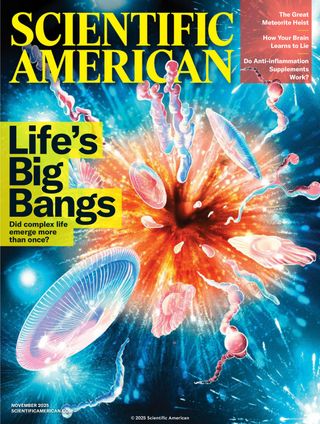

This story is from the November 2025 edition of Scientific American.
Subscribe to Magzter GOLD to access thousands of curated premium stories, and 10,000+ magazines and newspapers.
Already a subscriber? Sign In
MORE STORIES FROM Scientific American

Scientific American
The Quiet Math Problem That Runs the Planet
How Diffie-Hellman key exchange secures everything from your text messages to government secrets

7 mins
May 2026

Scientific American
The Fog of Science
Did an adversary just invent a world-changing weapon, or are they making it up? DARPA is building an AI to instantly call their bluff
4 mins
May 2026

Scientific American
The Hubble Space Telescope Is Still Awesome
Hubble is going strong despite its decades in space and next-generation successors
4 mins
May 2026

Scientific American
Meet America's Native Bees
Scientists estimate there are about 4,000 species of native bees in the U.S.
5 mins
May 2026

Scientific American
The Chemistry of Desire
Inside the secretive laboratories where scientists build novel molecules to make luxury fragrance feel like pure emotion
5 mins
May 2026

Scientific American
Scanning the Stone
As ore gets harder to find, the mining industry is turning to subatomic-particle sensors to push deep underground
8 mins
May 2026

Scientific American
YOUR HEART IN FLAMES
Inflammation may be the true cause of cardiovascular diseaseand there's a drug to treat it
13 mins
May 2026

Scientific American
Ancient Lexicon
Stone Age art may reveal a 40,000-year-old precursor to writing
2 mins
May 2026

Scientific American
Thermal Breakthrough
A new super heat conductor challenges fundamental physics
2 mins
May 2026

Scientific American
How to Vacation in Space
Planned orbital hotels promise luxury, but can they deliver?
4 mins
May 2026
Listen
Translate
Change font size