Try GOLD - Free
The Cosmos Revised
Scientific American
|September 2025
The universe has a habit of disproving “unassailable” facts
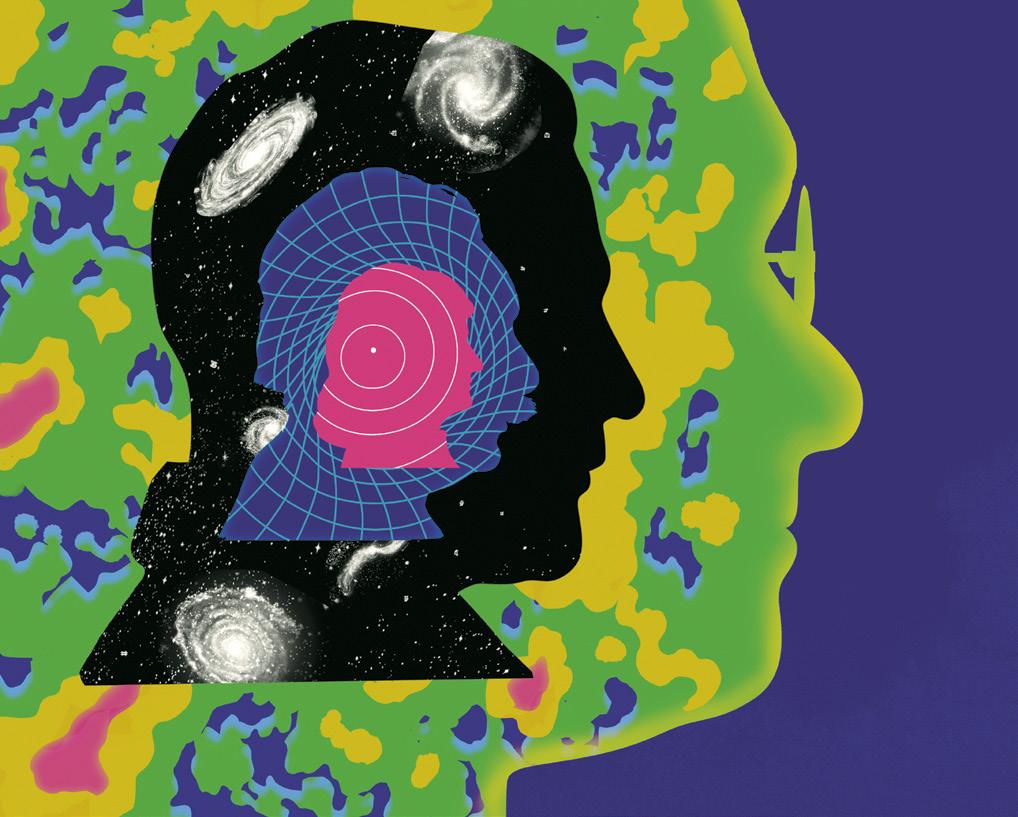
TO ASTRONOMERS IN THE 1990s, these three facts were self-evident: The universe is expanding; all the matter in the universe is gravitationally attracting all the other matter in the universe; therefore, the expansion of the universe is slowing.
Two scientific collaborations assigned themselves the task of determining the rate of that deceleration. Find that rate, they figured, and they would know nothing less than the fate of the universe. Is the expansion slowing just enough that it will eventually come to a halt? Or is it slowing so much that it will eventually stop, reverse itself and result in a kind of big bang boomerang?
The answer, which the two teams reached independently in 1998, was precisely the opposite of what they expected.
The expansion of the universe isn’t slowing down. It’s speeding up.
COSMOLOGY HAS OFTEN lent itself to unthinking assumptions that turned out to be exactly wrong. The ur-example is geocentrism. Over the couple of millennia before the invention of the telescope in the early 1600s, the occasional philosopher suggested Earth orbits the sun and not the other way around. But the vast majority of astronomers could simply look up and see for themselves. The sun orbits Earth. The evidence was, well, self-evident.
But then, most of the history of astronomy had relied on an unthinking assumption: The heavens would always be out of reach. Like the prisoners in Plato's parable, we would forever be at the mercy of our perceptual limitations, trying to make sense of the motions in a two-dimensional celestial realm that was the cosmic equivalent of a cave wall. The invention of the telescope in the first decade of the 17th century overturned both those assumptions: Earth orbits the sun; the heavens are at our fingertips.

This story is from the September 2025 edition of Scientific American.
Subscribe to Magzter GOLD to access thousands of curated premium stories, and 10,000+ magazines and newspapers.
Already a subscriber? Sign In
MORE STORIES FROM Scientific American

Scientific American
Probiotic Hope and Hype
Despite their popularity, supplements with billions of \"good\" microbes help only a few illnesses, research shows

3 mins
January 2026
Scientific American
Mondays Really Are More Stressful
The start of the workweek can be a biologically measurable stressor, with consequences for long-term health that can stretch into retirement
4 mins
January 2026
Scientific American
Tiny Display
An e-paper breakthrough brings extremely high-resolution color
2 mins
January 2026
Scientific American
Fine-Feathered Snack
A bat's tracker documents a dramatic midair hunt
2 mins
January 2026

Scientific American
OUR ROBOTIC PICTURE
Will mechanical helpers ever be commonplace at home, at work and beyond?
11 mins
January 2026

Scientific American
"Use Your Words" Can Be Good for Kids' Health
Writing or expressing feelings can help adults mentally and physically. Kids are no different
5 mins
January 2026

Scientific American
Distant Diplomacy
Unrelated species “talk” and understand one another to avoid threats
2 mins
January 2026
Scientific American
Behind the Nobel
A 2025 winner reflects on the mysterious T cells that won him the prize
5 mins
January 2026

Scientific American
A Suite of Killers
Heart ailments, kidney diseases and type 2 diabetes actually may be part of just one condition. It's called CKM syndrome
10 mins
January 2026
Scientific American
Static Launch
Tiny worms leap toward their fruit fly hosts with an electric “tractor beam”
3 mins
January 2026
Listen
Translate
Change font size