
Magzter GOLDで無制限に
10,000以上の雑誌、新聞、プレミアム記事に無制限にアクセスできます。
試す 金 - 無料
The Cosmos Revised
Scientific American
|September 2025
The universe has a habit of disproving “unassailable” facts
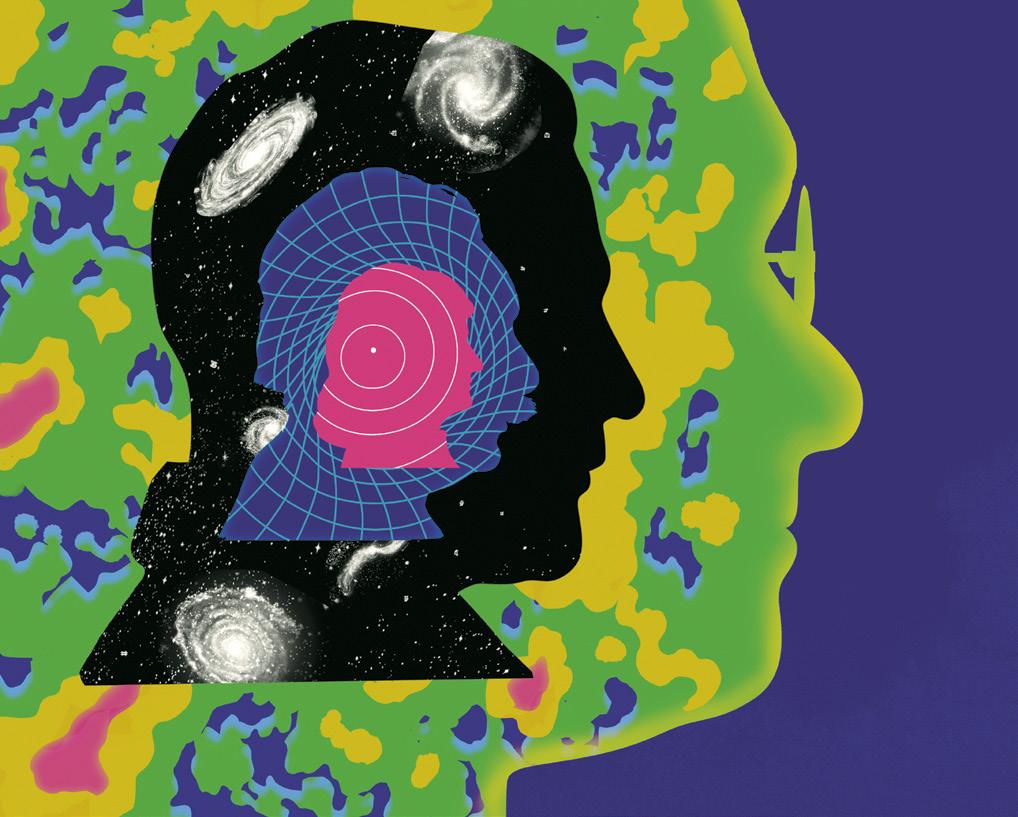
TO ASTRONOMERS IN THE 1990s, these three facts were self-evident: The universe is expanding; all the matter in the universe is gravitationally attracting all the other matter in the universe; therefore, the expansion of the universe is slowing.
Two scientific collaborations assigned themselves the task of determining the rate of that deceleration. Find that rate, they figured, and they would know nothing less than the fate of the universe. Is the expansion slowing just enough that it will eventually come to a halt? Or is it slowing so much that it will eventually stop, reverse itself and result in a kind of big bang boomerang?
The answer, which the two teams reached independently in 1998, was precisely the opposite of what they expected.
The expansion of the universe isn’t slowing down. It’s speeding up.
COSMOLOGY HAS OFTEN lent itself to unthinking assumptions that turned out to be exactly wrong. The ur-example is geocentrism. Over the couple of millennia before the invention of the telescope in the early 1600s, the occasional philosopher suggested Earth orbits the sun and not the other way around. But the vast majority of astronomers could simply look up and see for themselves. The sun orbits Earth. The evidence was, well, self-evident.
But then, most of the history of astronomy had relied on an unthinking assumption: The heavens would always be out of reach. Like the prisoners in Plato's parable, we would forever be at the mercy of our perceptual limitations, trying to make sense of the motions in a two-dimensional celestial realm that was the cosmic equivalent of a cave wall. The invention of the telescope in the first decade of the 17th century overturned both those assumptions: Earth orbits the sun; the heavens are at our fingertips.

このストーリーは、Scientific American の September 2025 版からのものです。
Magzter GOLD を購読すると、厳選された何千ものプレミアム記事や、10,000 以上の雑誌や新聞にアクセスできます。
すでに購読者ですか? サインイン
Scientific American からのその他のストーリー

Scientific American
The Quiet Math Problem That Runs the Planet
How Diffie-Hellman key exchange secures everything from your text messages to government secrets

7 mins
May 2026

Scientific American
The Fog of Science
Did an adversary just invent a world-changing weapon, or are they making it up? DARPA is building an AI to instantly call their bluff
4 mins
May 2026
Scientific American
The Hubble Space Telescope Is Still Awesome
Hubble is going strong despite its decades in space and next-generation successors
4 mins
May 2026

Scientific American
Meet America's Native Bees
Scientists estimate there are about 4,000 species of native bees in the U.S.
5 mins
May 2026

Scientific American
The Chemistry of Desire
Inside the secretive laboratories where scientists build novel molecules to make luxury fragrance feel like pure emotion
5 mins
May 2026
Scientific American
Scanning the Stone
As ore gets harder to find, the mining industry is turning to subatomic-particle sensors to push deep underground
8 mins
May 2026

Scientific American
YOUR HEART IN FLAMES
Inflammation may be the true cause of cardiovascular diseaseand there's a drug to treat it
13 mins
May 2026

Scientific American
Ancient Lexicon
Stone Age art may reveal a 40,000-year-old precursor to writing
2 mins
May 2026

Scientific American
Thermal Breakthrough
A new super heat conductor challenges fundamental physics
2 mins
May 2026
Scientific American
How to Vacation in Space
Planned orbital hotels promise luxury, but can they deliver?
4 mins
May 2026
Listen
Translate
Change font size