Try GOLD - Free
FIX DEBT TO FUND CLIMATE FUTURE
Down To Earth
|July 01, 2025
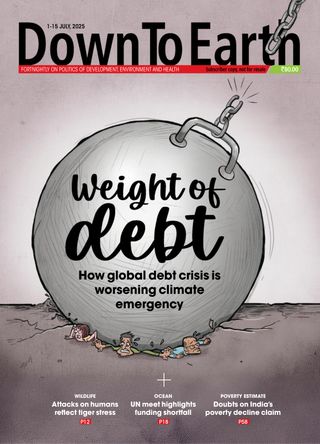
Reforming global debt architecture is key to unlocking climate finance, enabling vulnerable nations to invest in resilience and development
-
THE MOUNTING debt crisis in developing countries is often portrayed as a failure of fiscal prudence or governance. But “The Jubilee Report”, released recently, shows that this narrative is both misleading and incomplete. The truth is, today’s crisis is a systemic failure—of global financial architecture, creditor behaviour and neglect.
Debtor governments borrowed beyond their means, often under poor terms and short maturities. Creditors, including private investors and multilateral institutions, knowingly extended excessive and risky financing in the greed for better returns. International financial institutions enabled the spiral by delaying hard conversations, offering bandaid solutions, and propping up a system that privileges short-term returns over long-term resilience.
At the root of the problem lies a gaping hole in the global economic order: there is no international mechanism to deal with sovereign debt distress. Unlike corporations that can declare bankruptcy and restructure, countries in crisis are left to navigate a complex maze of fragmented, creditor-dominated negotiations—with no framework for timely, fair or equitable outcomes. Meanwhile, the deep asymmetries that define the global financial system continue to widen. Countries like the US and France—whose public debt now exceeds 100 per cent of GDP—are considered safe borrowers. Zimbabwe and Chad, with far lower debt-to-GDP ratios, are penalised with exorbitant interest rates and harsh borrowing conditions. This is because wealthy countries borrow largely in their own currencies, enjoy favourable credit ratings, and are perceived as “low risk.”

This story is from the July 01, 2025 edition of Down To Earth.
Subscribe to Magzter GOLD to access thousands of curated premium stories, and 10,000+ magazines and newspapers.
Already a subscriber? Sign In
MORE STORIES FROM Down To Earth

Down To Earth
THINK TWICE BEFORE FELLING SAL TREES
Many trees considered to be affected by sal borer in the 1990s are still alive today

1 mins
February 16, 2026

Down To Earth
EDGE OF SURVIVAL
Caste divides deny marginalised communities land, resources and essential aid, leaving them more vulnerable to climate disasters
6 mins
February 16, 2026

Down To Earth
A WISH LIST?
Union Budget for 2026-27 conveys the impression of a roll-call of intentions and ambitious proposals, with little detail on their formulation
6 mins
February 16, 2026
Down To Earth
Break down the gender wall
THE RULING National Democratic Alliance (NDA) government has been heavily invested in the goal to make India a developed economy by 2047.
2 mins
February 16, 2026

Down To Earth
MENSTRUAL HEALTH, NOW A FUNDAMENTAL RIGHT
In a landmark judgement, the Supreme Court has recognised menstrual health and hygiene as a fundamental right under Article 21 of the Constitution of India, which guarantees the right to life and dignity.
8 mins
February 16, 2026

Down To Earth
Of devolution and new disasters
The 16th Finance Commission pushes for changes in view of new fiscal and climatic conditions
11 mins
February 16, 2026
Down To Earth
Rising risks of plastics
NEGATIVE IMPACTS on human health due to emissions linked to the plastic lifecycle could double by 2040, according to a study published in The Lancet Planetary Health in January.
1 min
February 16, 2026

Down To Earth
GAP BETWEEN EPIDEMICS NARROWING
A watershed-based and landscape-level approach is needed to address forest degradation
2 mins
February 16, 2026
Down To Earth
WAITING TO STRIKE
Sal heartwood borer is considered the biggest threat to forestry in India, especially to the sal tree, where it lives and breeds.
11 mins
February 16, 2026

Down To Earth
A SPRING DELIGHT
Mustard flowers are not meant only for the eyes. Invite them to your plate once in a while
3 mins
February 16, 2026
Listen
Translate
Change font size