
استمتع بـUnlimited مع Magzter GOLD
احصل على وصول غير محدود إلى أكثر من 9000 مجلة وصحيفة وقصة مميزة مقابل
يحاول ذهب - حر
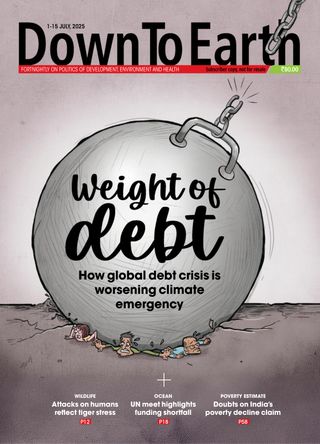
FIX DEBT TO FUND CLIMATE FUTURE
July 01, 2025
|Down To Earth
Reforming global debt architecture is key to unlocking climate finance, enabling vulnerable nations to invest in resilience and development
-
THE MOUNTING debt crisis in developing countries is often portrayed as a failure of fiscal prudence or governance. But “The Jubilee Report”, released recently, shows that this narrative is both misleading and incomplete. The truth is, today’s crisis is a systemic failure—of global financial architecture, creditor behaviour and neglect.
Debtor governments borrowed beyond their means, often under poor terms and short maturities. Creditors, including private investors and multilateral institutions, knowingly extended excessive and risky financing in the greed for better returns. International financial institutions enabled the spiral by delaying hard conversations, offering bandaid solutions, and propping up a system that privileges short-term returns over long-term resilience.
At the root of the problem lies a gaping hole in the global economic order: there is no international mechanism to deal with sovereign debt distress. Unlike corporations that can declare bankruptcy and restructure, countries in crisis are left to navigate a complex maze of fragmented, creditor-dominated negotiations—with no framework for timely, fair or equitable outcomes. Meanwhile, the deep asymmetries that define the global financial system continue to widen. Countries like the US and France—whose public debt now exceeds 100 per cent of GDP—are considered safe borrowers. Zimbabwe and Chad, with far lower debt-to-GDP ratios, are penalised with exorbitant interest rates and harsh borrowing conditions. This is because wealthy countries borrow largely in their own currencies, enjoy favourable credit ratings, and are perceived as “low risk.”

هذه القصة من طبعة July 01, 2025 من Down To Earth.
اشترك في Magzter GOLD للوصول إلى آلاف القصص المتميزة المنسقة، وأكثر من 9000 مجلة وصحيفة.
هل أنت مشترك بالفعل؟ تسجيل الدخول
المزيد من القصص من Down To Earth

Down To Earth
GREAT NICOBAR DILEMMA
In the fragile ecosystem of Nicobar, strategic development must align with constitutional commitment to protect environment, indigenous dignity

3 mins
March 16, 2026
Down To Earth
CATCH BY THE ROOTS
Sabai grass could be a game-changer for the marginalised economies of West Bengal's dry uplands. All it needs is an efficient market strategy
4 mins
March 16, 2026

Down To Earth
POWERING TRANSITION
India's renewable ambitions are rising rapidly, with half of its installed power capacity now coming from non-fossil sources. Yet the gap between capacity and generation remains wide. The experiences of two pioneering states, Karnataka and Tamil Nadu, which together generate over a fifth of the country's renewable energy, offer crucial lessons for accelerating the transition, reports PUJA DAS from Bengaluru, Chennai, Mumbai and New Delhi
16 mins
March 16, 2026
Down To Earth
At core of survival
Water scarcity defines life in a village inside Sariska Tiger Reserve's critical habitat, as debates over its relocation drag on
5 mins
March 16, 2026

Down To Earth
What's on your plate
An upcoming digital tool can help people learn about the origin of their meals and make climate-positive food choices
2 mins
March 16, 2026

Down To Earth
'Bad environment can never be good economics'
The Supreme Court of India and even the high courts were once very active and took a proactive role in protecting the environment; unfortunately, that is no longer true
4 mins
March 16, 2026
Down To Earth
Things fall apart
IN THE past year, the world has counted more missiles and bombs than hours.
2 mins
March 16, 2026

Down To Earth
Universities in crisis, innovation is stifled
Political control and skewed policies have led to unrest in academia, stifling creativity and meaningful research
4 mins
March 16, 2026

Down To Earth
SPARK IN THE GAME
The Reserve Bank of India's restored recognition of Default Loss Guarantees re-enables credit flow into last-mile electric mobility
3 mins
March 16, 2026

Down To Earth
Ushering in new eras
An appraisal of the state of biodiversity conservation, pollution reduction and climate adaptation regimes in India
3 mins
March 16, 2026
Listen
Translate
Change font size