
Go Unlimited with Magzter GOLD
Get unlimited access to 10,000+ magazines, newspapers and Premium stories for just
MARS SEASON HAS ARRIVED
BBC Sky at Night Magazine
|October 2022
With Mars at opposition this December - and a rare lunar occultation expected too - now's the time to start observing and tracking its changing features, writes Paul G Abel
-

On 8 December 2022, Mars reaches opposition. It's going to be a splendid telescopic target, well-placed for observation in the Northern Hemisphere and well worth observing in the dark winter months. And as an added bonus, on the same night as opposition the Moon will appear to pass in front of Mars in an event known as a lunar occultation. December is set to be the month of Mars. But before then, Mars will be growing steadily larger and brighter, meaning there's plenty to see in the run-up. Here we'll explore the exciting phenomena we can observe before and after opposition.
Opposition occurs when an outer planet is opposite the Sun in the sky. Sun, Earth and planet all lie in a straight line, with Earth in the middle, and at this time the planet is due south at midnight and visible all night. We don't get a Mars opposition every year, nor are they all favourable for UK observers. This is due to the shape of the Martian orbit. All planetary Perihelic orbits are slightly elliptical, but the Martian one is more so than Jupiter's and Saturn's. As a result, Mars comes to opposition once every two years.
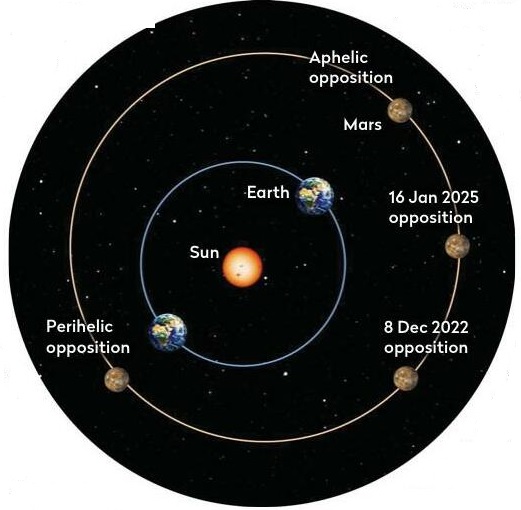
▲ At perihelion, Mars is at the closest point to us in its elliptical orbit. Aphelion is the opposite
The position of Mars in its orbit dictates its altitude in our skies at opposition. In a perihelic opposition, Mars is at (or near) perihelion (its closest point to the Sun). The planet is large and bright, but low down for Northern Hemisphere observers. In aphelic oppositions, Mars is at its furthest point from the Sun and has a small apparent diameter, but is high in UK skies. December's opposition is a transitional one: moving from perihelic to aphelic. In my opinion, these are the best: Mars reaches a good size and is fairly well placed.
Get your bearings


This story is from the October 2022 edition of BBC Sky at Night Magazine.
Subscribe to Magzter GOLD to access thousands of curated premium stories, and 10,000+ magazines and newspapers.
Already a subscriber? Sign In
MORE STORIES FROM BBC Sky at Night Magazine
BBC Sky at Night Magazine
MOONWATCH
January's top lunar feature to observe

2 mins
January 2026
BBC Sky at Night Magazine
Speed up your processing workflow
How to use Photoshop's Actions tool to drastically cut your processing time
3 mins
January 2026
BBC Sky at Night Magazine
Chasing Canada's polar lights
With solar maximum peaking and a new Moon promising dark skies, Jamie Carter travels to Churchill, Manitoba to hunt the Northern Lights - and dodge polar bears – in Canada's far north
7 mins
January 2026
BBC Sky at Night Magazine
Beyond Pluto: The search for the hidden planets
Could one – or even two - undiscovered planets lurk at the edges of our Solar System? Nicky Jenner explores how close we are to finding the elusive 'Planet 9'
6 mins
January 2026
BBC Sky at Night Magazine
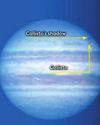
Jupiter moon events
Jupiter is a magnificent planet to observe.
2 mins
January 2026

BBC Sky at Night Magazine
What samples from space have taught us
Alastair Gunn explains what scientists have learnt in the 20 years since the first unmanned mission brought materials back from alien worlds
3 mins
January 2026
BBC Sky at Night Magazine
The Milky Way as you've never seen it before
This is the largest low-frequency radio colour image of our Galaxy ever assembled
1 min
January 2026
BBC Sky at Night Magazine
Merger of ‘impossibly' massive black holes explained
Scientists discover how enormous, fast-spinning black holes can exist after all
1 mins
January 2026
BBC Sky at Night Magazine
Lunar occultation of the Pleiades
BEST TIME TO SEE: 27 January from 20:30 UT
1 min
January 2026
BBC Sky at Night Magazine
The Universe's expansion may be slowing down
New study suggests current theories of dark energy could be wrong
1 mins
January 2026
Translate
Change font size