Poging GOUD - Vrij
MARS SEASON HAS ARRIVED
BBC Sky at Night Magazine
|October 2022
With Mars at opposition this December - and a rare lunar occultation expected too - now's the time to start observing and tracking its changing features, writes Paul G Abel
-

On 8 December 2022, Mars reaches opposition. It's going to be a splendid telescopic target, well-placed for observation in the Northern Hemisphere and well worth observing in the dark winter months. And as an added bonus, on the same night as opposition the Moon will appear to pass in front of Mars in an event known as a lunar occultation. December is set to be the month of Mars. But before then, Mars will be growing steadily larger and brighter, meaning there's plenty to see in the run-up. Here we'll explore the exciting phenomena we can observe before and after opposition.
Opposition occurs when an outer planet is opposite the Sun in the sky. Sun, Earth and planet all lie in a straight line, with Earth in the middle, and at this time the planet is due south at midnight and visible all night. We don't get a Mars opposition every year, nor are they all favourable for UK observers. This is due to the shape of the Martian orbit. All planetary Perihelic orbits are slightly elliptical, but the Martian one is more so than Jupiter's and Saturn's. As a result, Mars comes to opposition once every two years.
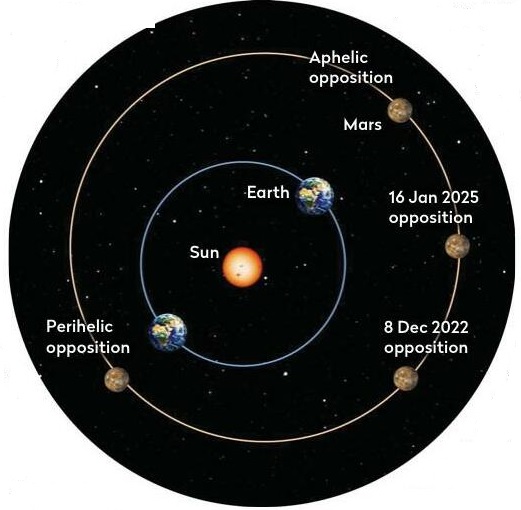
▲ At perihelion, Mars is at the closest point to us in its elliptical orbit. Aphelion is the opposite
The position of Mars in its orbit dictates its altitude in our skies at opposition. In a perihelic opposition, Mars is at (or near) perihelion (its closest point to the Sun). The planet is large and bright, but low down for Northern Hemisphere observers. In aphelic oppositions, Mars is at its furthest point from the Sun and has a small apparent diameter, but is high in UK skies. December's opposition is a transitional one: moving from perihelic to aphelic. In my opinion, these are the best: Mars reaches a good size and is fairly well placed.
Get your bearings


Dit verhaal komt uit de October 2022-editie van BBC Sky at Night Magazine.
Abonneer u op Magzter GOLD voor toegang tot duizenden zorgvuldig samengestelde premiumverhalen en meer dan 9000 tijdschriften en kranten.
Bent u al abonnee? Aanmelden
MEER VERHALEN VAN BBC Sky at Night Magazine

BBC Sky at Night Magazine
Capture NLCs with a smartphone
Make this the summer that you nail a shot of beautiful night-shining clouds

3 mins
July 2026
BBC Sky at Night Magazine
ZWO Seestar S30 Pro smart telescope
ZWO Seestar S30 Pro smart telescope
4 mins
July 2026
BBC Sky at Night Magazine
The speed of light
The Universe has a speed limit - and it underpins everything we know about it. We explain the speed of light and its far-reaching implications for astronomy
2 mins
July 2026
BBC Sky at Night Magazine
COMETS AND ASTEROIDS
Can you spot dim, barely moving Pluto?
1 min
July 2026
BBC Sky at Night Magazine
THE SKY GUIDE CHALLENGE
What's the youngest Moon you can photograph? Try our ‘impossible’ challenge
2 mins
July 2026
BBC Sky at Night Magazine
Q&A WITH A SCIENCE COMMUNICATOR
As we find more planets in the habitable zones around other suns, we ask Neil deGrasse Tyson what would happen if we did meet intelligent alien life
3 mins
July 2026
BBC Sky at Night Magazine
Make an all-sky camera
How to set up an always-watching system to catch fleeting sky events
3 mins
July 2026
BBC Sky at Night Magazine
The Universe doesn't need a multiverse
The Universe doesn't need a multiverse The idea that there are many universes seems to solve our most stubborn cosmic mysteries. But, argues Brian Clegg, it's no substitute for hard evidence
2 mins
July 2026
BBC Sky at Night Magazine
Planets of mystery
Uranus and Neptune – visited just once, 40 years ago – are the least-known planets in our Solar System. Now 21st-century science has revealed they may not even be the ‘ice giants’ we thought. Joseph Phelan investigates
6 mins
July 2026
BBC Sky at Night Magazine
THE BIG THREE
The top sights to observe or image this month
4 mins
July 2026
Translate
Change font size