Try GOLD - Free
SAVE THE SHARKS...SAVE THE OCEANS
BBC Science Focus
|October 2024
RUTHLESS PREDATORS, MINDLESS KILLERS, MAN-EATERS... SHARKS HAVE A FEARSOME REPUTATION THAT BEARS LITTLE RELATION TO REALITY. THE TRUTH IS, THESE REMARKABLE CREATURES ARE STRUGGLING TO SURVIVE. BUT OUR WATERS WON'T BE ANY SAFER WITHOUT THEM. IN FACT, THE PLANET'S SEAS WILL BE IN EVEN GREATER JEOPARDY THAN THEY ALREADY ARE

Each morning, hundreds of thousands of fishing vessels head into the waters around Indonesia.
The country, comprising around 17,000 islands with a combined coastline of almost 100,000km (about 62,000 miles), is one of the world's fishing superpowers and, in recent decades, has grown in strength.
The country has established a reputation for providing quality tuna, shrimp and crab to high-end restaurants around the world. But behind this economic and culinary success story is an uncomfortable truth: Indonesia ranks among the world's top shark-killing nations, catching an estimated 100,000 metric tonnes (98,400 tons) of shark a year, which is contributing to an alarming global decline in shark numbers.
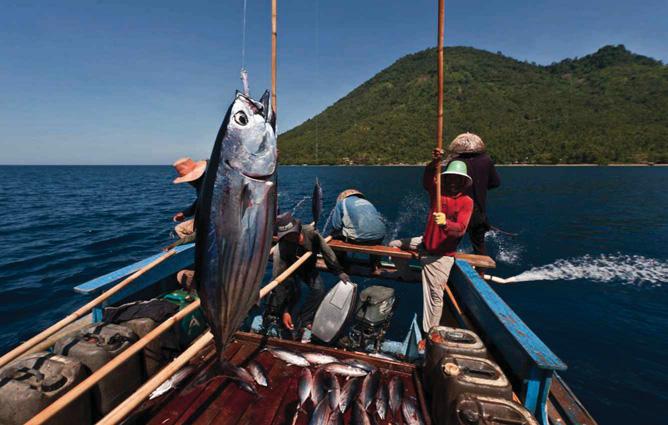 "The biggest threat to sharks currently is fishing," says Dr Colin Simpfendorfer of the University of Tasmania's Institute for Marine and Antarctic Studies. "Its impact dwarfs any of the other impacts for almost all species.
Too many sharks are dying in fisheries." The issue is by no means exclusive to Indonesian waters. Across the planet, an estimated 100 million sharks are killed annually either intentionally or as bycatch. That's one shark per 80 people - a colossal figure that's almost impossible to comprehend.
According to an article published in Nature, the global abundance of oceanic sharks and rays has declined by 71 per cent since 1970 and, as reported in a 2021 analysis in Current Biology, one-third of sharks and rays are now threatened with extinction. Historically, that decline has been largely attributed to overfishing, but it's not the only activity putting pressure on shark populations today. "New threats such as shipping, offshore wind farms and climate change are also affecting populations," says Dr James Sulikowski, director of the Coastal Oregon Marine Experiment Station in the US.

This story is from the October 2024 edition of BBC Science Focus.
Subscribe to Magzter GOLD to access thousands of curated premium stories, and 10,000+ magazines and newspapers.
Already a subscriber? Sign In
MORE STORIES FROM BBC Science Focus

BBC Science Focus
HOW UNLIKELY IS OUR UNIVERSE?
Our understanding of the Universe has revealed that its existence, and indeed our own, relies on a particular set of rules.

1 mins
December 2025

BBC Science Focus
DOES YOUR NAME AFFECT YOUR PERSONALITY?
Research is revealing that nominative determinism isn't as easy to dismiss as you might think
5 mins
December 2025

BBC Science Focus
HOW DIFFICULT WOULD IT BE TO FLY THROUGH THE ASTEROID BELT?
In the 1980 film Star Wars: The Empire Strikes Back, Han Solo and friends try to escape pursuing imperial forces by flying through an asteroid field. Droid C-3PO remarks, \"the odds of successfully navigating an asteroid field is approximately 3,720 to 1\". The scene depicts a chaotic, dense field of rocks swirling and spinning through space. This scenario has been played out many times in the cinema.
1 min
December 2025

BBC Science Focus
HOW CAN I BE MORE PERSUASIVE?
Most of us like to think we're rational people. If someone shows us evidence that we're wrong, we'll change our minds, right? Well, not necessarily, because it's not always that simple. Being wrong feels uncomfortable and sometimes threatening. That's why changing someone's mind is often much harder than it seems.
2 mins
December 2025

BBC Science Focus
This bizarre optical illusion could teach us how animals think
By seeing which animals fall for a classic visual trick, scientists are uncovering how different brains make sense of the world
1 mins
December 2025

BBC Science Focus
LIFE AT THE PARTY
The secret that keeps the superagers so sprightly could be socialising
3 mins
December 2025

BBC Science Focus
AIN'T NO MOUNTAIN HIGH ENOUGH
Could an exoskeleton help you scale every peak with ease? Ezzy Pearson straps on some cyborg enhancements to find out
5 mins
December 2025

BBC Science Focus
A slice across the sky
The green flash slicing through the skies in this shot is a fireball.
1 min
December 2025

BBC Science Focus
TB is surging. Should we be worried?
Cases of the world's deadliest infection are climbing in the UK and US. Why is tuberculosis returning and how do we fight back?
4 mins
December 2025

BBC Science Focus
I survived the worst fire in the history of space exploration and had to keep it a secret
Astronaut Jerry Linenger opens up about one of the worst accidents in space, and the cover-up that followed
1 mins
December 2025
Listen
Translate
Change font size