Try GOLD - Free
IMAGES OF THE CENTURY
BBC Science Focus
|January 2025
THE WORLD IS FULL OF WONDERS, AND HIGH-RESOLUTION CAMERAS LET US SEE THEM IN UNPRECEDENTED DETAIL.

CHECK OUT OUR FAVOURITE IMAGES CAPTURED DURING THE FIRST 25 YEARS OF THE 21ST CENTURY
BEST. SELFIE. EVER.
MONT MERCOU, MARS
2021
Launched in 2011, NASA's Curiosity Rover was sent to search for signs that life could have existed on Mars. It has now spent well over a decade on the Red Planet, carrying out experiments with its onboard laboratory. While Curiosity isn't heading back to Earth any time soon, the take-home message from its Martian campaign is that the planet once had free-flowing water and the kind of chemistry suitable for supporting life, namely microbes.
One of Curiosity's most memorable moments came in 2021, when the sixwheeled wanderer took this cheeky selfie while posing on a small outcrop of rock that scientists named Mont Mercou, after the French mountain. It's perhaps not quite the 'moment' that it first appears, though. To create the selfie, scientists had to composite 60 images taken over two days with two cameras - most by using a robot arm like a selfie stick and the remainder using the 'Mastcam' on Curiosity's head.
MUMMIFIED MAMMOTH
THE YUKON, CANADA
2022
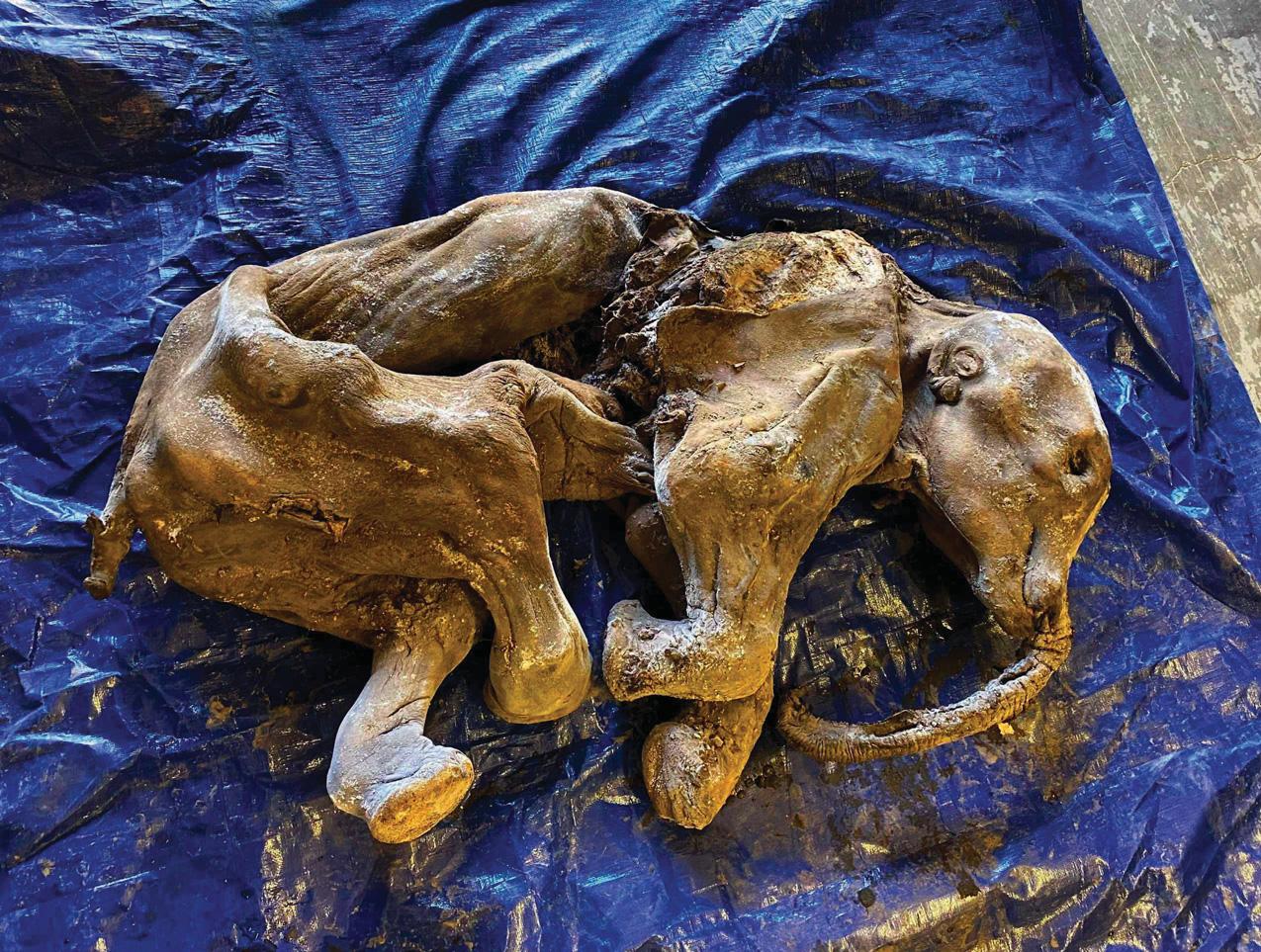 This is Nun Cho Ga, the only whole baby woolly mammoth to have been discovered in North America (near Dawson City, Yukon) to date. In the Hän language spoken in the region where her mummified remains were found, her name means 'big baby animal'. Nun Cho Ga was preserved in permafrost for 30,000 years before gold miners found her and handed her over to the Tr'ondëk Hwëch'in First Nation and Yukon governments. In 2024, she was moved to the Canadian Conservation Institute to be carefully preserved.
LOST IN THE SHADOWS
AMERICA (FROM THE DEEP SPACE CLIMATE OBSERVATORY)

This story is from the January 2025 edition of BBC Science Focus.
Subscribe to Magzter GOLD to access thousands of curated premium stories, and 10,000+ magazines and newspapers.
Already a subscriber? Sign In
MORE STORIES FROM BBC Science Focus
BBC Science Focus
World's biggest cobweb is home to 100,000 spiders
Spiders don't normally create such large colonies, so there's no need to worry about finding one in your basement

1 min
February 2026

BBC Science Focus
A dementia vaccine could be gamechanging – and available already
Getting vaccinated against shingles could protect you from getting dementia, or slow the progression of the disease
1 mins
February 2026

BBC Science Focus
DATA IN SPACE
An unusual spacecraft reached orbit in November 2025, one that might herald the dawn of a new era.
7 mins
February 2026
BBC Science Focus
Climate change is already shrinking your salary
No matter where you live, a new study has found warmer temperatures are picking your pocket
4 mins
February 2026
BBC Science Focus
A MENTAL HEALTH GLOW-UP
Forget fine lines. Could Botox give you an unexpected mental health tweakment?
3 mins
February 2026
BBC Science Focus
Most people with high cholesterol gene don't know they have it
Standard testing struggles to detect the condition
1 mins
February 2026

BBC Science Focus
HOW CAN I BOOST MY IQ?
If you're serious about getting smarter, it's time to ditch the brain-training apps
4 mins
February 2026

BBC Science Focus
Humans are absolutely terrible at reading dogs' emotions
Think you can tell how our furry friends are feeling? Think again
1 mins
February 2026

BBC Science Focus
HOW TO TEACH AI RIGHT FROM WRONG
If we want to get good responses from AI, we may need to see what it does when we ask it to be evil
3 mins
February 2026

BBC Science Focus
What Australia's social media ban could really mean for under-16s
Many people think social media is bad for our kids. Australia is trying to prove it
5 mins
February 2026
Listen
Translate
Change font size