
Go Unlimited with Magzter GOLD
Get unlimited access to 10,000+ magazines, newspapers and Premium stories for just
GOING BACK
The Atlantic
|September 2025
What home meant before, and after, Hurricane Katrina
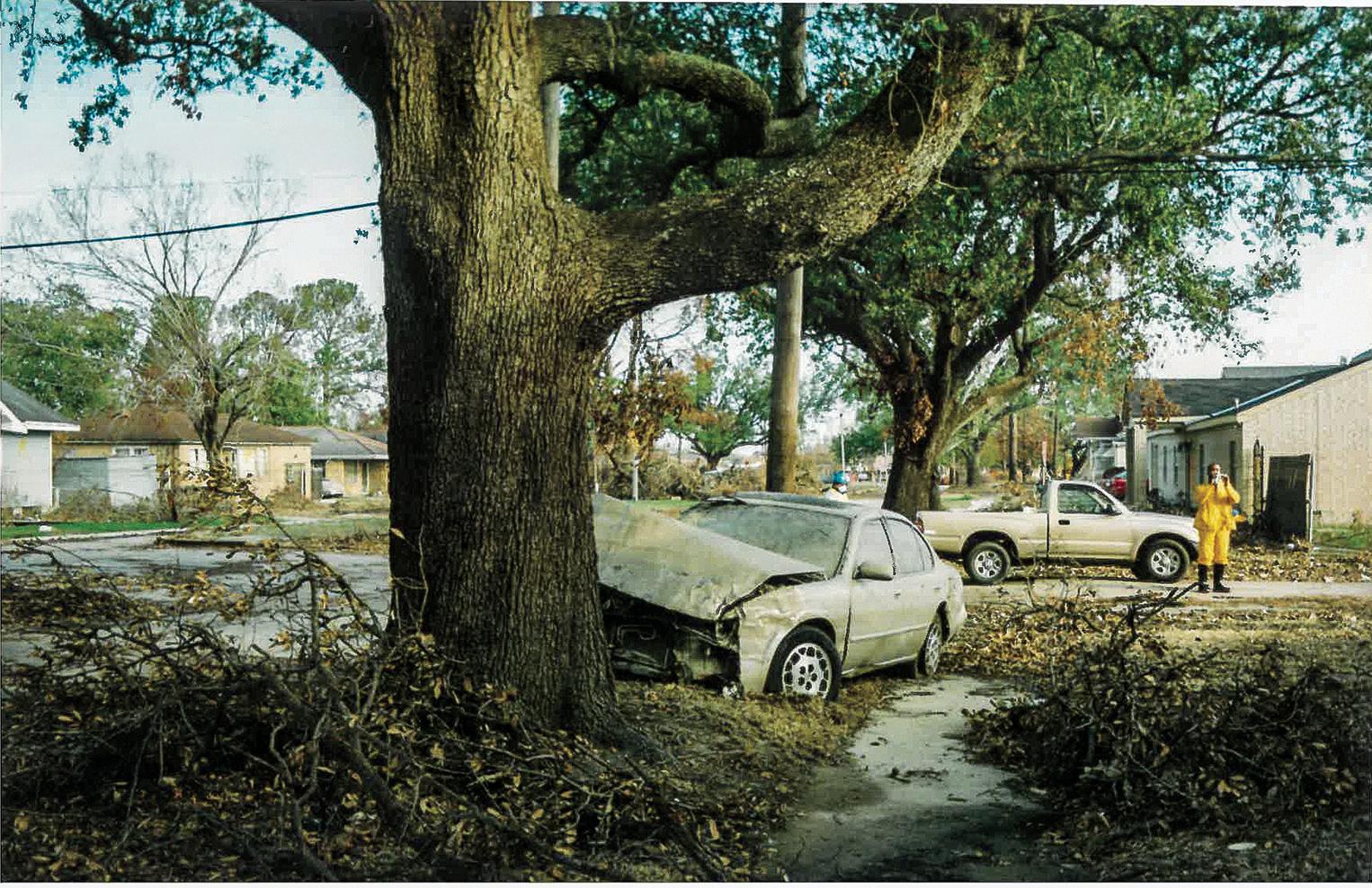
The scene before me appeared and disappeared and reappeared again with every breath I took, the hot air from my lungs fogging the gas mask that fit snugly over my face. My mother, father, and little sister stood in front of me wearing hazmat suits. It was October 2005, and we'd been among the first in Gentilly, our New Orleans neighborhood, to receive permission to return to our home after Hurricane Katrina. I was nervous. Gentilly had sat beneath up to eight feet of water for weeks. I didn't know what I would see, or how I would feel.
Our neighborhood had never been this quiet before. There had always been kids riding bikes, or someone playing music from their car or their front porch or their shoulder with a bass line that made the street vibrate. There had always been the sound of a basketball colliding with concrete as boys went in search of a court and a hoop and a game. Squirrels had always scurried through trees, where birds sang. Now there were no birds, no balls, no squirrels, no bikes. Only an eerie silence.
A silver car with clouded windows had crashed into the trunk of the old oak tree in front of our home, its hood bent into a crooked crescent. Branches from that old oak—some as thick as bodies—were scattered across the street and the yard. On the boarded-up window next to our door was a spray-painted orange X, a symbol used by search-and-rescue teams that could be seen throughout New Orleans in the days and weeks after the storm. Each quadrant of the X had a different number. The top quadrant showed the time and date the house had been searched; the left one identified which team had conducted the search; the right indicated any hazards found inside; and the bottom was for the number of people, dead or alive, found there. Our bottom quadrant read “0,” but I am still haunted by the orange spray paint on homes we passed that said something else.


This story is from the September 2025 edition of The Atlantic.
Subscribe to Magzter GOLD to access thousands of curated premium stories, and 10,000+ magazines and newspapers.
Already a subscriber? Sign In
MORE STORIES FROM The Atlantic
The Atlantic
You Had to Be There
An emerging field of history asks if we can ever really understand how our forebears experienced love, anger, fear, and sorrow.

23 mins
January 2026

The Atlantic
By the Horns
The week before the biggest bullfight of her career, in Cádiz, Spain, this past July, 24-year-old Miriam Cabas posted a carefully produced video on Instagram.
1 mins
January 2026

The Atlantic
The New German War Machine
After World War II, Germany embraced pacifism as a form of atonement. Now the country is arming itself again.
18 mins
January 2026
The Atlantic
The Eloquence
The prime minister was watching a disaster movie when we found him.
4 mins
January 2026

The Atlantic
What's for Dinner, Mom?
The women who want to change the way America eats
12 mins
January 2026

The Atlantic
How Terror Works
A 1947 German novel explores the sometimes corrosive, sometimes energizing nature of fear.
8 mins
January 2026

The Atlantic
Yesterday's Idea of a Modern Man
Sam Shepard, a self-made cowboy, was also a poet of masculine angst.
7 mins
January 2026

The Atlantic
ACCOMMODATION NATION
America's colleges have an extra-time-on-tests problem.
11 mins
January 2026

The Atlantic
Respect the Drummer
A new history of rock, told through its overlooked heroes
5 mins
January 2026

The Atlantic
THE MOST POWERFUL MAN IN SCIENCE
WHY IS ROBERT F. KENNEDY JR. SO CONVINCED HE'S RIGHT?
42 mins
January 2026
Listen
Translate
Change font size