
Mit Magzter GOLD unbegrenztes Potenzial nutzen
Erhalten Sie unbegrenzten Zugriff auf über 9.000 Zeitschriften, Zeitungen und Premium-Artikel für nur
Versuchen GOLD - Frei
GOING BACK
The Atlantic
|September 2025
What home meant before, and after, Hurricane Katrina
The scene before me appeared and disappeared and reappeared again with every breath I took, the hot air from my lungs fogging the gas mask that fit snugly over my face. My mother, father, and little sister stood in front of me wearing hazmat suits. It was October 2005, and we'd been among the first in Gentilly, our New Orleans neighborhood, to receive permission to return to our home after Hurricane Katrina. I was nervous. Gentilly had sat beneath up to eight feet of water for weeks. I didn't know what I would see, or how I would feel.
Our neighborhood had never been this quiet before. There had always been kids riding bikes, or someone playing music from their car or their front porch or their shoulder with a bass line that made the street vibrate. There had always been the sound of a basketball colliding with concrete as boys went in search of a court and a hoop and a game. Squirrels had always scurried through trees, where birds sang. Now there were no birds, no balls, no squirrels, no bikes. Only an eerie silence.
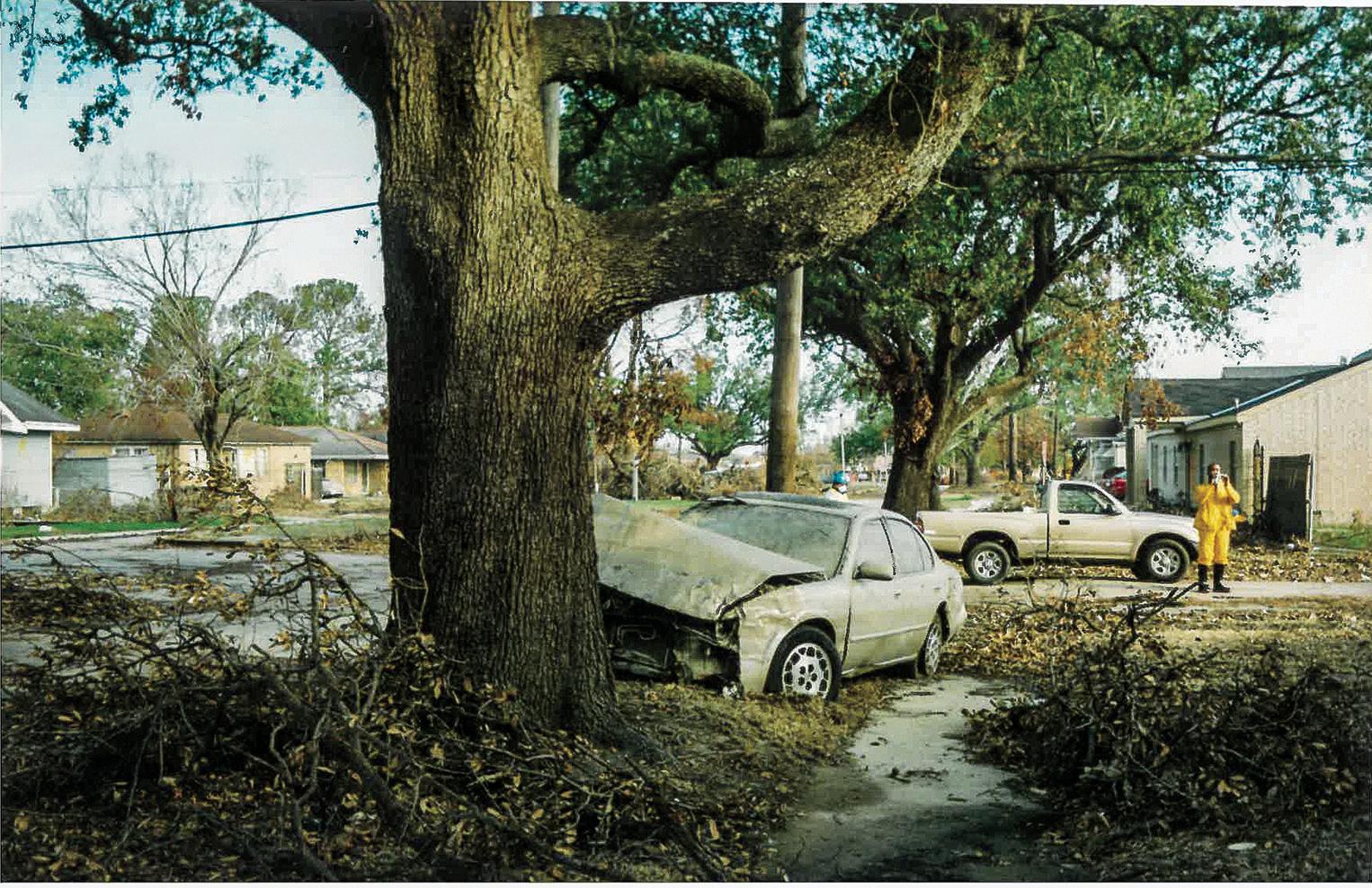
A silver car with clouded windows had crashed into the trunk of the old oak tree in front of our home, its hood bent into a crooked crescent. Branches from that old oak—some as thick as bodies—were scattered across the street and the yard. On the boarded-up window next to our door was a spray-painted orange X, a symbol used by search-and-rescue teams that could be seen throughout New Orleans in the days and weeks after the storm. Each quadrant of the X had a different number. The top quadrant showed the time and date the house had been searched; the left one identified which team had conducted the search; the right indicated any hazards found inside; and the bottom was for the number of people, dead or alive, found there. Our bottom quadrant read “0,” but I am still haunted by the orange spray paint on homes we passed that said something else.

Diese Geschichte stammt aus der September 2025-Ausgabe von The Atlantic.
Abonnieren Sie Magzter GOLD, um auf Tausende kuratierter Premium-Geschichten und über 9.000 Zeitschriften und Zeitungen zuzugreifen.
Sie sind bereits Abonnent? Anmelden
WEITERE GESCHICHTEN VON The Atlantic
The Atlantic
Deadlier Than Gettysburg
How the cruelty of the Confederacy's prison camps gave rise to the rules of war

10 mins
March 2026

The Atlantic
THE MAN WHO BROKE PHYSICS
One of the pleasures of watching Ilia Malinin, apart from his indifference to gravity, is to witness him becoming.
16 mins
March 2026

The Atlantic
How Toni Morrison Saw History
In her novels, she located the missing story of Black America.
12 mins
March 2026

The Atlantic
The Madness of Lord Tennyson
The Victorian poet was startlingly modern.
5 mins
March 2026

The Atlantic
THE PLOT AGAINST THE HUMANITIES
What is the Andrew W. Mellon Foundation doing to higher education?
22 mins
March 2026
The Atlantic
Why Do Democrats Hate Winning?
Ken Martin has one of those resting dread faces, as if he's bracing for someone to dump a bucket of rocks on his head.
37 mins
March 2026

The Atlantic
ROD DREHER'S DEMONS
HE DERIDES THE ENLIGHTENMENT, SECULARISM, AND THE MODERN WORLD. CONSERVATIVES-INCLUDING THE VICE PRESIDENT-ARE JOINING HIM ON A MARCH BACK TO THE MIDDLE AGES.
20 mins
March 2026

The Atlantic
Every Nation for Itself
President Trump wants to return to the 19th century's international order. He will leave America less prosperous—and the whole world less secure.
19 mins
March 2026
The Atlantic
The Secrets of Indigenous Art
Major exhibits are upending the way people understand Native American and Aboriginal artists.
14 mins
March 2026

The Atlantic
The Novel as Extended Op-Ed
If anyone could write good fiction about immigration, it would probably be Lionel Shriver. Instead, her latest book goes off the rails.
10 mins
March 2026
Listen
Translate
Change font size