Try GOLD - Free
You Are Not Alone
Outlook
|October 11, 2025
Dr Pratima Murthy is the Director of the National Institute of Mental Health and Neuro Sciences (NIMHANS), Bangalore. She has about 30 years of extensive experience in the field of mental health. A leader in addiction psychiatry, she has been recognised for her contribution in improving care for persons with mental illness through her work with the National Human Rights Commission on quality assurance in mental healthcare, both in institutions and in the community. Dr Murthy spoke to Avantika Mehta about the infrastructural gaps in mental healthcare in India and NIMHANS' ongoing efforts to raise awareness about mental illness
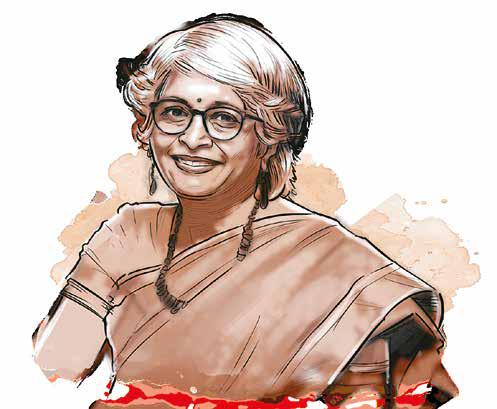
In spite of India's large burden of mental illness, fewer than one in ten people who need care actually receive it. What are the biggest infrastructural gaps NIMHANS is working to bridge?
The first National Mental Health Survey 2015-16 carried out by NIMHANS found that one in ten persons had a diagnosable mental disorder. But it must be remembered that there are many more who suffer symptoms of mental distress. Globally, the mental health gap differs for different kinds of mental illnesses, as it does in our country. For severe mental disorders like schizophrenia, it is more than 75 per cent, while for substance use disorders it is upwards of 90 per cent. Again, this differs across different states and regions of the country. The Mental Health Programme was launched in our country in the 1970s. It has now expanded to most districts, but to a different extent on the ground. While the number of people seeking help for mental disorders has certainly increased, it is undoubtedly true that this represents only a small percentage. Mental health service delivery needs adequately trained human resources.
While in the last decade, we have been certainly training more psychiatrists, clinical psychologists, psychiatric social workers and psychiatric nurses, for such a large country, the numbers are grossly insufficient. We need to look towards more, better, as well as other solutions.
With roughly 0.3 psychiatrists per 100,000 population, India faces a massive human-resource shortage. What scalable training or task-sharing models have shown the most promise?
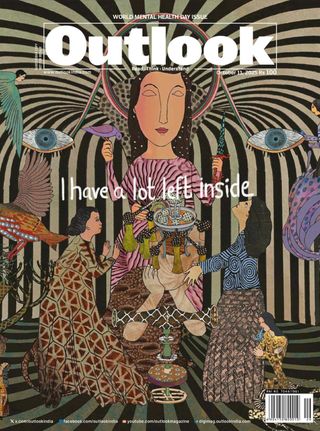

This story is from the October 11, 2025 edition of Outlook.
Subscribe to Magzter GOLD to access thousands of curated premium stories, and 10,000+ magazines and newspapers.
Already a subscriber? Sign In
MORE STORIES FROM Outlook

Outlook
The Big Blind Spot
Caste boundaries still shape social relations in Tamil Nadu-a state long rooted in self-respect politics

8 mins
December 11, 2025

Outlook
Jat Yamla Pagla Deewana
Dharmendra's tenderness revealed itself without any threats to his masculinity. He adapted himself throughout his 65-year-long career as both a product and creature of the times he lived through
5 mins
December 11, 2025

Outlook
Fairytale of a Fallow Land
Hope Bihar can once again be that impossibly noisy village in Phanishwar Nath Renu's Parti Parikatha-divided, yes, but still capable of insisting that rights are not favours and development is more than a slogan shouted from a stage
14 mins
December 11, 2025

Outlook
The Lesser Daughters of the Goddess
The Dravidian movement waged an ideological war against the devadasi system. As former devadasis lead a new wave of resistance, the practice is quietly sustained by caste, poverty, superstition and inherited ritual
2 mins
December 11, 2025

Outlook
The Meaning of Mariadhai
After a hundred years, what has happened to the idea of self-respect in contemporary Tamil society?
5 mins
December 11, 2025

Outlook
When the State is the Killer
The war on drugs continues to be a war on the poor
5 mins
December 11, 2025

Outlook
We Are Intellectuals
A senior law officer argued in the Supreme Court that \"intellectuals\" could be more dangerous than \"ground-level terrorists\"
5 mins
December 11, 2025

Outlook
An Equal Stage
The Dravidian Movement used novels, plays, films and even politics to spread its ideology
12 mins
December 11, 2025

Outlook
The Dignity in Self-Respect
How Periyar and the Self-Respect Movement took shape in Tamil Nadu and why the state has done better than the rest of the country on many social, civil and public parameters
5 mins
December 11, 2025

Outlook
When Sukumaar Met Elakkiya
Self-respect marriage remains a force of socio-political change even a century later
7 mins
December 11, 2025
Listen
Translate
Change font size