Prøve GULL - Gratis
You Are Not Alone
Outlook
|October 11, 2025
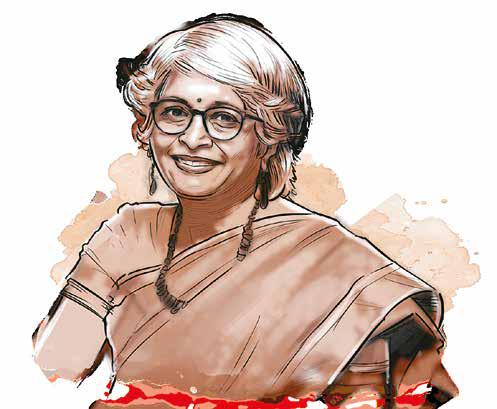
Dr Pratima Murthy is the Director of the National Institute of Mental Health and Neuro Sciences (NIMHANS), Bangalore. She has about 30 years of extensive experience in the field of mental health. A leader in addiction psychiatry, she has been recognised for her contribution in improving care for persons with mental illness through her work with the National Human Rights Commission on quality assurance in mental healthcare, both in institutions and in the community. Dr Murthy spoke to Avantika Mehta about the infrastructural gaps in mental healthcare in India and NIMHANS' ongoing efforts to raise awareness about mental illness
In spite of India's large burden of mental illness, fewer than one in ten people who need care actually receive it. What are the biggest infrastructural gaps NIMHANS is working to bridge?
The first National Mental Health Survey 2015-16 carried out by NIMHANS found that one in ten persons had a diagnosable mental disorder. But it must be remembered that there are many more who suffer symptoms of mental distress. Globally, the mental health gap differs for different kinds of mental illnesses, as it does in our country. For severe mental disorders like schizophrenia, it is more than 75 per cent, while for substance use disorders it is upwards of 90 per cent. Again, this differs across different states and regions of the country. The Mental Health Programme was launched in our country in the 1970s. It has now expanded to most districts, but to a different extent on the ground. While the number of people seeking help for mental disorders has certainly increased, it is undoubtedly true that this represents only a small percentage. Mental health service delivery needs adequately trained human resources.
While in the last decade, we have been certainly training more psychiatrists, clinical psychologists, psychiatric social workers and psychiatric nurses, for such a large country, the numbers are grossly insufficient. We need to look towards more, better, as well as other solutions.
With roughly 0.3 psychiatrists per 100,000 population, India faces a massive human-resource shortage. What scalable training or task-sharing models have shown the most promise?

Denne historien er fra October 11, 2025-utgaven av Outlook.
Abonner på Magzter GOLD for å få tilgang til tusenvis av kuraterte premiumhistorier og over 9000 magasiner og aviser.
Allerede abonnent? Logg på
FLERE HISTORIER FRA Outlook

Outlook
JOHNSON GRAMMAR SCHOOL, HYDERABAD
A Legacy of 45 Years in Academic Excellence and Holistic Development

2 mins
January 01, 2026
Outlook
Refuse, Don't Reuse!
Beyond the Recycle Bin: How Vantage Hall Girls' Residential School is Redefining Sustainability
1 mins
January 01, 2026

Outlook
Pragyan School: Where Learning Spreads Its Wings Beyond the Horizon
Pragyan School Greater Noida : Empowering Young Minds, Fostering Holistic Growth, and Shaping Future Leaders
2 mins
January 01, 2026

Outlook
A School That Celebrates Every Child's Potential
At Doon Public School, tradition meets innovation to shape confident, compassionate global citizens
2 mins
January 01, 2026
Outlook
Lodha Alibaug Penthouse Sale Boosts Coastal Luxury
A marquee penthouse at acquired in a transaction creating strong buzz within luxury real estate circles.
1 min
January 01, 2026

Outlook
K-12 School Rankings: A Guide to Right Future Choices
India is witnessing a robust transformation of the educational landscape where excellence in education, teaching and learning has scaled to heights like never before.
2 mins
January 01, 2026

Outlook
Scale Gives Way to Substance
As 2026 unfolds, industry experts see Indian real estate maturing beyond volume-led growth toward trust, design excellence, and enduring asset value.
2 mins
January 01, 2026
Outlook
Fully-loaded Magazine
It was in 2012 when I walked into the Delhi Outlook Magazine office and realised that this was a place that was throbbing with a rare energy that newsrooms are known for and I knew I'd always keep that intact. To be on the other side of a media organisation is a difficult road to navigate and yet, it comes with a unique fulfilment that I have felt often as I have defended the editorial freedom and integrity as the CEO.
7 mins
January 01, 2026
Outlook
Diary
Over 30 years ago, when I joined the weekly Sunday as a reporter, everyone around me said it was a big mistake. 'The age of magazines is over' was the chorus. Sunday Magazine did close down for various reasons but the age of magazines was not over. Evidently, it still isn't as this special issue of '30 Years of Outlook' proves. There is something exciting, unpredictable and complete about a magazine. The thrill of sitting down with a new edition of a magazine, holding the cover to the light to examine its design, opening the first pages, to look at the contents to savour what's inside, then to flip the pages to give a look-see at the various stories and articles, stopping at some stunning photograph or an illustration, and then finally zeroing in on which article to start reading from is a unique experience.
2 mins
January 01, 2026
Outlook
To Men Who Write Women Off
“Women feel differently, so they talk differently, have a different relationship to words and to ideas of which these are the vehicle. Asserting difference at the same time as demanding equal rights is obviously the position to take. We must impose female cultural models, which have a universal value in a world where ‘universal’ equals ‘masculine’. In other words, cultivate marginality until the margin takes up half the page. We have a long way to go...”—Marina Yaguello, French linguist
3 mins
January 01, 2026
Listen
Translate
Change font size