Try GOLD - Free
Elizabeth Kolbert on John McPhee's "Encounters with the Archdruid"
The New Yorker
|March 31, 2025
When President Lyndon Johnson signed the Wilderness Act, on September 3, 1964, he called it one of the “most far-reaching conservation measures” ever approved.
-
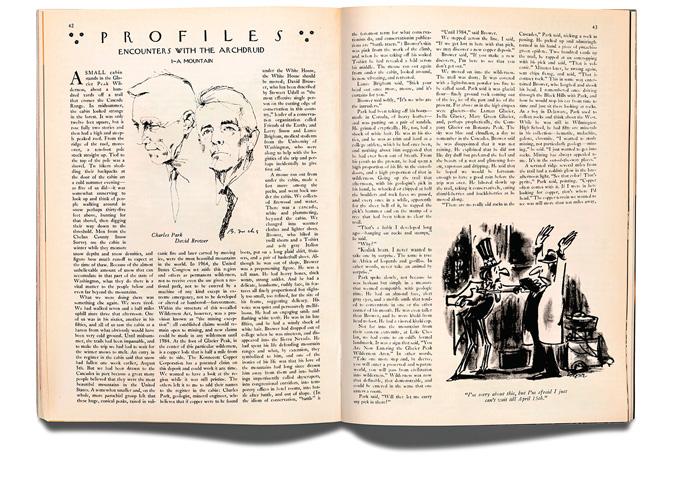
March 20, 1971
The bill established fifty-four wilderness areas, most in the American West, which, together, encompassed more than nine million acres. As the act famously put it, in these areas “the earth and its community of life” were to remain “untrammeled by man.” Homes, roads, cars, and even bicycles would therefore be prohibited.
There was, however, a gap in the law, one big enough to drive an earthmover through—or, really, several hundred. To win passage of the measure, which had gone through more than sixty drafts in the course of eight years, its sponsors agreed to a compromise. For the next twenty years, mining claims would still be honored. Anyone who held such a claim could blast a hole through a spot that otherwise was protected.

This story is from the March 31, 2025 edition of The New Yorker.
Subscribe to Magzter GOLD to access thousands of curated premium stories, and 10,000+ magazines and newspapers.
Already a subscriber? Sign In
MORE STORIES FROM The New Yorker

The New Yorker
VISITING HOURS
In Harriet Clark's début novel, a prisoner's daughter must find her way.

10 mins
May 11, 2026

The New Yorker
REVAMPS
Two new musicals on Broadway, \"Schmigadoon!\" and \"The Lost Boys.\"
7 mins
May 11, 2026

The New Yorker
RESOLVED
High-school debate, our real national pastime.
4 mins
May 11, 2026

The New Yorker
THE BIG PICTURE
Frederic Church turned landscape into a vision of national virtue.
17 mins
May 11, 2026

The New Yorker
COUTURE SHOCK
\"The Devil Wears Prada 2.\"
6 mins
May 11, 2026
The New Yorker
THE SHOT HEARD ROUND THE WORLD?
The American Revolution was just one front in a vast global war. Which went rather well for the Brits.
16 mins
May 11, 2026

The New Yorker
CROSSROADS
The inventor of “intersectionality” looks back—and ahead.
16 mins
May 11, 2026

The New Yorker
WHAT WE HOLD
The writing and meaning of the Declaration of Independence.
19 mins
May 11, 2026

The New Yorker
STANDINGS
My given name, Jeon-Gi, with a hard “G,” was one that some of the kids in my apartment complex enjoyed deforming.
33 mins
May 11, 2026

The New Yorker
AMERICAN TWEEN
In some ways, the world is cooked. But being a twelve-year-old still kind of eats.
33 mins
May 11, 2026
Listen
Translate
Change font size