Try GOLD - Free
CATCH ME IF YOU CAN
The New Yorker
|March 03, 2025
The many guises of Robert Frost.
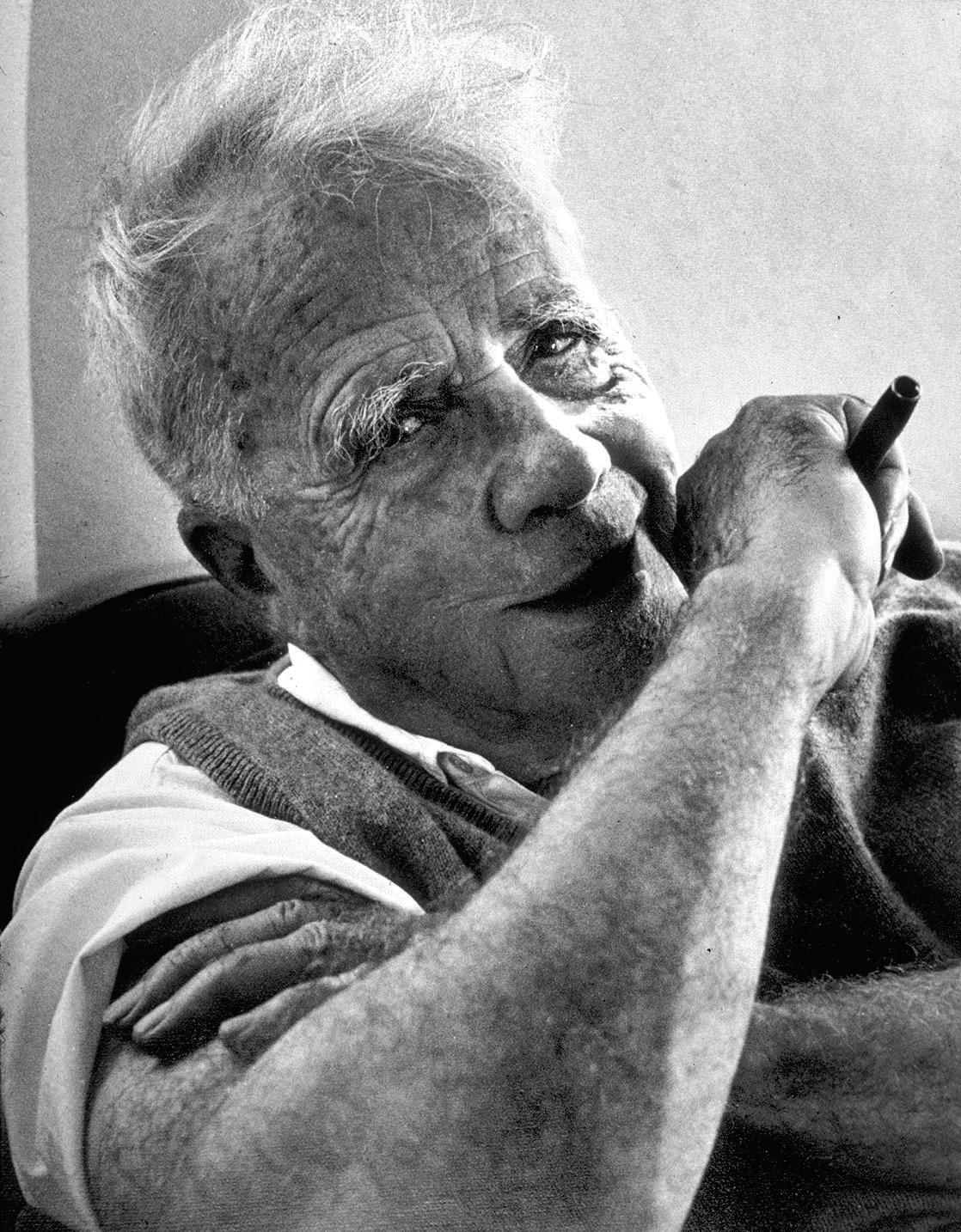
Robert Frost presented himself as a simple man. Not for him the literary circles of London or the stilted dinner parties of Brahmin Boston. Nor was he at home in academia. He dropped out of college twice, citing a need for independence, and although he spent his middle and later years teaching at universities, he was constantly fleeing them, retreating to farms in rural New England. He didn't read book reviews or so he claimed and he didn't write them, preferring instead to let his poems find their natural audience, which turned out to be a wide one. He mocked literary critics and shunned intellectual debate, though he was a great talker and loved to tell stories. His ideal days, he said, were spent in the countryside, going on long, solitary walks or chatting with his farmer neighbors, appreciating the patterns and tones of their speech.
The simplicity of his life informed his work. Ascending to fame at a time when Anglo-American poetry was growing increasingly difficult and obscure, Frost set himself apart. A lyric poet inspired by Longfellow, he described the hard lives of country folk-a war widow, a hired man-and the hard landscapes that they worked to tame. In "Out, Out-,"" a poem from 1916, a boy loses his hand to a buzz saw and dies, perhaps from shock; his family, "since they/Were not the ones dead," swiftly move on. Some of Frost's poems have the lilting quality of lullabies; others seem to deliver their morals in unambiguous terms. "I took the one less traveled by," declares the speaker of "The Road Not Taken," perhaps Frost's most famous poem, after meeting a fork in the path. "And that has made all the difference." His were, and still are, poems for everyone: schoolchildren, casual readers, the makers of greeting cards. One doesn't need to be versed in the literary tradition to read a poem by Frost-only, as one poem goes, to be "versed in country things."

This story is from the March 03, 2025 edition of The New Yorker.
Subscribe to Magzter GOLD to access thousands of curated premium stories, and 10,000+ magazines and newspapers.
Already a subscriber? Sign In
MORE STORIES FROM The New Yorker

The New Yorker
AND YOUR LITTLE DOG, TOO
When animals attack.

8 mins
December 15, 2025
The New Yorker
Katy Waldman on Mary McCarthy's "One Touch of Nature"
I first encountered Mary McCarthy not through her novels or criticism but through her political reporting. A former editor recommended that I read “The Mask of State: Watergate Portraits” before covering Paul Manafort’s arraignment in 2017. (Were we ever so young?) I loved McCarthy’s witty cameos of malefactors—behold Maurice Stans, Nixon’s erstwhile Secretary of Commerce, “a silver-haired, sideburned super-accountant and magic fundraiser, who gave a day-and-a-half-long demonstration of the athletics of evasion, showing himself very fit for a man of his age.” McCarthy’s sentences were like mousetraps, snapping shut on both visual information and something deeper, the kind of quintessence that fictional characters possess and that we often long for real people to have, too.
2 mins
December 15, 2025

The New Yorker
KILLING BORROWED TIME
Will Geese redeem noisy, lawless rock and roll?
5 mins
December 15, 2025
The New Yorker
PRISON BREAKS
A new study illuminates the origins of incarceration
13 mins
December 15, 2025
The New Yorker
UNDERSTANDING THE SCIENCE
“Everyone thinks they're on this big journey now,” Debbie said, refilling her glass.
22 mins
December 15, 2025

The New Yorker
ALL RISE
A new Afghan bakery, in New York's golden age of bread.
7 mins
December 15, 2025

The New Yorker
HOW TO LEAVE THE U.S.A.
Why fed-up Americans are going Dutch.
26 mins
December 15, 2025

The New Yorker
TRADING PLACES
The ex-bankers behind HBO's \"Industry\" are the latest British élites to dramatize their own kind.
26 mins
December 15, 2025

The New Yorker
BRIGHT LIGHTS, BIG CITY
The new Studio Museum in Harlem shows that Black art matters.
10 mins
December 15, 2025
The New Yorker
MIND OVER MATTER
Did the celebrated neurologist Oliver Sacks write his patients into case studies of his own psyche?
36 mins
December 15, 2025
Listen
Translate
Change font size