
Magzter GOLD ile Sınırsız Olun
Sadece 9.000'den fazla dergi, gazete ve Premium hikayeye sınırsız erişim elde edin
Denemek ALTIN - Özgür
CATCH ME IF YOU CAN
The New Yorker
|March 03, 2025
The many guises of Robert Frost.
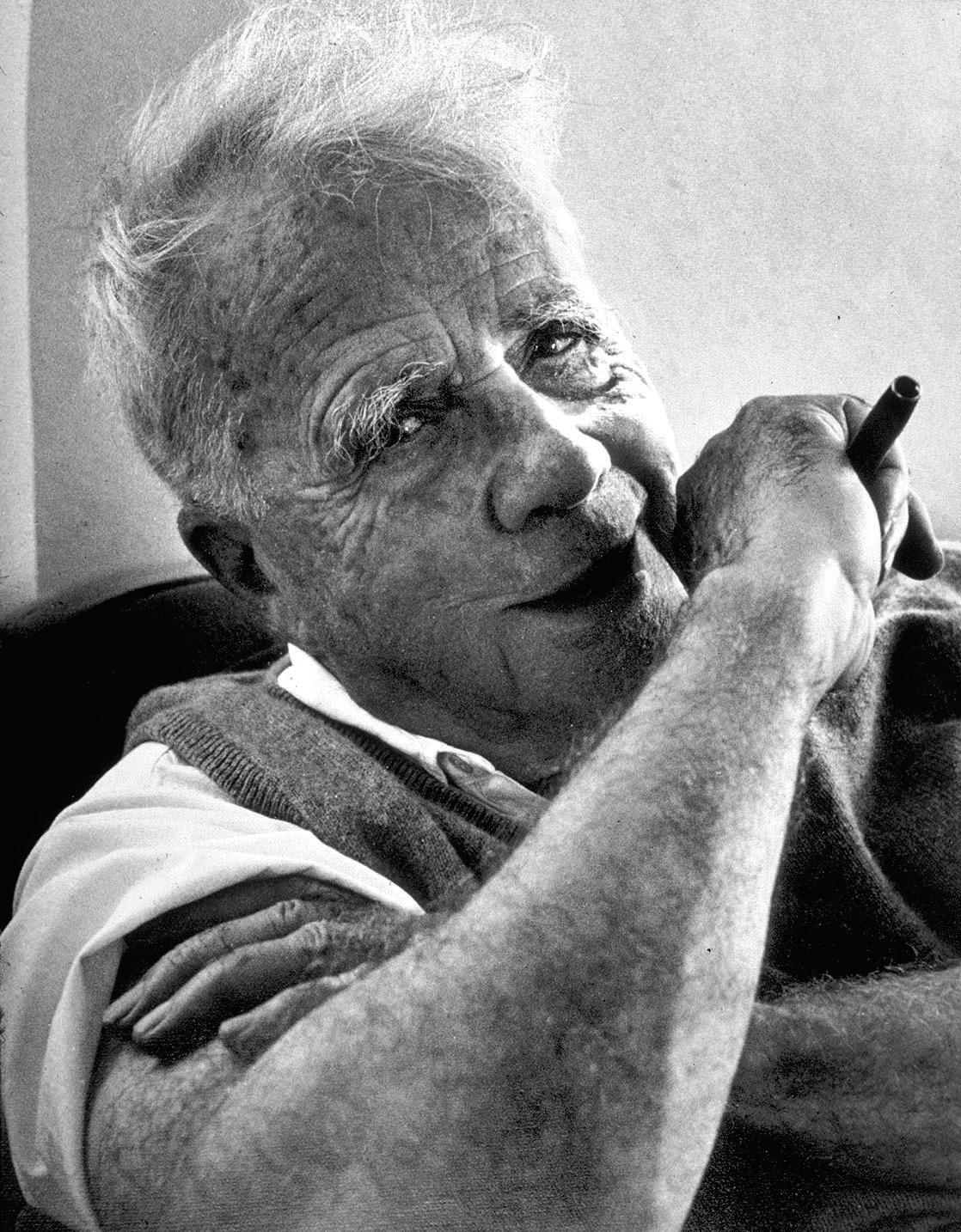
Robert Frost presented himself as a simple man. Not for him the literary circles of London or the stilted dinner parties of Brahmin Boston. Nor was he at home in academia. He dropped out of college twice, citing a need for independence, and although he spent his middle and later years teaching at universities, he was constantly fleeing them, retreating to farms in rural New England. He didn't read book reviews or so he claimed and he didn't write them, preferring instead to let his poems find their natural audience, which turned out to be a wide one. He mocked literary critics and shunned intellectual debate, though he was a great talker and loved to tell stories. His ideal days, he said, were spent in the countryside, going on long, solitary walks or chatting with his farmer neighbors, appreciating the patterns and tones of their speech.
The simplicity of his life informed his work. Ascending to fame at a time when Anglo-American poetry was growing increasingly difficult and obscure, Frost set himself apart. A lyric poet inspired by Longfellow, he described the hard lives of country folk-a war widow, a hired man-and the hard landscapes that they worked to tame. In "Out, Out-,"" a poem from 1916, a boy loses his hand to a buzz saw and dies, perhaps from shock; his family, "since they/Were not the ones dead," swiftly move on. Some of Frost's poems have the lilting quality of lullabies; others seem to deliver their morals in unambiguous terms. "I took the one less traveled by," declares the speaker of "The Road Not Taken," perhaps Frost's most famous poem, after meeting a fork in the path. "And that has made all the difference." His were, and still are, poems for everyone: schoolchildren, casual readers, the makers of greeting cards. One doesn't need to be versed in the literary tradition to read a poem by Frost-only, as one poem goes, to be "versed in country things."

Bu hikaye The New Yorker dergisinin March 03, 2025 baskısından alınmıştır.
Binlerce özenle seçilmiş premium hikayeye ve 9.000'den fazla dergi ve gazeteye erişmek için Magzter GOLD'a abone olun.
Zaten abone misiniz? Oturum aç
The New Yorker'den DAHA FAZLA HİKAYE

The New Yorker
MY BALENCIAGA HAN ONG
My mother and I were living on the Upper West Side in New York, with my aunt Fely, who was at work—she was the chief thoracic surgeon at Mount Sinai—when I heard that the film star Nora Aunor had passed.

29 mins
March 23, 2026

The New Yorker
BACK TO BASICS
Zac Posen's path from making ball gowns to remaking the Gap.
32 mins
March 23, 2026
The New Yorker
THE DOCTOR IS IN
What Egon Schiele saw at the hospital.
6 mins
March 23, 2026

The New Yorker
MICROBE AGGRESSION
\"Project Hail Mary.\"
6 mins
March 23, 2026
The New Yorker
THE PRICE OF INDEPENDENCE
Who bankrolled the American Revolution?
14 mins
March 23, 2026

The New Yorker
ALTER EGOS
Lisa Kudrow comes back to \"The Comeback.\"
27 mins
March 23, 2026
The New Yorker
RELATIVITY
\"You Got Older\" and \"What We Did Before Our Moth Days.\"
7 mins
March 23, 2026

The New Yorker
OODLES OF DOODLES
How so-called designer dogs have upended the purebred world.
26 mins
March 23, 2026
The New Yorker
LISTEN TO YOURSELVES
Adam Phillips's playful campaign against psychoanalytic orthodoxy.
10 mins
March 23, 2026

The New Yorker
THE END OF IMPERIALISM
What's behind Trump's new world disorder?
16 mins
March 23, 2026
Listen
Translate
Change font size