Try GOLD - Free
Collaborating With Your Reader
Writer’s Digest
|September/October 2025
How to create the scaffolding readers need to enter your story.
Here’s a pet theory: A book never read is, by definition, incomplete.
This sounds like a philosophical problem—a book falls in the woods ...
Writing is a collaborative art form between writer and reader. The writing itself is just words on pages. It’s not a finished experience. The reader uses their own imagination to complete this process. The story almost literally comes alive within their mind. This is why we, as readers, become attached to characters—we feel they're now part of our lives.
It’s a kind of magic trick. But crucially, we're not casting a spell over our reader. We're helping them cast a spell over themselves.
The snag is—and this is why writing requires skill—if we don’t provide our reader with the right stuff (pick your metaphor: scaffolding or ingredients for this spell), they can’t do their part of the collaboration. Just because you, the writer, can see what’s going on in your head, doesn’t mean that your reader can. Readers easily get confused, are unable to picture situations, can’t understand the characters, and ultimately feel nothing.
Anticipating your reader's experience, moment by moment, as they move through your sentences is crucial. You have to know what exactly they will need and when they need it. This is, no exaggeration, the most important skill for a writer.
This might sound daunting, but it’s not. How do we, as writers, help our readers in this magical process? Here are some ground rules I use to help my students and coaching clients.
The Physical World Is Hard to Guess
Writers often want to create a cinematic experience for their readers, but what they end up writing is similar to a screenplay (lots of dialogue, not a lot of setting). However, if you've ever read a screenplay, you know reading a script is not actually similar to watching a movie. Which is why people don't often buy screenplays, but they do like to watch TV shows and movies.
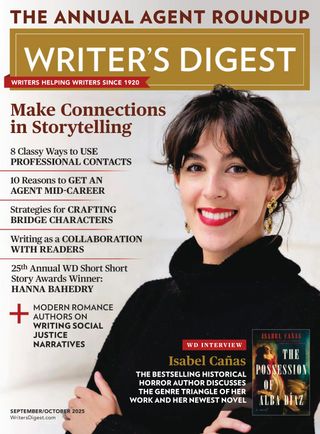

This story is from the September/October 2025 edition of Writer’s Digest.
Subscribe to Magzter GOLD to access thousands of curated premium stories, and 10,000+ magazines and newspapers.
Already a subscriber? Sign In
MORE STORIES FROM Writer’s Digest
Writer’s Digest
100 Best Markets for Writers
A list of print and online publications looking for freelancers to contribute their knowledge on everything from pet care to finance and beyond.

65 mins
Yearbook 2026

Writer’s Digest
Memoir Plus
Add a bonus to your personal narrative for a marketing boost.
8 mins
Yearbook 2026
Writer’s Digest
Surefire Ways to Sell Your Children's Book
In my 28 years editing children's books, I've learned that publishing exists at the intersection of art and commerce.
5 mins
Yearbook 2026
Writer’s Digest
The ABCs of Freelance Success
Many freelance writers, especially those at the beginning of their careers, tend to place almost all of their professional focus on one specific component: craft.
5 mins
Yearbook 2026
Writer’s Digest
How to Write in Different Genres
Emiko Jean and Yulin Kuang share tips and strategies for how they successfully write in different genres and mediums.
8 mins
Yearbook 2026
Writer’s Digest
Small But Mighty
Why small presses might be the perfect home for your book.
8 mins
Yearbook 2026

Writer’s Digest
The Story Behind the Story
What's backstory, and what's it doing here anyway?
6 mins
Yearbook 2026

Writer’s Digest
2025 Year in Review
Publishing expert Jane Friedman recaps the biggest news in the industry.
8 mins
Yearbook 2026

Writer’s Digest
What Is Your Story Question?
When a story isn't working—when you know it's not quite coming together, when beta readers and critique partners confirm your fears but can't put a finger on why, or you're not getting offers from agents or publishers—savvy authors start trying to diagnose the issue by examining its component parts, like characterization, plot, and stakes.
6 mins
Yearbook 2026
Writer’s Digest
Writer's Digest 27th Annual 101 Best Websites for Writers
For the 27th year, Writer's Digest is shining a light on 101 websites with a goal of helping writers in a variety of ways.
26 mins
Yearbook 2026
Listen
Translate
Change font size