Essayer OR - Gratuit
Collaborating With Your Reader
Writer’s Digest
|September/October 2025
How to create the scaffolding readers need to enter your story.
Here’s a pet theory: A book never read is, by definition, incomplete.
This sounds like a philosophical problem—a book falls in the woods ...
Writing is a collaborative art form between writer and reader. The writing itself is just words on pages. It’s not a finished experience. The reader uses their own imagination to complete this process. The story almost literally comes alive within their mind. This is why we, as readers, become attached to characters—we feel they're now part of our lives.
It’s a kind of magic trick. But crucially, we're not casting a spell over our reader. We're helping them cast a spell over themselves.
The snag is—and this is why writing requires skill—if we don’t provide our reader with the right stuff (pick your metaphor: scaffolding or ingredients for this spell), they can’t do their part of the collaboration. Just because you, the writer, can see what’s going on in your head, doesn’t mean that your reader can. Readers easily get confused, are unable to picture situations, can’t understand the characters, and ultimately feel nothing.
Anticipating your reader's experience, moment by moment, as they move through your sentences is crucial. You have to know what exactly they will need and when they need it. This is, no exaggeration, the most important skill for a writer.
This might sound daunting, but it’s not. How do we, as writers, help our readers in this magical process? Here are some ground rules I use to help my students and coaching clients.
The Physical World Is Hard to Guess
Writers often want to create a cinematic experience for their readers, but what they end up writing is similar to a screenplay (lots of dialogue, not a lot of setting). However, if you've ever read a screenplay, you know reading a script is not actually similar to watching a movie. Which is why people don't often buy screenplays, but they do like to watch TV shows and movies.
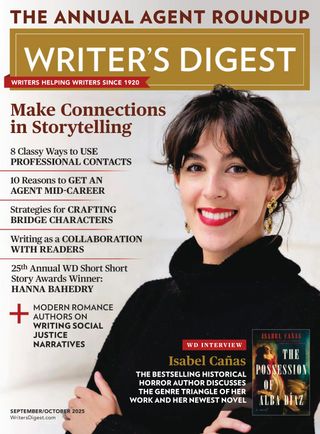

Cette histoire est tirée de l'édition September/October 2025 de Writer’s Digest.
Abonnez-vous à Magzter GOLD pour accéder à des milliers d'histoires premium sélectionnées et à plus de 9 000 magazines et journaux.
Déjà abonné ? Se connecter
PLUS D'HISTOIRES DE Writer’s Digest
Writer’s Digest
Fate and Prophesy
Defying destiny may be just as hazardous as succumbing to it.”

5 mins
May / June 2026

Writer’s Digest
How to Pitch in Person Without Losing the Plot
Conference-ready tips to make sure your story stands out.
5 mins
May / June 2026
Writer’s Digest
How to Handle Money as a Writer
That is, in case you actually make any ...
8 mins
May / June 2026

Writer’s Digest
Dress Your Manuscript for the Job You Want It to Have
Dress Your Manuscript for the Job You Want It to Have How often have you heard the adage “dress for the job you want”? Probably often enough that it’s a cliché.
5 mins
May / June 2026

Writer’s Digest
Mike Chen
The award-winning science-fiction author discusses the importance of fandom, writing for IP giants like Star Wars, and tackling his biggest project yet: a space opera.
13 mins
May / June 2026
Writer’s Digest
Outlaw Openers
There was a time when starting a sentence with And, But, or So felt like breaking the law.
2 mins
May / June 2026
Writer’s Digest
Collaborate to Create
Why co-authoring nonfiction is a pro strategy worth considering.
7 mins
May / June 2026
Writer’s Digest
The Life-Changing Magic of Tidying Up Your Writing Portfolio
Creating an organized online home for your nonfiction writing samples gives you a strategic advantage.
5 mins
May / June 2026
Writer’s Digest
20 Elevator Pitches for Recently Published Books
One of the most important professional skills an author can develop is the ability to craft an enticing elevator pitch for their book.
5 mins
May / June 2026
Writer’s Digest
On Writing & Newsroom Autobiography
Today, the rise of 24-hour cable news has dramatically reshaped how we consume information.
2 mins
May / June 2026
Listen
Translate
Change font size