Try GOLD - Free
Time Well Spent: A New Way to Value Time Could Transform Your Life
MIT Sloan Management Review
|Summer 2025
Calculating the subjective value of your time reveals where small changes in your weekly schedule can significantly boost life satisfaction and well-being.

HOUR BY HOUR, HOW WE SPEND OUR time adds up to how we spend our lives — and for many of us, the sum can feel unsatisfying. Cultural attitudes embedded in adages like “time is money” spur us to prioritize efficiency and to look for ways to condense and consolidate to maximize how much we can get done. But which activities should we really prioritize if we want to craft our best lives at work and in life? We lack a way to assess our time spent from the perspective of the value we personally derive from it. We need such a measure if we are to make the best allocations of our time and build more satisfying lives.
Given mounting evidence that happiness and satisfaction in life can yield high performance and engagement at work, the question of how we spend our time to shape fulfilling lives is ever more salient for leaders and their teams.¹ If we want to consider that question rigorously and begin to make changes in our daily activities, we need better insight into the subjective value of our time — our experience of what we are doing — rather than the productive value of our time, which we're already pretty good at assessing. While that has defied measurement in the past, our recent research drawing on detailed time-and-activity reporting from thousands of individuals has yielded new tools and metrics that quantify the subjective value each person derives from time spent. This approach has enabled research participants to make small but meaningful changes in how they spend their time, improving their life satisfaction.
Our goal is to explain how you can maximize the subjective value you derive from how you spend your time — and how you can extend this practice to your team. That may not require major change: Shifting one or two hours a week to a higher-value activity, or recognizing how a low-value activity can be enriched, can make a big difference in how you experience your quality of life.
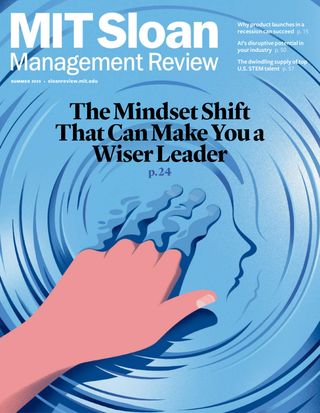

This story is from the Summer 2025 edition of MIT Sloan Management Review.
Subscribe to Magzter GOLD to access thousands of curated premium stories, and 10,000+ magazines and newspapers.
Already a subscriber? Sign In
MORE STORIES FROM MIT Sloan Management Review

MIT Sloan Management Review
A Smarter Approach to Measuring Customer Experience
Many companies collect more customer experience data points than they need or can use effectively. Here's how to focus on the metrics that matter.

10 mins
Spring 2026

MIT Sloan Management Review
Why Digital Dexterity Is Key to Transformation
To make headway with digital transformation, executives are redefining the challenge: Build a workforce to take advantage of new technologies.
17 mins
Spring 2026

MIT Sloan Management Review
Ask Sanyin: What Makes a 'Listening Tour' Meaningful?
I've just stepped into a new leadership role and was advised to embark on a \"listening tour.\"
2 mins
Spring 2026

MIT Sloan Management Review
Build Business Advantage With Real-Time Decision-Making
Stop running your business on yesterday's data. Real-time data, empowered employees, and agile systems can lead to higher margins.
11 mins
Spring 2026

MIT Sloan Management Review
Balancing Innovation and Risk in the Age of AI
Monica Caldas is executive vice president and global CIO of Liberty Mutual Insurance.
2 mins
Spring 2026

MIT Sloan Management Review
Turn Customer Complaints Into Innovation Blueprints
You can reframe client grievances as an opportunity instead of a burden. At one Swiss hospital, complaints have become a pipeline for improvements to the customer experience.
6 mins
Spring 2026

MIT Sloan Management Review
The Eight Core Principles of Strategic Innovation
A company's future depends on the new directions it explores and develops today — and that requires different structures and capabilities from incremental innovation.
14 mins
Spring 2026

MIT Sloan Management Review
What AI Can Teach Us About Designing Better KPIs
Machine learning research offers four proven strategies to prevent people from gaming measures of organizational performance.
12 mins
Spring 2026

MIT Sloan Management Review
THREE THINGS TO KNOW ABOUT Learning by Hiring
LEADERS WHO RECOGNIZE THAT OUT-siders can be major drivers of innovation often seek to bring new knowledge into their organizations by making external hires.
2 mins
Spring 2026

MIT Sloan Management Review
Validating LLM Output? Prepare to Be ‘Persuasion Bombed’
Research demonstrates how generative AI ramps up the rhetorical pressure on users who question the AI's output.
8 mins
Spring 2026
Listen
Translate
Change font size