Try GOLD - Free
Set Up to Fail
MIT Sloan Management Review
|Summer 2022
Poor design of C-suite jobs can block executives from succeeding in their roles.

Why is the average tenure of a C-suite executive a brief 5.3 years? And why do chief marketing and chief information officers last barely more than four years in the job, on average?
The answer may lie between the lines of the job specifications shopped around by executive recruiters. One of us (Kimberly A. Whitler) was approached to gauge interest in a CMO position and, as she reviewed the 12-page job spec, realized that she couldn’t in good conscience recommend anyone for the role. Based on the responsibilities, expectations, and ideal candidate qualifications described in that document, the role was poorly designed. It was setting up the incoming CMO for failure.
Unfortunately, based on our experience and research, many C-level jobs are poorly designed — and the individuals interviewing for these jobs are unaware of it. We shared that CMO job spec with a group of senior-level marketers and asked how many would be interested in the role, assuming it offered competitive compensation and an attractive location. A large majority of the executives were interested: They had no idea how to assess how well aligned the responsibilities, performance expectations, and qualifications were — and whether the job design set them up to succeed or fail.
An Expensive Problem What makes the short C-level tenure surprising is that it is similar to that of average salaried workers, despite the much greater effort, expense, and time spent identifying and filling C-level roles.2 Companies pay hundreds of thousands of dollars to executive recruiting firms and may involve other C-suite executives, including the CEO, and potentially the board of directors, in defining and approving C-level roles.
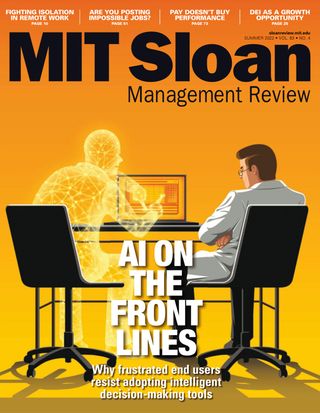

This story is from the Summer 2022 edition of MIT Sloan Management Review.
Subscribe to Magzter GOLD to access thousands of curated premium stories, and 10,000+ magazines and newspapers.
Already a subscriber? Sign In
MORE STORIES FROM MIT Sloan Management Review

MIT Sloan Management Review
Assess What Is Certain in a Sea of Unknowns
Understanding what won't change clarifies what might — and strengthens decision-making in volatile times.

13 mins
winter 2026

MIT Sloan Management Review
Ask Sanyin: Why Is It So Hard to Pull the Plug on a Project?
We're finding it difficult to wind down projects that no longer serve our priorities.
2 mins
winter 2026

MIT Sloan Management Review
Integrate Sustainability and Innovation to Find New Opportunities
Five common innovation practices can help leaders pursue sustainability as a growth strategy.
12 mins
winter 2026

MIT Sloan Management Review
The Case for Quiet Corporate Activism
Leaders concerned that they will be penalized for championing sustainability and diversity can still sustain their commitments.
11 mins
winter 2026

MIT Sloan Management Review
The Perils of Algorithmic Pricing
Some revenue management systems based on algorithms may lead to unintended collusion and antitrust violations.
9 mins
winter 2026

MIT Sloan Management Review
Broadening Future Perspectives at the Bank of England
Leaders at the U.K’s central bank sought to broaden their thinking about future risks and opportunities. Here’s how they built longer-term horizon-scanning capabilities and what they learned along the way.
9 mins
winter 2026

MIT Sloan Management Review
How Nesting Changes Platform Strategy
Should your platform host another platform — or be hosted by one? Here's how to think through the choices.
14 mins
winter 2026
MIT Sloan Management Review
Are You an Authentic Leader or an Authentic Jerk?
Leaders who are true to their values can inspire trust and respect, but not if \"being yourself\" becomes the problem.
13 mins
winter 2026

MIT Sloan Management Review
How to Make Scenario Planning Stick
Developing future scenarios can deepen leaders’ strategic insights. Establishing scenario planning as an ongoing capability and reaping its full benefits require linking it to other processes.
16 mins
winter 2026

MIT Sloan Management Review
A Faster Way to Build Future Scenarios
This streamlined approach to scenario planning incorporates AI and helps managers navigate future uncertainties more efficiently.
13 mins
winter 2026
Translate
Change font size