Try GOLD - Free
Managing the Human Risks of Biometric Applications
MIT Sloan Management Review
|Fall 2024
The intimate surveillance afforded by biometric technologies requires managers to consider negative impacts on privacy and human dignity.

In April, Colorado became the first state to mandate that companies protect the privacy of data generated from a person's brain waves, an action spurred by concerns over the commercial use of wearable devices intended to monitor users' brain activity. Use of those and other devices that enable the collection of humans' physiological data warrants robust discussion of the legal and moral implications of the increasing surveillance and datafication of people's lives.
Biometric technologies measure intimate body characteristics or behaviors, such as fingerprints, retinas, facial structure, vein patterns, speech, breathing patterns, brainwaves, gait, keystroke patterns, and other movements. While much activity in the field has focused on authenticating individuals' identities in security applications, some biometric technologies are touted as offering deeper insights into humans' states of mind and behaviors. It's when these biometric capabilities are put into play that companies may endanger consumers' trust.
Managers in some organizations see the potential for analyzing highly granular physiological data to improve operational efficiency. Financial institutions Barclays and Lloyds use heat-sensing devices under desks to monitor which workstations are used frequently in order to improve office layouts, desk assignments, and resource allocation. Mining company BHP uses smart hats that measure brainwaves to detect and track truckers' levels of fatigue, to protect them and improve company safety. These applications can benefit both the companies and their employees.
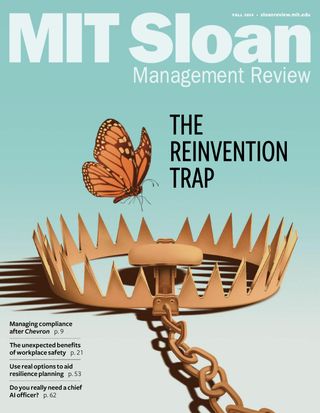

This story is from the Fall 2024 edition of MIT Sloan Management Review.
Subscribe to Magzter GOLD to access thousands of curated premium stories, and 10,000+ magazines and newspapers.
Already a subscriber? Sign In
MORE STORIES FROM MIT Sloan Management Review

MIT Sloan Management Review
Assess What Is Certain in a Sea of Unknowns
Understanding what won't change clarifies what might — and strengthens decision-making in volatile times.

13 mins
winter 2026

MIT Sloan Management Review
Ask Sanyin: Why Is It So Hard to Pull the Plug on a Project?
We're finding it difficult to wind down projects that no longer serve our priorities.
2 mins
winter 2026

MIT Sloan Management Review
Integrate Sustainability and Innovation to Find New Opportunities
Five common innovation practices can help leaders pursue sustainability as a growth strategy.
12 mins
winter 2026

MIT Sloan Management Review
The Case for Quiet Corporate Activism
Leaders concerned that they will be penalized for championing sustainability and diversity can still sustain their commitments.
11 mins
winter 2026

MIT Sloan Management Review
The Perils of Algorithmic Pricing
Some revenue management systems based on algorithms may lead to unintended collusion and antitrust violations.
9 mins
winter 2026

MIT Sloan Management Review
Broadening Future Perspectives at the Bank of England
Leaders at the U.K’s central bank sought to broaden their thinking about future risks and opportunities. Here’s how they built longer-term horizon-scanning capabilities and what they learned along the way.
9 mins
winter 2026

MIT Sloan Management Review
How Nesting Changes Platform Strategy
Should your platform host another platform — or be hosted by one? Here's how to think through the choices.
14 mins
winter 2026
MIT Sloan Management Review
Are You an Authentic Leader or an Authentic Jerk?
Leaders who are true to their values can inspire trust and respect, but not if \"being yourself\" becomes the problem.
13 mins
winter 2026

MIT Sloan Management Review
How to Make Scenario Planning Stick
Developing future scenarios can deepen leaders’ strategic insights. Establishing scenario planning as an ongoing capability and reaping its full benefits require linking it to other processes.
16 mins
winter 2026

MIT Sloan Management Review
A Faster Way to Build Future Scenarios
This streamlined approach to scenario planning incorporates AI and helps managers navigate future uncertainties more efficiently.
13 mins
winter 2026
Listen
Translate
Change font size