Try GOLD - Free
How AI Skews Our Sense of Responsibility
MIT Sloan Management Review
|Summer 2024
Research shows how using an Al-augmented system may affect humans' perception of their own agency and responsibility.

As artificial intelligence plays an everlarger role in automated systems and decision-making processes, the question of how it affects humans’ sense of their own agency is becoming less theoretical — and more urgent. It’s no surprise that humans often defer to automated decision recommendations, with exhortations to “trust the AI!” spurring user adoption in corporate settings. However, there’s growing evidence that AI diminishes users’ sense of responsibility for the consequences of those decisions.
This question is largely overlooked in current discussions about responsible AI. In reality, such practices are intended to manage legal and reputational risk — a limited view of responsibility, if we draw on German philosopher Hans Jonas’s useful conceptualization. He defined three types of responsibility, but AI practice appears concerned with only two. The first is legal responsibility, wherein an individual or corporate entity is held responsible for repairing damage or compensating for losses, typically via civil law, and the second is moral responsibility, wherein individuals are held accountable via punishment, as in criminal law.
What we’re most concerned about here is the third type, what Jonas called the sense of responsibility. It’s what we mean when we speak admiringly of someone “acting responsibly.” It entails critical thinking and predictive reflection on the purpose and possible consequences of one’s actions, not only for oneself but for others. It’s this sense of responsibility that AI and automated systems can alter.
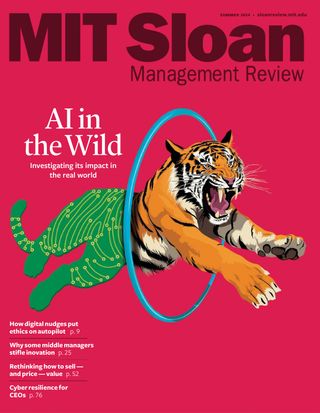

This story is from the Summer 2024 edition of MIT Sloan Management Review.
Subscribe to Magzter GOLD to access thousands of curated premium stories, and 10,000+ magazines and newspapers.
Already a subscriber? Sign In
MORE STORIES FROM MIT Sloan Management Review

MIT Sloan Management Review
A Smarter Approach to Measuring Customer Experience
Many companies collect more customer experience data points than they need or can use effectively. Here's how to focus on the metrics that matter.

10 mins
Spring 2026

MIT Sloan Management Review
Why Digital Dexterity Is Key to Transformation
To make headway with digital transformation, executives are redefining the challenge: Build a workforce to take advantage of new technologies.
17 mins
Spring 2026

MIT Sloan Management Review
Ask Sanyin: What Makes a 'Listening Tour' Meaningful?
I've just stepped into a new leadership role and was advised to embark on a \"listening tour.\"
2 mins
Spring 2026

MIT Sloan Management Review
Build Business Advantage With Real-Time Decision-Making
Stop running your business on yesterday's data. Real-time data, empowered employees, and agile systems can lead to higher margins.
11 mins
Spring 2026

MIT Sloan Management Review
Balancing Innovation and Risk in the Age of AI
Monica Caldas is executive vice president and global CIO of Liberty Mutual Insurance.
2 mins
Spring 2026

MIT Sloan Management Review
Turn Customer Complaints Into Innovation Blueprints
You can reframe client grievances as an opportunity instead of a burden. At one Swiss hospital, complaints have become a pipeline for improvements to the customer experience.
6 mins
Spring 2026

MIT Sloan Management Review
The Eight Core Principles of Strategic Innovation
A company's future depends on the new directions it explores and develops today — and that requires different structures and capabilities from incremental innovation.
14 mins
Spring 2026

MIT Sloan Management Review
What AI Can Teach Us About Designing Better KPIs
Machine learning research offers four proven strategies to prevent people from gaming measures of organizational performance.
12 mins
Spring 2026

MIT Sloan Management Review
THREE THINGS TO KNOW ABOUT Learning by Hiring
LEADERS WHO RECOGNIZE THAT OUT-siders can be major drivers of innovation often seek to bring new knowledge into their organizations by making external hires.
2 mins
Spring 2026

MIT Sloan Management Review
Validating LLM Output? Prepare to Be ‘Persuasion Bombed’
Research demonstrates how generative AI ramps up the rhetorical pressure on users who question the AI's output.
8 mins
Spring 2026
Listen
Translate
Change font size