
Go Unlimited with Magzter GOLD
Get unlimited access to 10,000+ magazines, newspapers and Premium stories for just
Agents Of Shield
Racecar Engineering
|September 2017
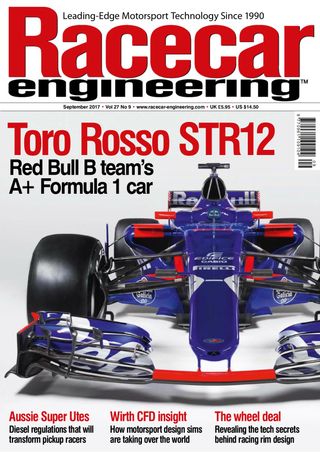
The latest F1 cockpit protection device was aired in practice at the British GP – but a disappointing test, and lack of time, has now resulted in a decision to go with the Halo in 2018

Before the British Grand Prix, the latest in a line of experimental cockpit safety systems was trialled on a Ferrari SF70H during free practice. Dubbed the Shield, the device is designed to protect a driver’s head from flying debris, such as that which killed Henry Surtees in F2 in 2009 and Justin Wilson in IndyCar in 2015.
The new device was developed following the mixed response to the steel Halo device trialled in 2016, and also the Aeroscreen tested by Red Bull. Early this year it was announced that a cockpit protection system would definitely be introduced for the 2018 season and for a while Shield looked like the best solution. But, since the test, F1 has now opted for Halo.
Shield revealed
Silverstone was the first chance for most of the paddock, the media and indeed the public to see the Shield, which when revealed did not look nearly as sleek as the concept renderings circulated when it was announced. However, the design did seem to get a generally positive response in terms of its aesthetics.
Made up of an as yet undisclosed polymeric material from the polycarbonate family, the prototype weighed in at around 4kg, with another 2kg for its mounting plate. Four variants of the Shield have been developed, two different shapes with two different thicknesses available for each. The version used at its Silverstone test was the thinner of the two, the thicker version weighs an additional 2kg.
Dizzy spell
One of the reasons for the two different thicknesses was that the Shield had yet to be subjected to all of the impact tests, which have previously involved a complete 20kg wheel and tyre assembly being fired at the cockpit protection device at 225kph.

This story is from the September 2017 edition of Racecar Engineering.
Subscribe to Magzter GOLD to access thousands of curated premium stories, and 10,000+ magazines and newspapers.
Already a subscriber? Sign In
MORE STORIES FROM Racecar Engineering

Racecar Engineering
Talk the torque
More thoughts on in-wheel motors and their effects on twisting force

6 mins
December 2021

Racecar Engineering
Rolling about
An explanation of the limitations of a previous load transfer article, bringing jacking forces into the mix
5 mins
December 2021

Racecar Engineering
F1 breaks schedule records
The FIA has confirmed no fewer than 23 races on the 2022 Formula 1 World Championship schedule, the highest number of grands prix ever to be held in a single season, and that has led to criticism from some teams that will be on the road for eight months.
1 mins
December 2021

Racecar Engineering
Under pressure
Toyota may have finished first and second at Le Mans this year, but the effort required to overcome a fuel delivery problem and finish with both cars was Herculean
12 mins
December 2021
Racecar Engineering
Physics at work
Dutch company, Intrax, offers Racecar Engineering an insight into the technologies it employs to optimise its suspension products
4 mins
December 2021

Racecar Engineering
Williams' 2030 ambition
Williams Racing has committed to becoming climate positive by 2030 as part of an all-new sustainability strategy.
1 min
December 2021

Racecar Engineering
Diff'rent strokes
Racecar looks at the different types of mechanical differential, their benefits and limitations
14 mins
December 2021

Racecar Engineering
Das Boot
A curious Twitter exchange fired up a unique, hydrogen-powered, cross-country project that will contest the Baja 1000 in November 2022
8 mins
December 2021

Racecar Engineering
Air born
Every racecar engineer's dream is a blank sheet of paper design. When Hoonigan and Subaru approached Vermont Sportscars about building the next generation of Gymkhana racer, that's just what the company was given
8 mins
December 2021
Racecar Engineering
Remote control
Called variously ‘virtual garages’, ‘mission control’ or ‘race support rooms’ is the future of race engineering sitting in the warm back at HQ?
14 mins
December 2021
Translate
Change font size