Try GOLD - Free
Genesis Of Water
Down To Earth
|March 16, 2017
Life on Earth is the result of several fascinating coincidences, of which the presence of water is considered the most important. But we are still not sure where this water came from.

This excerpt of a hymn from Hinduism’s most sacred texts represents one of humankind’s earliest written inquiries into how Earth was formed and how all life came to be. Like other religious texts, it attributes the creation of water to some inexplicable divine force. And yet, one cannot miss the uncanny reference to scientific phenomena we have come to research or accept today. Written around 4,000 years ago, the poem recognises water as the prerequisite for creation of all life on Earth and alludes to an immense source of heat or energy from which water arose. Most of all, it also speculates that water existed right from the beginning of Earth’s formation, a possibility scientists are still investigating today.
It is true that without water, Earth would have been a dead, desolate planet, much like its closest sibling, Mars. Water is one of the most abundant compounds on Earth and influences almost every natural cycle on the planet. The adult human body is itself around 60 per cent water. Yet, the question of how we came to be in possession of this miracle compound remains.
Water as ET
School textbooks say water is extra-terrestrial. It was brought to Earth by meteors from passing comets which, when they struck Earth, became meteorites. Such bombardment was frequent when Earth was still being formed more than 4.5 billion years ago. To reach this conclusion, scientists hypothesised that in the moments after the Big Bang, when galaxies with solar systems and planets were being formed, scorching temperatures would have rendered it impossible for Earth to retain any water. Hence, water must have come from outer space as projectiles from comets (snowballs of frozen gases, rock and dust). Around 80 per cent of all the water in the world was thought to have come this way. This remained a widely accepted theory until advancements in scientific research indicated other possibilities.
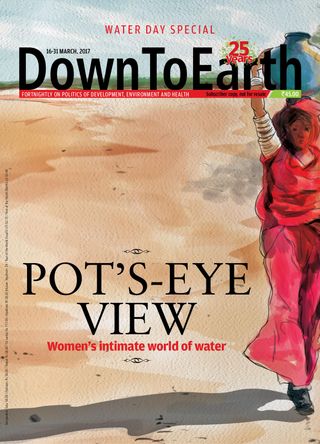

This story is from the March 16, 2017 edition of Down To Earth.
Subscribe to Magzter GOLD to access thousands of curated premium stories, and 10,000+ magazines and newspapers.
Already a subscriber? Sign In
MORE STORIES FROM Down To Earth

Down To Earth
Bitter pill
THE WEB SERIES PHARMA EXPOSES HARSH TRUTHS OF THE PHARMACEUTICAL INDUSTRY, WHERE PROFIT OFTEN BECOMES MORE IMPORTANT THAN HUMAN HEALTH

3 mins
January 16, 2026
Down To Earth
CHAOS IN-DEFINITION
The Aravallis are perhaps India's most litigated hill range. More than 4,000 court cases have failed to arrest their destruction. The latest dispute concerns a narrow legal definition of this geological antiquity, much of which has been obliterated by mining and urban sprawl. While the Supreme Court has stayed its own judgement accepting that definition, it must see the underlying reality and help reconcile development and national security with conservation.
19 mins
January 16, 2026

Down To Earth
BITS: INDIA
Indore has recorded 16 deaths and more than 1,600 hospitalisations between December 24 and January 6.
1 min
January 16, 2026

Down To Earth
GUARANTEE EXPIRES
India's rural employment guarantee law is replaced with a centrally controlled, budget-capped scheme. Is this an attack on the right to work?
3 mins
January 16, 2026

Down To Earth
BLOOM OR BANE
Surge of vibrant pink water lilies in Kuttanad, Kerala, provides socio-economic benefits, but the plant's ecological impacts must be understood
4 mins
January 16, 2026

Down To Earth
INVISIBLE EMPLOYER
Field and academic evidence shows sharp falls in casual agricultural employment at places where groundwater access declines
3 mins
January 16, 2026

Down To Earth
Schemed for erasure
Does the VB-G RAMG Act address structural weaknesses long observed in MGNREGA's implementation?
10 mins
January 16, 2026

Down To Earth
School of change
An open school in Panagar, Madhya Pradesh, aims to protect children of tribal settlements from falling into the trap of addiction
2 mins
January 16, 2026

Down To Earth
PULSE OF RESILIENCE
As a climate-ready crop, cowpea shows potential for widespread use in India
3 mins
January 16, 2026
Down To Earth
BITS GLOBAL
Britain recorded its hottest and sunniest year ever in 2025, the country's meteorological office said on January 2.
1 min
January 16, 2026
Translate
Change font size