
मैगज़्टर गोल्ड के साथ असीमित हो जाओ
10,000 से अधिक पत्रिकाओं, समाचार पत्रों और प्रीमियम कहानियों तक असीमित पहुंच प्राप्त करें सिर्फ
कोशिश गोल्ड - मुक्त
Genesis Of Water
Down To Earth
|March 16, 2017
Life on Earth is the result of several fascinating coincidences, of which the presence of water is considered the most important. But we are still not sure where this water came from.

This excerpt of a hymn from Hinduism’s most sacred texts represents one of humankind’s earliest written inquiries into how Earth was formed and how all life came to be. Like other religious texts, it attributes the creation of water to some inexplicable divine force. And yet, one cannot miss the uncanny reference to scientific phenomena we have come to research or accept today. Written around 4,000 years ago, the poem recognises water as the prerequisite for creation of all life on Earth and alludes to an immense source of heat or energy from which water arose. Most of all, it also speculates that water existed right from the beginning of Earth’s formation, a possibility scientists are still investigating today.
It is true that without water, Earth would have been a dead, desolate planet, much like its closest sibling, Mars. Water is one of the most abundant compounds on Earth and influences almost every natural cycle on the planet. The adult human body is itself around 60 per cent water. Yet, the question of how we came to be in possession of this miracle compound remains.
Water as ET
School textbooks say water is extra-terrestrial. It was brought to Earth by meteors from passing comets which, when they struck Earth, became meteorites. Such bombardment was frequent when Earth was still being formed more than 4.5 billion years ago. To reach this conclusion, scientists hypothesised that in the moments after the Big Bang, when galaxies with solar systems and planets were being formed, scorching temperatures would have rendered it impossible for Earth to retain any water. Hence, water must have come from outer space as projectiles from comets (snowballs of frozen gases, rock and dust). Around 80 per cent of all the water in the world was thought to have come this way. This remained a widely accepted theory until advancements in scientific research indicated other possibilities.
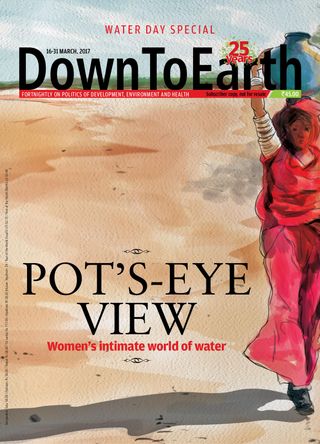

यह कहानी Down To Earth के March 16, 2017 संस्करण से ली गई है।
हजारों चुनिंदा प्रीमियम कहानियों और 10,000 से अधिक पत्रिकाओं और समाचार पत्रों तक पहुंचने के लिए मैगज़्टर गोल्ड की सदस्यता लें।
क्या आप पहले से ही ग्राहक हैं? साइन इन करें
Down To Earth से और कहानियाँ

Down To Earth
THINK TWICE BEFORE FELLING SAL TREES
Many trees considered to be affected by sal borer in the 1990s are still alive today

1 mins
February 16, 2026

Down To Earth
EDGE OF SURVIVAL
Caste divides deny marginalised communities land, resources and essential aid, leaving them more vulnerable to climate disasters
6 mins
February 16, 2026

Down To Earth
A WISH LIST?
Union Budget for 2026-27 conveys the impression of a roll-call of intentions and ambitious proposals, with little detail on their formulation
6 mins
February 16, 2026
Down To Earth
Break down the gender wall
THE RULING National Democratic Alliance (NDA) government has been heavily invested in the goal to make India a developed economy by 2047.
2 mins
February 16, 2026

Down To Earth
MENSTRUAL HEALTH, NOW A FUNDAMENTAL RIGHT
In a landmark judgement, the Supreme Court has recognised menstrual health and hygiene as a fundamental right under Article 21 of the Constitution of India, which guarantees the right to life and dignity.
8 mins
February 16, 2026

Down To Earth
Of devolution and new disasters
The 16th Finance Commission pushes for changes in view of new fiscal and climatic conditions
11 mins
February 16, 2026
Down To Earth
Rising risks of plastics
NEGATIVE IMPACTS on human health due to emissions linked to the plastic lifecycle could double by 2040, according to a study published in The Lancet Planetary Health in January.
1 min
February 16, 2026

Down To Earth
GAP BETWEEN EPIDEMICS NARROWING
A watershed-based and landscape-level approach is needed to address forest degradation
2 mins
February 16, 2026
Down To Earth
WAITING TO STRIKE
Sal heartwood borer is considered the biggest threat to forestry in India, especially to the sal tree, where it lives and breeds.
11 mins
February 16, 2026

Down To Earth
A SPRING DELIGHT
Mustard flowers are not meant only for the eyes. Invite them to your plate once in a while
3 mins
February 16, 2026
Translate
Change font size