
Go Unlimited with Magzter GOLD
Get unlimited access to 10,000+ magazines, newspapers and Premium stories for just
Try GOLD - Free
A Mountain Lost
Down To Earth
|April 01, 2019
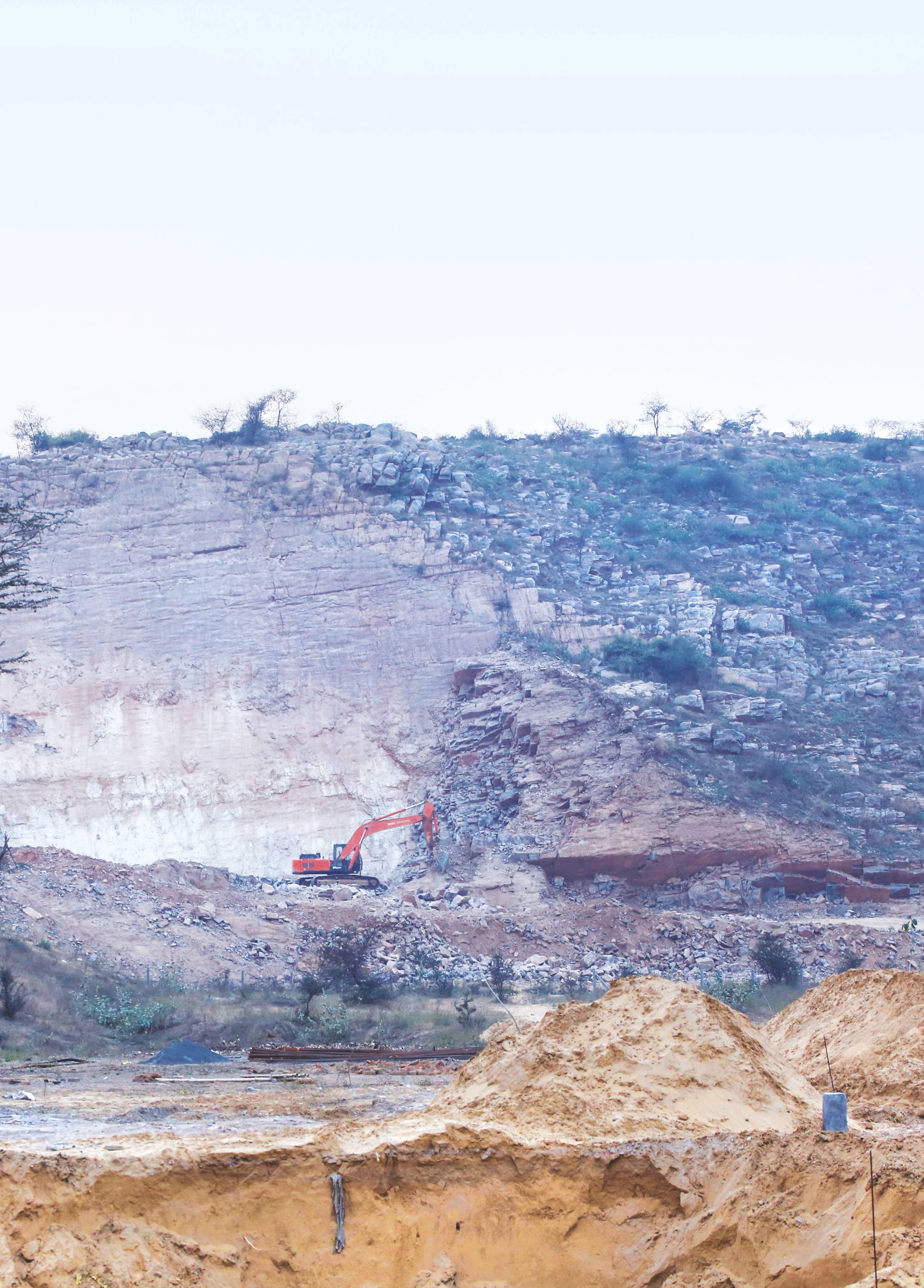
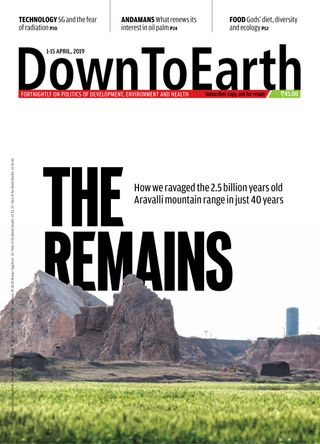
The Aravalli mountain range extends for more than 692 km from Champaner in Gujarat to Delhi and beyond. Its role in defining the shape of the Indian subcontinent and its climate, and the fact that it triggered the explosion of multicellular life, are under-appreciated. The rugged mountains guide the monsoon clouds and protect the fertile alluvial river valleys from the assault of cold westerly winds from Central Asia. However, over the past four decades, the world's oldest mountain range has been destroyed by mining, deforestation and over-exploitation of its fragile and ancient water channels

IF YOU were an alien or a space traveller some three billion years ago (it is possible to imagine this in the current political climate), the only discernible feature you would have seen—which defined the northern margins of the landmass we call India—would have been the Aravalli mountain range. It took nearly two billion years (3.2 to 1.2 billion years ago) of shoving and pushing of tectonic plates and magma outpourings to create these oldest fold mountains in the world.
Since then, these mountains have endured millions of years of sustained assault of lava flows, submergence by seas, uplift by force of gushing magma from the depths of the Earth, collision with landmasses and erosion by wind and rain. But the Aravallis now struggle to survive the greed, pettiness and the extreme short-sightedness of politicians and corporations.
Starting from its south extent, the Aravallis begin their 692 km expanse from Champaner and Palanpur in Gujarat as small denuded hills. The peaks reach their maximum height in the south-western segment, with some rising more than 1,000 m (like the 1,722 m-high Guru Shikhar near Mount Abu and hills around Udaipur). As we move north, the range begins to taper and the hills become modest. By the time the Aravallis reach Delhi, they get inundated under a swathe of young alluvium, only rising occasionally as hillocks like the Raisina Hill, upon which rest the powerful government offices, the North and South Block. The northeastern part of the Aravallis upon which Delhi sits has an average elevation of 400-600 m.

This story is from the April 01, 2019 edition of Down To Earth.
Subscribe to Magzter GOLD to access thousands of curated premium stories, and 10,000+ magazines and newspapers.
Already a subscriber? Sign In
MORE STORIES FROM Down To Earth

Down To Earth
THINK TWICE BEFORE FELLING SAL TREES
Many trees considered to be affected by sal borer in the 1990s are still alive today

1 mins
February 16, 2026

Down To Earth
EDGE OF SURVIVAL
Caste divides deny marginalised communities land, resources and essential aid, leaving them more vulnerable to climate disasters
6 mins
February 16, 2026

Down To Earth
A WISH LIST?
Union Budget for 2026-27 conveys the impression of a roll-call of intentions and ambitious proposals, with little detail on their formulation
6 mins
February 16, 2026
Down To Earth
Break down the gender wall
THE RULING National Democratic Alliance (NDA) government has been heavily invested in the goal to make India a developed economy by 2047.
2 mins
February 16, 2026

Down To Earth
MENSTRUAL HEALTH, NOW A FUNDAMENTAL RIGHT
In a landmark judgement, the Supreme Court has recognised menstrual health and hygiene as a fundamental right under Article 21 of the Constitution of India, which guarantees the right to life and dignity.
8 mins
February 16, 2026

Down To Earth
Of devolution and new disasters
The 16th Finance Commission pushes for changes in view of new fiscal and climatic conditions
11 mins
February 16, 2026
Down To Earth
Rising risks of plastics
NEGATIVE IMPACTS on human health due to emissions linked to the plastic lifecycle could double by 2040, according to a study published in The Lancet Planetary Health in January.
1 min
February 16, 2026

Down To Earth
GAP BETWEEN EPIDEMICS NARROWING
A watershed-based and landscape-level approach is needed to address forest degradation
2 mins
February 16, 2026
Down To Earth
WAITING TO STRIKE
Sal heartwood borer is considered the biggest threat to forestry in India, especially to the sal tree, where it lives and breeds.
11 mins
February 16, 2026

Down To Earth
A SPRING DELIGHT
Mustard flowers are not meant only for the eyes. Invite them to your plate once in a while
3 mins
February 16, 2026
Translate
Change font size