Intentar ORO - Gratis
A Mountain Lost
Down To Earth
|April 01, 2019
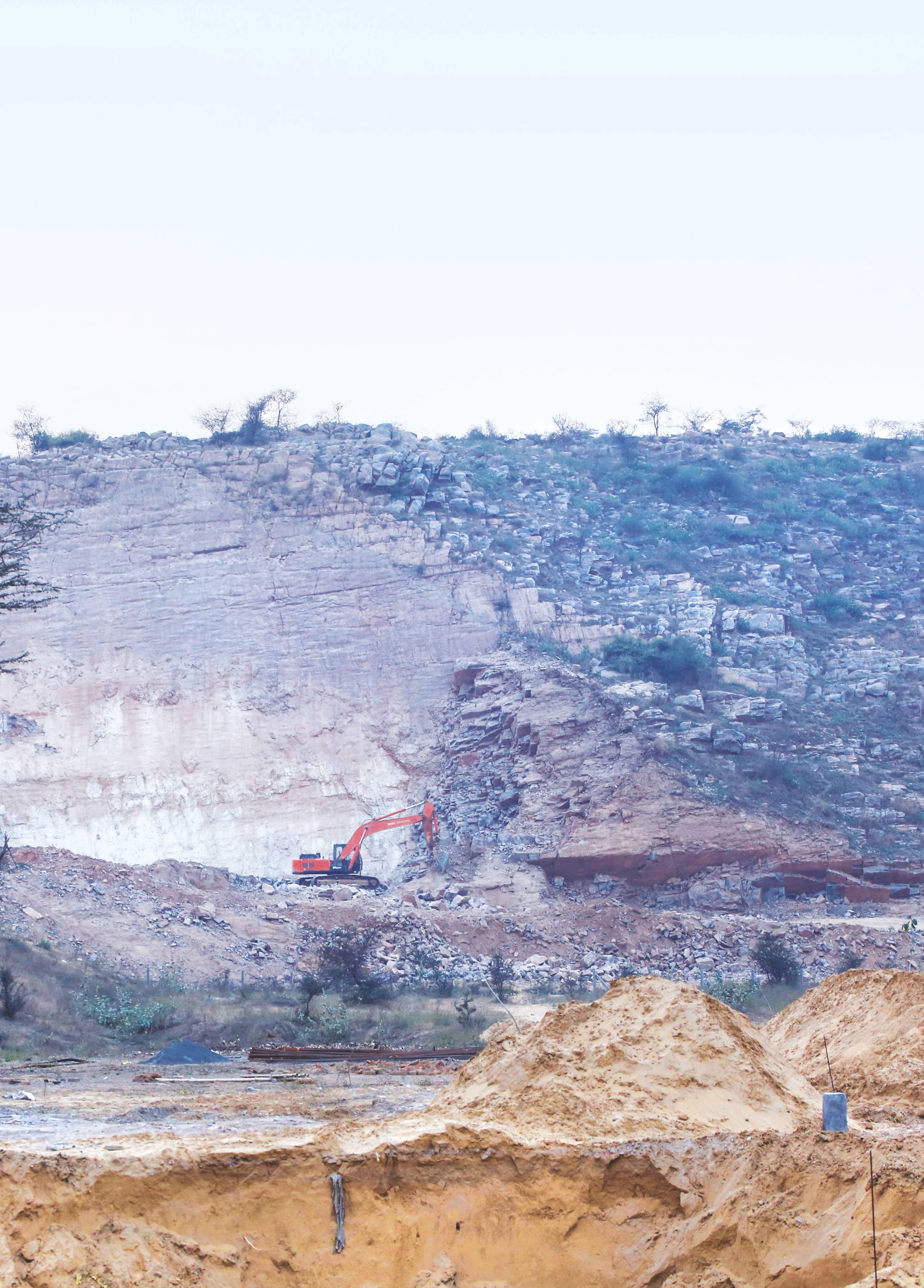
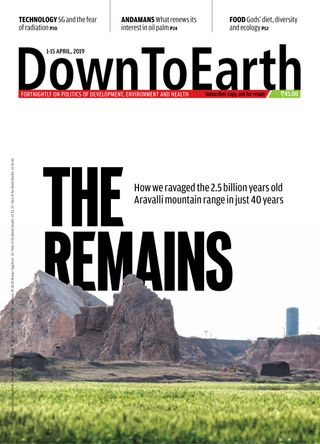
The Aravalli mountain range extends for more than 692 km from Champaner in Gujarat to Delhi and beyond. Its role in defining the shape of the Indian subcontinent and its climate, and the fact that it triggered the explosion of multicellular life, are under-appreciated. The rugged mountains guide the monsoon clouds and protect the fertile alluvial river valleys from the assault of cold westerly winds from Central Asia. However, over the past four decades, the world's oldest mountain range has been destroyed by mining, deforestation and over-exploitation of its fragile and ancient water channels

IF YOU were an alien or a space traveller some three billion years ago (it is possible to imagine this in the current political climate), the only discernible feature you would have seen—which defined the northern margins of the landmass we call India—would have been the Aravalli mountain range. It took nearly two billion years (3.2 to 1.2 billion years ago) of shoving and pushing of tectonic plates and magma outpourings to create these oldest fold mountains in the world.
Since then, these mountains have endured millions of years of sustained assault of lava flows, submergence by seas, uplift by force of gushing magma from the depths of the Earth, collision with landmasses and erosion by wind and rain. But the Aravallis now struggle to survive the greed, pettiness and the extreme short-sightedness of politicians and corporations.
Starting from its south extent, the Aravallis begin their 692 km expanse from Champaner and Palanpur in Gujarat as small denuded hills. The peaks reach their maximum height in the south-western segment, with some rising more than 1,000 m (like the 1,722 m-high Guru Shikhar near Mount Abu and hills around Udaipur). As we move north, the range begins to taper and the hills become modest. By the time the Aravallis reach Delhi, they get inundated under a swathe of young alluvium, only rising occasionally as hillocks like the Raisina Hill, upon which rest the powerful government offices, the North and South Block. The northeastern part of the Aravallis upon which Delhi sits has an average elevation of 400-600 m.

Esta historia es de la edición April 01, 2019 de Down To Earth.
Suscríbete a Magzter GOLD para acceder a miles de historias premium seleccionadas y a más de 9000 revistas y periódicos.
¿Ya eres suscriptor? Iniciar sesión
MÁS HISTORIAS DE Down To Earth
Down To Earth
Popular distrust
THE WORLD seems to be going through a period of stasis despite facing an unfathomable polycrisis.

2 mins
February 01, 2026

Down To Earth
CONSERVE OR PERISH
Periyar Tiger Reserve has rewritten Indian conservation by turning poachers into protectors and conflict into coexistence
5 mins
February 01, 2026

Down To Earth
'Rivers need to run free'
From Tibet to West Bengal, the Brahmaputra is the pulse of communities and ecosystems along its course. But what are the risks the river faces through human interventions, particularly dams, discusses journalist, author and filmmaker SANJOY HAZARIKA in his new book, River Traveller.
4 mins
February 01, 2026

Down To Earth
India is facing up to its innovation lag
There are signs now that India is acknowledging the superior strides made by China in a frontier technology like Al
4 mins
February 01, 2026

Down To Earth
Competing concerns
What are the repercussions of the EU-Mercosur pact that have made European farmers protest against the free trade agreement?
4 mins
February 01, 2026

Down To Earth
From fryer to flight
Sustainable fuel made from used cooking oil can play a pivotal role in helping India achieve its aviation emission reduction goals. Measures to collect this oil must be revamped
4 mins
February 01, 2026

Down To Earth
ACCESS OPEN
An amendment to India's nodal forest conservation law opens up forests across India to commercial exploitation by the paper industry
6 mins
February 01, 2026
Down To Earth
DRINK FROM TAP CAN BE A REALITY
As cities across India struggle to supply safe piped water, Odisha offers a success story
2 mins
February 01, 2026
Down To Earth
GREAT DRYING
The Earth is hotter than at any point in the past 100,000 years, with 2023-25 becoming the warmest three-year period on record and also breaching the 1.5°C threshold for the first time. One fallout is dwindling freshwater.
22 mins
February 01, 2026

Down To Earth
Green redemption
Restoration of grasslands of Kerala's Pampadum Shola National Park, once dominated by invasive Australian wattles, see a return of streams and native species
1 mins
February 01, 2026
Translate
Change font size