
Go Unlimited with Magzter GOLD
Get unlimited access to 10,000+ magazines, newspapers and Premium stories for just
Try GOLD - Free
Leadership From The Heart
Heartfulness eMagazine
|November 2019
PRAKASH SESHADRI takes the reader from survival mode to a mature leadership model, by sharpening Emotional and Spiritual Quotients through the practices of meditation, introspection and inquiry.
-

Challenges to Graduating Up the Competency Spectrum
Why is that some people do not learn fast, and what stops them? I was reading an interesting article recently, in which it was suggested that everyone in the world who has ever been born or will be born has the same hardware as Albert Einstein or Newton, and our brains are also wired in a similar manner. Einstein could achieve so much in his lifetime, but most of us are ineffective though we have the same set of capabilities. What is the difference? For hardware to work efficiently we need software and unfortunately, people are never taught how to build it. I may buy readymade Windows or Mac software and install it, and it works. But how do I write my own code, build my own operating system, or write my own app? These are the biggest challenges. Today we cannot build our own software because we are not inquisitive; we have lost the ability to ask questions. Every question you ask can be replaced by a higher level of questioning, which will expand your consciousness, your state of being and your awareness.
The second biggest challenge is to look within and introspect, and we do not make the time to do so, we have lost the art of introspection. Looking within with distractions is very different from looking within without distractions. So it brings us back to the competency model. We need to develop these tools. Like the Lion and the Deer story, we humans are also busy with our survival, and we do not have the time to hit the pause button, to spend time asking questions, and to introspect. In fact, 99.99% of the time many of us are in perennial survival mode. Realizing that is the first step: we are moving from Unconscious Incompetence to Conscious Incompetency mode.
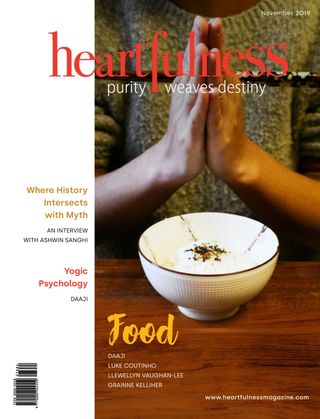

This story is from the November 2019 edition of Heartfulness eMagazine.
Subscribe to Magzter GOLD to access thousands of curated premium stories, and 10,000+ magazines and newspapers.
Already a subscriber? Sign In
MORE STORIES FROM Heartfulness eMagazine

Heartfulness eMagazine
A Touch of Heaven
Irish singer and teacher, EILISH BUTLER, combines the mystical chant of Saint Hildegard von Bingen (1098-1176) with the evolutionary path of Uncovering the Voice, satisfying her passion for mystical spirituality and music.

2 mins
November 2025

Heartfulness eMagazine
FROM INNER STILLNESS TO OUTER AGENCY:
How Heartfulness Builds an Internal Locus of Control and Workplace Success
3 mins
November 2025

Heartfulness eMagazine
Virtual Intelligence
Author and cultural commentator CHARLES EISENSTEIN extends last month's argument about virtual substitutes hollowing out reality-this time to Al's imitation of intimacy-and points to what only embodied relationships can restore.
10 mins
November 2025

Heartfulness eMagazine
Grace Is the Creative Spark
Do you sometimes feel that life is blessed and things are unfolding effortlessly, without force or struggle? Some people say it is because of “grace” or “God’s grace.
5 mins
November 2025
Heartfulness eMagazine
Zuri's Guiding Light
A luminous fable from LIAA KUMAR on self-trust, belonging, and inner guidance.
3 mins
November 2025

Heartfulness eMagazine
I AM
In a quiet meditation on desire, stillness, and the witnessing Self, JARNA KHIMANI traces the shift from seeking to being.
3 mins
November 2025

Heartfulness eMagazine
Courage: From Relief to Presence
JASON NUTTING on why relief is temporary-and how courage, rooted in the heart, endures.
3 mins
November 2025

Heartfulness eMagazine
Embracing The Value Within
DR. ROXANNE M. ST. CLAIR on seeing the value in you—and in others—and making it a daily practice.
4 mins
November 2025
Heartfulness eMagazine
Gratitude's Gift
A Creston woman recently recounted her experience in a checkout line.
2 mins
November 2025

Heartfulness eMagazine
HAPPINESS and Gut Health
Q: How does gut health influence mental well-being, and can practices like meditation actively support a healthier digestive system? The gut is often called the second brain because it has over 500 million neurons that constantly talk to the brain through the vagus nerve.
2 mins
November 2025
Translate
Change font size