Try GOLD - Free
Akhand Path
Outlook
|November 18, 2019
From the earliest days of the Gurus through the zenith of Ranjit Singh’s empire, the colonial era and as part of the mosaic of an independent India, Sikhs have always hewed close to a proudly distinct identity and culture

THE Sikhs today are a people with a distinct identity and culture with their holy places spread all over India—the historic India bounded on one side by the Himalayas, and on the other, the Indian Ocean. The largest concentration of their holy places is in what Akbar called the land of the five rivers, which today is divided between India and Pakistan. The influence of the Sikh Gurus, especially of Guru Nanak Devji, was considerable over the entire territory, whose eastern border was broadly marked by the river Yamuna. It spread in the region between the foothills in the north, the marshes of the Indus river in the south, and the desert in the south-west. In the years when the British ruled India this was the land of Punjab and Sind, with Delhi being its southern-most town.
The Sikhs were recognised as a distinct group of people in India by the colonial government from the earliest times. Even before Maharaja Ranjit Singh had established the Khalsa Raj at Lahore, English visitors to India had remarked on Sikhs being distinct from all other social groups in India.
Ranjit Singh’s rule ensured that the identity of the Sikhs as rulers of Punjab was set. They were also known to be skilled at battle and adept at dealing even with powers that were much stronger than them. A short history of Ranjit Singh that was reported in the Delhi Gazette on the eve of the British invasion of Afghanistan in 1838 is most instructive about the special qualities of the Sikhs that the British were noticing. Wrote the
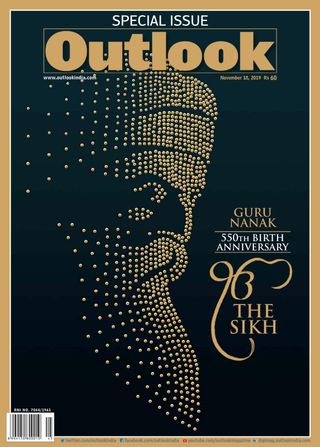

This story is from the November 18, 2019 edition of Outlook.
Subscribe to Magzter GOLD to access thousands of curated premium stories, and 10,000+ magazines and newspapers.
Already a subscriber? Sign In
MORE STORIES FROM Outlook
Outlook
Joy Words Club
Lit fests are defined by their audience. Organisers, speakers, curators are all replaceable but not the readers, not the audience

4 mins
February 01, 2026

Outlook
The Sting of the Bar
India today has more than 4.3 lakh undertrial prisoners. A significant number of them are linked to political cases
8 mins
February 01, 2026
Outlook
The Dispossessed
The systematic creation of criminal and security legislations view Adivasis as an inherently suspect class of criminals and terrorists
8 mins
February 01, 2026

Outlook
The Hypocrisy of Liberals
Favour of the self-proclaimed 'liberals' is lost the minute religion intervenes
5 mins
February 01, 2026
Outlook
Inside the Phansi Yard
Death row intensifies the structured brutalities of the penal system and reminds us why the struggle against the death penalty must also include the fact of prison violence
9 mins
February 01, 2026
Outlook
The Detention Legacy
Since Independence, a number of laws have been enacted that allow preventive detention which have been widely used by all regimes against their political opponents
7 mins
February 01, 2026
Outlook
“This Could Happen to You
The Bhima Koregaon case is not only about those who were imprisoned. It is also about the fate of democracy itself
8 mins
February 01, 2026
Outlook
"I Remember Swinging Between Hope and Despair"
HOPE and despair are basic human emotions and I believe that all human beings, now and then, swing between these two ends of the spectrum in life.
2 mins
February 01, 2026

Outlook
Think Ink
In 2026-the 'year of analog'-how will our relationship with literary festivals evolve?
6 mins
February 01, 2026

Outlook
Who Stole My Youth?
A Delhi district court granted Mohammad Iqbal bail in the riots case within three months. On March 18, 2025, he was discharged in the Babbu murder case, even as the riots trial continues
6 mins
February 01, 2026
Translate
Change font size