
Passez à l'illimité avec Magzter GOLD
Obtenez un accès illimité à plus de 9 000 magazines, journaux et articles Premium pour seulement
Essayer OR - Gratuit
Akhand Path
Outlook
|November 18, 2019
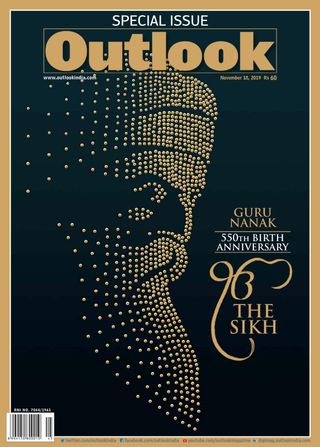
From the earliest days of the Gurus through the zenith of Ranjit Singh’s empire, the colonial era and as part of the mosaic of an independent India, Sikhs have always hewed close to a proudly distinct identity and culture

THE Sikhs today are a people with a distinct identity and culture with their holy places spread all over India—the historic India bounded on one side by the Himalayas, and on the other, the Indian Ocean. The largest concentration of their holy places is in what Akbar called the land of the five rivers, which today is divided between India and Pakistan. The influence of the Sikh Gurus, especially of Guru Nanak Devji, was considerable over the entire territory, whose eastern border was broadly marked by the river Yamuna. It spread in the region between the foothills in the north, the marshes of the Indus river in the south, and the desert in the south-west. In the years when the British ruled India this was the land of Punjab and Sind, with Delhi being its southern-most town.
The Sikhs were recognised as a distinct group of people in India by the colonial government from the earliest times. Even before Maharaja Ranjit Singh had established the Khalsa Raj at Lahore, English visitors to India had remarked on Sikhs being distinct from all other social groups in India.
Ranjit Singh’s rule ensured that the identity of the Sikhs as rulers of Punjab was set. They were also known to be skilled at battle and adept at dealing even with powers that were much stronger than them. A short history of Ranjit Singh that was reported in the Delhi Gazette on the eve of the British invasion of Afghanistan in 1838 is most instructive about the special qualities of the Sikhs that the British were noticing. Wrote the

Cette histoire est tirée de l'édition November 18, 2019 de Outlook.
Abonnez-vous à Magzter GOLD pour accéder à des milliers d'histoires premium sélectionnées et à plus de 9 000 magazines et journaux.
Déjà abonné ? Se connecter
PLUS D'HISTOIRES DE Outlook

Outlook
'Why GDP Growth Doesn't Always Translate Into Votes'
The recent election results have once again shown that economic growth alone does not guarantee electoral victory.

3 mins
June 06, 2026

Outlook
Lights, Camera, Othering
The establishment of Israel has been accompanied by a national cinema devoted to negating and erasing the Palestinian Other
5 mins
June 06, 2026

Outlook
Goodbye to All That
Booker-winning British author Julian Barnes' Departure(s) is a unique hybrid work: playful, philosophical, whimsical
4 mins
June 06, 2026

Outlook
Collapse of Trust
As the NEET-UG 2026 paper leak forced the cancellation of India’s biggest medical entrance exam, more than 22 lakh aspirants find themselves trapped in uncertainty
11 mins
June 06, 2026

Outlook
NO LONGER A TWELFTH MAN
Bihar cricket, which has languished in the shadows for long, is all set to improve its strike rate, thanks to Vaibhav Sooryavanshi, the new Bihari kid on the block
5 mins
June 06, 2026

Outlook
BLAZE OF GLORY
The challenges of being a celebrity cricketer at a young age can be tough to handle
5 mins
June 06, 2026

Outlook
THE SWASHBUCKLERS
A new generation of fearless stars is emerging and finding its feet at the very top of an extremely competitive cricketing environment
5 mins
June 06, 2026

Outlook
THE TEEN TORNAD
At the age of 15, Vaibhav Sooryavanshi is already a cricketing legend
10 mins
June 06, 2026

Outlook
A Journey to Remember
The prerecorded message crackled over the din in the compartment: ‘Welcome to the Shatabdi Express.
4 mins
June 06, 2026

Outlook
Crossing Borders
Ruth Martin is the translator of German-Iranian author Shida Bazyar’s novel The Nights are Quiet in Tehran (originally written in German), which has been shortlisted for the 2026 International Booker Prize.
4 mins
June 06, 2026
Translate
Change font size