
Go Unlimited with Magzter GOLD
Get unlimited access to 10,000+ magazines, newspapers and Premium stories for just
Try GOLD - Free
Speed trap
Racecar Engineering
|February 2021
Making the current IndyCar both look fast and hit its performance targets was a delicate balance of engineering and aesthetics

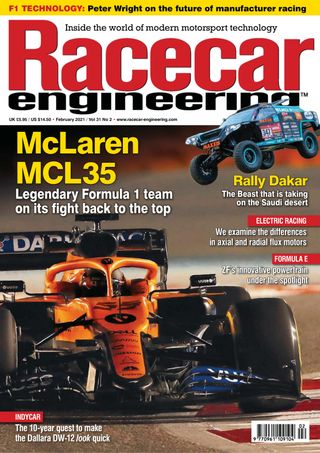
There had been several runners in the race to land the 2012 IndyCar chassis supplier contract, including concepts from Reynard, Lola and Swift. The extraordinary looking Delta Wing was also in the mix for a while, but was perhaps a step too far out of the traditional comfort zone for some. But in July of 2010, IndyCar announced that Italian racecar manufacturer, Dallara, had been awarded the contract to replace the series’ ageing IR-5 chassis with a new vehicle titled the IR-12.
Dallara had been sole supplier of chassis to IndyCar since 2007 with the IR-5, which was a development of the IR-3 and had become the weapon of choice for teams, pushing out Panoz at the end of the 2006 season.
The IR-5 served the series well but, as always in motorsport, there was a need to progress and further enhance driver safety. IndyCar’s intent was to produce a next-generation safety cell, drawing on Dallara’s extensive experience in the series, and the wider racing industry. The chassis was designed to allow the upper surfaces of the car to be swapped for updated parts as both Dallara and IndyCar refined the aero package.
Dallara worked with IndyCar legend, Dan Wheldon, while testing the IR-12, with Wheldon providing invaluable feedback to the engineers and designers refining the car ready for manufacture and customer delivery. Such was Wheldon’s contribution, it was named the DW12 in his honour following the Las Vegas accident that cost Wheldon his life and rocked the sport to its core.

This story is from the February 2021 edition of Racecar Engineering.
Subscribe to Magzter GOLD to access thousands of curated premium stories, and 10,000+ magazines and newspapers.
Already a subscriber? Sign In
MORE STORIES FROM Racecar Engineering

Racecar Engineering
Talk the torque
More thoughts on in-wheel motors and their effects on twisting force

6 mins
December 2021

Racecar Engineering
Rolling about
An explanation of the limitations of a previous load transfer article, bringing jacking forces into the mix
5 mins
December 2021

Racecar Engineering
F1 breaks schedule records
The FIA has confirmed no fewer than 23 races on the 2022 Formula 1 World Championship schedule, the highest number of grands prix ever to be held in a single season, and that has led to criticism from some teams that will be on the road for eight months.
1 mins
December 2021

Racecar Engineering
Under pressure
Toyota may have finished first and second at Le Mans this year, but the effort required to overcome a fuel delivery problem and finish with both cars was Herculean
12 mins
December 2021
Racecar Engineering
Physics at work
Dutch company, Intrax, offers Racecar Engineering an insight into the technologies it employs to optimise its suspension products
4 mins
December 2021

Racecar Engineering
Williams' 2030 ambition
Williams Racing has committed to becoming climate positive by 2030 as part of an all-new sustainability strategy.
1 min
December 2021

Racecar Engineering
Diff'rent strokes
Racecar looks at the different types of mechanical differential, their benefits and limitations
14 mins
December 2021

Racecar Engineering
Das Boot
A curious Twitter exchange fired up a unique, hydrogen-powered, cross-country project that will contest the Baja 1000 in November 2022
8 mins
December 2021

Racecar Engineering
Air born
Every racecar engineer's dream is a blank sheet of paper design. When Hoonigan and Subaru approached Vermont Sportscars about building the next generation of Gymkhana racer, that's just what the company was given
8 mins
December 2021
Racecar Engineering
Remote control
Called variously ‘virtual garages’, ‘mission control’ or ‘race support rooms’ is the future of race engineering sitting in the warm back at HQ?
14 mins
December 2021
Translate
Change font size