
Go Unlimited with Magzter GOLD
Get unlimited access to 10,000+ magazines, newspapers and Premium stories for just
Making Sense Of Sensors
Racecar Engineering
|Anatomy of a Racecar
Modern racecar engineering is data-driven, which means a car needs to be fitted with an array of durable, light and – most importantly – accurate sensors to tell the team what’s happening to it out on the race track. But how do these hi-tech devices work and what exactly do they do?

A wide spectrum of sensory equipment has seen industrial application for centuries, yet in motorsport there have been many engineering obstacles that have proved tricky to overcome. With desires to keep weight to a minimum, increasingly small package spaces and extreme NVH (noise, vibration, and harshness) conditions, achieving the high level of accuracy required has been very difficult.
Also, as electronically controlled automotive systems proliferated, so did the requirements of measurement and control engineering. But advances in manufacturing technologies, materials understanding, and electronic sophistication, at the same time edged sensor technology towards the refinement levels necessary. The most notable advancement was with the introduction of electronic powertrain control systems – electronic ignition, electronic fuel injection, electronic throttle actuation, wheel speed sensors, crank position sensors, fuel pressure regulators, etc. These were all innovations led by the advancement of sensor technology – and look at what they have done to the internal combustion engine in terms of fuel efficiency and power density.
The proliferation of sensor technology didn’t stop at the powertrain, though, especially with racecars where understanding the physical events happening around the vehicle is crucial in the drive to master the art. And so mechanical servos, pumps, and solenoids are operated with closed-loop feedback from position sensors, temperature sensors, pressure sensors, and accelerometers – assisting in the automation of functions to a level only dreamed of by engineers as little as 20 years ago.
Sensor sensibility
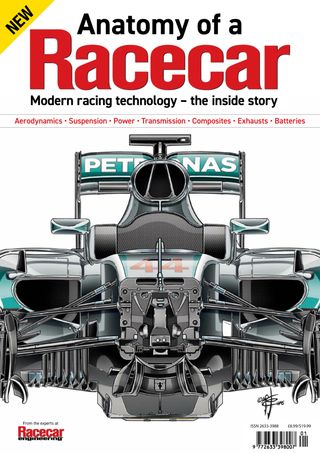

This story is from the Anatomy of a Racecar edition of Racecar Engineering.
Subscribe to Magzter GOLD to access thousands of curated premium stories, and 10,000+ magazines and newspapers.
Already a subscriber? Sign In
MORE STORIES FROM Racecar Engineering

Racecar Engineering
Talk the torque
More thoughts on in-wheel motors and their effects on twisting force

6 mins
December 2021

Racecar Engineering
Rolling about
An explanation of the limitations of a previous load transfer article, bringing jacking forces into the mix
5 mins
December 2021

Racecar Engineering
F1 breaks schedule records
The FIA has confirmed no fewer than 23 races on the 2022 Formula 1 World Championship schedule, the highest number of grands prix ever to be held in a single season, and that has led to criticism from some teams that will be on the road for eight months.
1 mins
December 2021

Racecar Engineering
Under pressure
Toyota may have finished first and second at Le Mans this year, but the effort required to overcome a fuel delivery problem and finish with both cars was Herculean
12 mins
December 2021

Racecar Engineering
Physics at work
Dutch company, Intrax, offers Racecar Engineering an insight into the technologies it employs to optimise its suspension products
4 mins
December 2021

Racecar Engineering
Williams' 2030 ambition
Williams Racing has committed to becoming climate positive by 2030 as part of an all-new sustainability strategy.
1 min
December 2021

Racecar Engineering
Diff'rent strokes
Racecar looks at the different types of mechanical differential, their benefits and limitations
14 mins
December 2021

Racecar Engineering
Das Boot
A curious Twitter exchange fired up a unique, hydrogen-powered, cross-country project that will contest the Baja 1000 in November 2022
8 mins
December 2021

Racecar Engineering
Air born
Every racecar engineer's dream is a blank sheet of paper design. When Hoonigan and Subaru approached Vermont Sportscars about building the next generation of Gymkhana racer, that's just what the company was given
8 mins
December 2021

Racecar Engineering
Remote control
Called variously ‘virtual garages’, ‘mission control’ or ‘race support rooms’ is the future of race engineering sitting in the warm back at HQ?
14 mins
December 2021
Translate
Change font size