
Mit Magzter GOLD unbegrenztes Potenzial nutzen
Erhalten Sie unbegrenzten Zugriff auf über 9.000 Zeitschriften, Zeitungen und Premium-Artikel für nur
Versuchen GOLD - Frei
A Dangerous Silver Bullet
Scientific American
|October 2025
Drugs that hit an Alzheimer's target are gaining traction. Some neurologists remain dubious
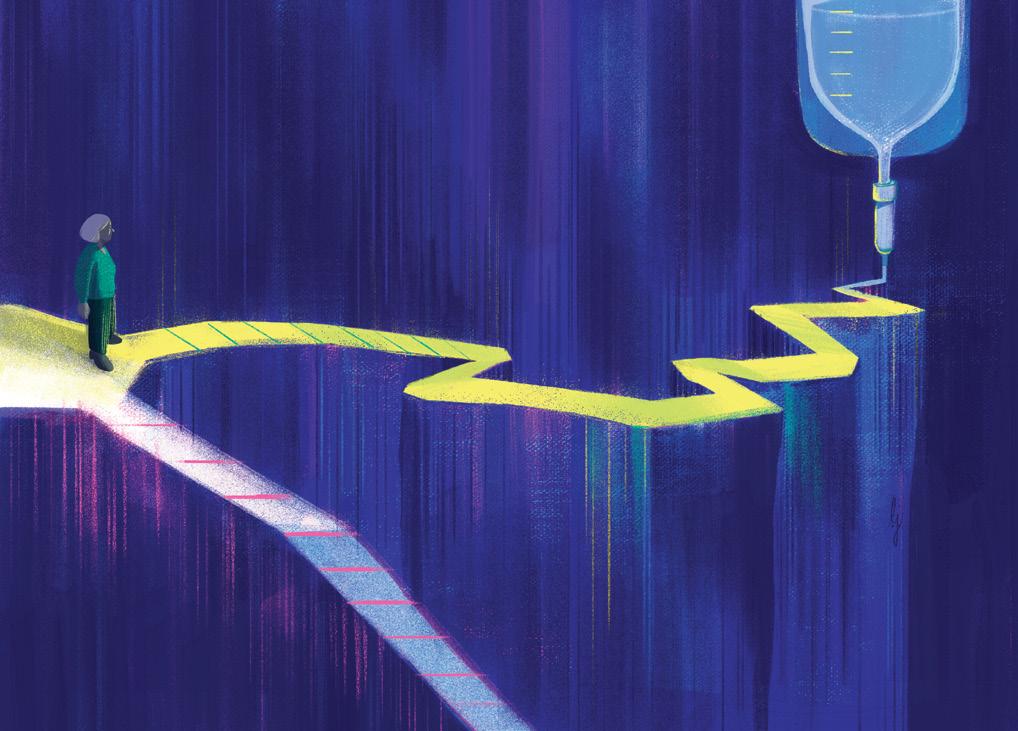
ONE OF NEUROLOGIST Anelyssa D’Abreu’s least favorite tasks is giving her patients a dreaded diagnosis: early-stage Alzheimer’s disease. But it’s not quite as bad as it used to be. Today when they ask, “Is there anything we can do?” D’Abreu has a new answer: “Perhaps.”
Unlike a decade ago, when D’Abreu had little to offer her patients with Alzheimer’s, there are now drugs that may impede the disease’s progression. The difficulty with this approach, however, is that it comes with a trade-off. The new medications carry the risk of serious side effects, including brain bleeds, stroke-like symptoms and even death. Yet they also come with hope, something new for Alzheimer’s patients and their families.
Drugs in this class, known as anti-amyloid therapies, have not gained much traction. In limited studies, they have been shown to slow or even decrease one of the biological symptoms of Alzheimer’s: the accumulation of amyloid beta in the brain. Nearly four dozen studies on these drugs have been conducted since 2018, and collectively they indicate that anti-amyloid therapies may marginally reduce the rate of cognitive decline. Some experts say that could offer perhaps an additional year of independence. But the clinical trials completed to date rely on only 18 months’ worth of published data, and their success has been tempered by the drugs’ significant downsides. Additionally, the framing of these drugs’ success has come under criticism.
D’Abreu, who heads the University of Virginia neurology department's cognitive and behavioral neurology division, was initially apprehensive about offering antiamyloid treatments to her patients with early-stage Alzheimer’s.

Diese Geschichte stammt aus der October 2025-Ausgabe von Scientific American.
Abonnieren Sie Magzter GOLD, um auf Tausende kuratierter Premium-Geschichten und über 9.000 Zeitschriften und Zeitungen zuzugreifen.
Sie sind bereits Abonnent? Anmelden
WEITERE GESCHICHTEN VON Scientific American

Scientific American
50, 100 & 150 Years
NATURAL FISSION REACTOR

3 mins
July/August 2026

Scientific American
A Youthful Illusion Sharpens Memory
By making people feel as if their face is a younger version of itself, researchers can bring childhood memories into sharper focus
4 mins
July/August 2026

Scientific American
BRAIN DRAIN
Dozens of countries are trying to convince disaffected American scientists to move there permanently—and plenty of young researchers are eager to go
10 mins
July/August 2026

Scientific American
The Youth American Scientists - Xiao Yang
Improving brain-machine interfaces to make them more resilient
1 mins
July/August 2026

Scientific American
The Youth American Scientists - Emily Finn
Studying why people interpret the same thing in different ways
1 mins
July/August 2026

Scientific American
The Youth American Scientists - Jaye Gardiner
Learning how the matrix around cells and tissues impacts cancers
1 mins
July/August 2026

Scientific American
The Youth American Scientists - Mikhail Kolmogorov
Developing software to reveal large genetic changes that lead to cancer
1 mins
July/August 2026

Scientific American
How to Fix Science
The federal funding system for scientific research in the U.S. needs reform
9 mins
July/August 2026

Scientific American
On Our Radar
These young scientists are making waves in their own ways. Keep an eye on them—great things are ahead
2 mins
July/August 2026

Scientific American
Journey to Titan
Inside NASA’s Dragonfly mission to Saturn’s largest moon
5 mins
July/August 2026
Listen
Translate
Change font size