Essayer OR - Gratuit
A Dangerous Silver Bullet
Scientific American
|October 2025
Drugs that hit an Alzheimer's target are gaining traction. Some neurologists remain dubious
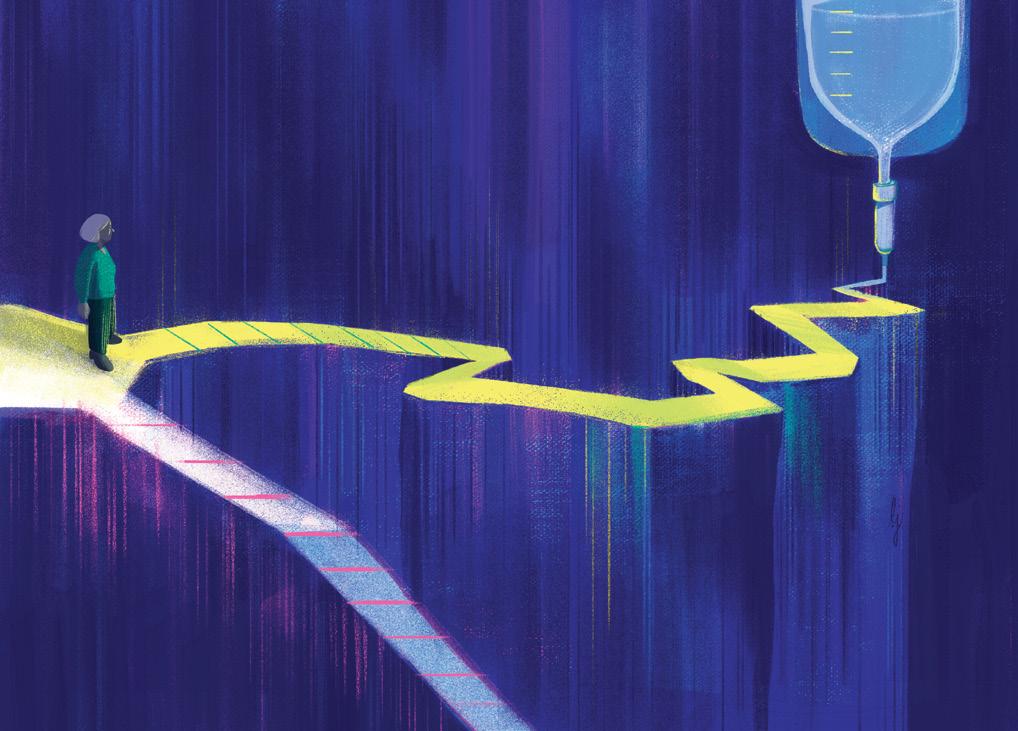
ONE OF NEUROLOGIST Anelyssa D’Abreu’s least favorite tasks is giving her patients a dreaded diagnosis: early-stage Alzheimer’s disease. But it’s not quite as bad as it used to be. Today when they ask, “Is there anything we can do?” D’Abreu has a new answer: “Perhaps.”
Unlike a decade ago, when D’Abreu had little to offer her patients with Alzheimer’s, there are now drugs that may impede the disease’s progression. The difficulty with this approach, however, is that it comes with a trade-off. The new medications carry the risk of serious side effects, including brain bleeds, stroke-like symptoms and even death. Yet they also come with hope, something new for Alzheimer’s patients and their families.
Drugs in this class, known as anti-amyloid therapies, have not gained much traction. In limited studies, they have been shown to slow or even decrease one of the biological symptoms of Alzheimer’s: the accumulation of amyloid beta in the brain. Nearly four dozen studies on these drugs have been conducted since 2018, and collectively they indicate that anti-amyloid therapies may marginally reduce the rate of cognitive decline. Some experts say that could offer perhaps an additional year of independence. But the clinical trials completed to date rely on only 18 months’ worth of published data, and their success has been tempered by the drugs’ significant downsides. Additionally, the framing of these drugs’ success has come under criticism.
D’Abreu, who heads the University of Virginia neurology department's cognitive and behavioral neurology division, was initially apprehensive about offering antiamyloid treatments to her patients with early-stage Alzheimer’s.

Cette histoire est tirée de l'édition October 2025 de Scientific American.
Abonnez-vous à Magzter GOLD pour accéder à des milliers d'histoires premium sélectionnées et à plus de 9 000 magazines et journaux.
Déjà abonné ? Se connecter
PLUS D'HISTOIRES DE Scientific American

Scientific American
The Quiet Math Problem That Runs the Planet
How Diffie-Hellman key exchange secures everything from your text messages to government secrets

7 mins
May 2026

Scientific American
The Fog of Science
Did an adversary just invent a world-changing weapon, or are they making it up? DARPA is building an AI to instantly call their bluff
4 mins
May 2026

Scientific American
The Hubble Space Telescope Is Still Awesome
Hubble is going strong despite its decades in space and next-generation successors
4 mins
May 2026

Scientific American
Meet America's Native Bees
Scientists estimate there are about 4,000 species of native bees in the U.S.
5 mins
May 2026

Scientific American
The Chemistry of Desire
Inside the secretive laboratories where scientists build novel molecules to make luxury fragrance feel like pure emotion
5 mins
May 2026

Scientific American
Scanning the Stone
As ore gets harder to find, the mining industry is turning to subatomic-particle sensors to push deep underground
8 mins
May 2026

Scientific American
YOUR HEART IN FLAMES
Inflammation may be the true cause of cardiovascular diseaseand there's a drug to treat it
13 mins
May 2026

Scientific American
Ancient Lexicon
Stone Age art may reveal a 40,000-year-old precursor to writing
2 mins
May 2026

Scientific American
Thermal Breakthrough
A new super heat conductor challenges fundamental physics
2 mins
May 2026

Scientific American
How to Vacation in Space
Planned orbital hotels promise luxury, but can they deliver?
4 mins
May 2026
Listen
Translate
Change font size