
Mit Magzter GOLD unbegrenztes Potenzial nutzen
Erhalten Sie unbegrenzten Zugriff auf über 9.000 Zeitschriften, Zeitungen und Premium-Artikel für nur
Versuchen GOLD - Frei
BRAIN DRAIN
Scientific American
|July/August 2026
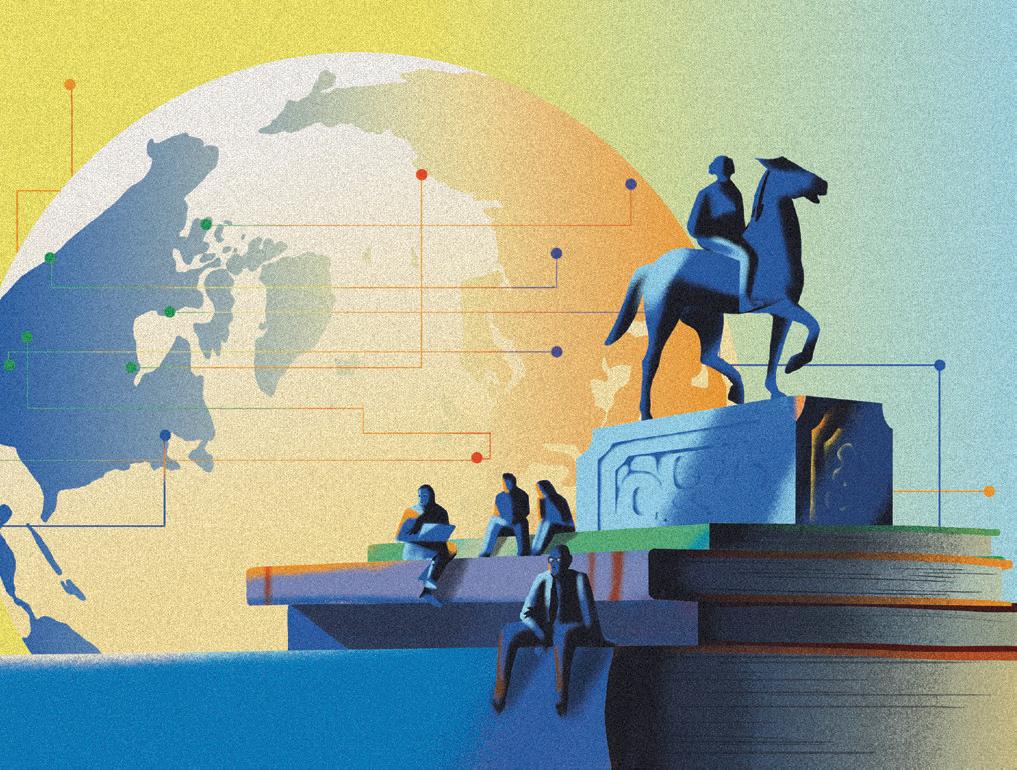
Dozens of countries are trying to convince disaffected American scientists to move there permanently—and plenty of young researchers are eager to go
BY DAY AMERICAN PHYSICIST KENNETH LONG WORKS WITH the world's largest particle accelerator, the Large Hadron Collider at CERN near Geneva.
He wants to better understand the W boson, a subatomic particle that is responsible for some kinds of radioactivity and for fusion. But he also likes bikes, and this July you might find him on a scenic roadside, cheering on competitors in the Tour de France. He won't have to take an international flight to spectate: Long moved abroad in February, splitting time between Lyon and Geneva as a scientist with the French National Center for Scientific Research (CNRS).
Long was brought to France by a recruitment program called Choose CNRS. The organization launched it last April, a few months after the Trump administration began cutting scientific programs in the U.S. The initiative aims to lure foreign researchers to Europe with stable positions, generous funding and promises of academic freedom. For many scientists from the U.S., programs like this one are a lifeline: a way to pursue world-class research without fighting against the funding cuts and disruptive policies currently stifling American science.
According to polls, application numbers and anecdata, many young American scientists are considering such moves. Three quarters of U.S. researchers who responded to a Nature poll conducted last March were thinking about moving abroad. The trend was especially apparent among early-career scientists: of the 690 postdocs and 340 Ph.D. students who responded, 803 said they were considering sailing for other shores.
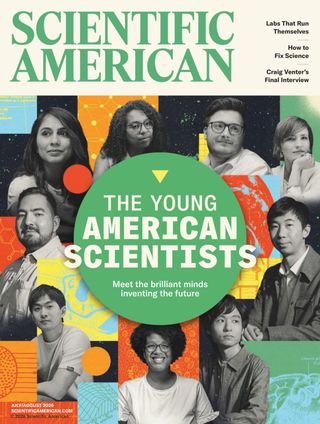

Diese Geschichte stammt aus der July/August 2026-Ausgabe von Scientific American.
Abonnieren Sie Magzter GOLD, um auf Tausende kuratierter Premium-Geschichten und über 9.000 Zeitschriften und Zeitungen zuzugreifen.
Sie sind bereits Abonnent? Anmelden
WEITERE GESCHICHTEN VON Scientific American

Scientific American
50, 100 & 150 Years
NATURAL FISSION REACTOR

3 mins
July/August 2026

Scientific American
A Youthful Illusion Sharpens Memory
By making people feel as if their face is a younger version of itself, researchers can bring childhood memories into sharper focus
4 mins
July/August 2026

Scientific American
BRAIN DRAIN
Dozens of countries are trying to convince disaffected American scientists to move there permanently—and plenty of young researchers are eager to go
10 mins
July/August 2026

Scientific American
The Youth American Scientists - Xiao Yang
Improving brain-machine interfaces to make them more resilient
1 mins
July/August 2026

Scientific American
The Youth American Scientists - Emily Finn
Studying why people interpret the same thing in different ways
1 mins
July/August 2026

Scientific American
The Youth American Scientists - Jaye Gardiner
Learning how the matrix around cells and tissues impacts cancers
1 mins
July/August 2026

Scientific American
The Youth American Scientists - Mikhail Kolmogorov
Developing software to reveal large genetic changes that lead to cancer
1 mins
July/August 2026

Scientific American
How to Fix Science
The federal funding system for scientific research in the U.S. needs reform
9 mins
July/August 2026
Scientific American
On Our Radar
These young scientists are making waves in their own ways. Keep an eye on them—great things are ahead
2 mins
July/August 2026
Scientific American
Journey to Titan
Inside NASA’s Dragonfly mission to Saturn’s largest moon
5 mins
July/August 2026
Listen
Translate
Change font size