Versuchen GOLD - Frei
Avoiding Harm in Technology Innovation
MIT Sloan Management Review
|Fall 2024
To capitalize on emerging technologies while mitigating unanticipated consequences, innovation managers need to establish a systematic review process.

ADVANCES IN SCIENCE AND TECHnology promise to solve some of the world's most vexing problems, create new markets, and fuel economic growth. At the same time, they often raise ethical questions, and their deployment may lead to unanticipated adverse consequences that many companies are ill-equipped to identify or address.
For example, technology that enables the editing of human DNA is leading to new medical treatments, but the practice is also rife with unintended consequences. In 2018, an ambitious researcher in China ignored both the norms of the field and the law and altered human embryos' genetic material in an effort to confer resistance to HIV. The changes he made to the embryos' genes may be passed down to future generations, and their effects on human development are unknown.¹
Failure to fully consider possible outcomes when deciding whether and how to develop any technology can lead to negative consequences for companies, customers, and other stakeholders. In a 2024 case involving an AI chatbot, Air Canada's enthusiasm for automated customer service ran ahead of its understanding of the significant limitations of generative AI when it comes to accuracy of output. It fielded a chatbot that misrepresented company policy on bereavement rates in response to a customer inquiry and then denied the customer reimbursement because they did not follow the policy, refusing to take responsibility for providing bad information. When the customer sued and won, the headlines did little to burnish Air Canada's reputation for customer service.
When considering new developments that are truly at the forefront of applied science and technology, innovators are usually well ahead of regulations that might provide guardrails around commercialization decisions. So how do they decide when to proceed and when to hold back on releasing a new technology into the world?
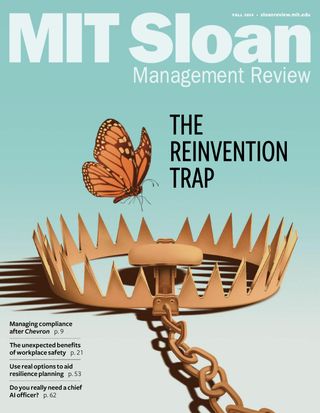

Diese Geschichte stammt aus der Fall 2024-Ausgabe von MIT Sloan Management Review.
Abonnieren Sie Magzter GOLD, um auf Tausende kuratierter Premium-Geschichten und über 9.000 Zeitschriften und Zeitungen zuzugreifen.
Sie sind bereits Abonnent? Anmelden
WEITERE GESCHICHTEN VON MIT Sloan Management Review

MIT Sloan Management Review
Assess What Is Certain in a Sea of Unknowns
Understanding what won't change clarifies what might — and strengthens decision-making in volatile times.

13 mins
winter 2026

MIT Sloan Management Review
Ask Sanyin: Why Is It So Hard to Pull the Plug on a Project?
We're finding it difficult to wind down projects that no longer serve our priorities.
2 mins
winter 2026

MIT Sloan Management Review
Integrate Sustainability and Innovation to Find New Opportunities
Five common innovation practices can help leaders pursue sustainability as a growth strategy.
12 mins
winter 2026

MIT Sloan Management Review
The Case for Quiet Corporate Activism
Leaders concerned that they will be penalized for championing sustainability and diversity can still sustain their commitments.
11 mins
winter 2026

MIT Sloan Management Review
The Perils of Algorithmic Pricing
Some revenue management systems based on algorithms may lead to unintended collusion and antitrust violations.
9 mins
winter 2026

MIT Sloan Management Review
Broadening Future Perspectives at the Bank of England
Leaders at the U.K’s central bank sought to broaden their thinking about future risks and opportunities. Here’s how they built longer-term horizon-scanning capabilities and what they learned along the way.
9 mins
winter 2026

MIT Sloan Management Review
How Nesting Changes Platform Strategy
Should your platform host another platform — or be hosted by one? Here's how to think through the choices.
14 mins
winter 2026
MIT Sloan Management Review
Are You an Authentic Leader or an Authentic Jerk?
Leaders who are true to their values can inspire trust and respect, but not if \"being yourself\" becomes the problem.
13 mins
winter 2026

MIT Sloan Management Review
How to Make Scenario Planning Stick
Developing future scenarios can deepen leaders’ strategic insights. Establishing scenario planning as an ongoing capability and reaping its full benefits require linking it to other processes.
16 mins
winter 2026

MIT Sloan Management Review
A Faster Way to Build Future Scenarios
This streamlined approach to scenario planning incorporates AI and helps managers navigate future uncertainties more efficiently.
13 mins
winter 2026
Listen
Translate
Change font size