يحاول ذهب - حر
Flying over TITAN
August 2024
|BBC Sky at Night Magazine
Ezzy Pearson reports on NASA's Dragonfly, the first-ever science mission to fly on another world, which is set to soar over Saturn's largest moon in search of the elements of life

Titan, Saturn's largest moon, is a contradiction: a world that's remarkably Earth-like and profoundly alien at the same time.
Like our own planet, the moon has a nitrogen-dominated atmosphere over a landscape of mountains, deserts and even seas. Only on Titan, the mountains aren't made from rock, but ice. And rather than water, in its rivers flows liquid methane.
Most captivating of all, the moon is rich with the organic chemicals that form the foundations of life on Earth. All this makes Titan an ideal place to investigate the evolution of the chemistry that makes our planet, and perhaps others too, habitable.
In April this year, NASA confirmed that it intends to send the Dragonfly mission on its way to the mysterious moon in July 2028. When it arrives in 2034, the spacecraft won't just roam on the moon's surface, it will also soar above it. Dragonfly will live up to its name, becoming the first-ever full science mission capable of flight in another world's atmosphere.
"Dragonfly is an octocopter - with four pairs of rotors - that will traverse to different sites on Titan by flying from place to place," says Zibi Turtle from Johns Hopkins University Applied Physics Laboratory and principal investigator of Dragonfly.
 During its mission, Dragonfly will cover hundreds of kilometres. It will start its journey in the Shangri-La dune field, a desert just south of Titan's equator.
From here it will hop from dune to dune, exploring a variety of landscapes and eventually making its way to the 80kmwide (50-mile) Selk impact crater.
Chemical quest


هذه القصة من طبعة August 2024 من BBC Sky at Night Magazine.
اشترك في Magzter GOLD للوصول إلى آلاف القصص المتميزة المنسقة، وأكثر من 9000 مجلة وصحيفة.
هل أنت مشترك بالفعل؟ تسجيل الدخول
المزيد من القصص من BBC Sky at Night Magazine
BBC Sky at Night Magazine
MOONWATCH
January's top lunar feature to observe

2 mins
January 2026
BBC Sky at Night Magazine
Speed up your processing workflow
How to use Photoshop's Actions tool to drastically cut your processing time
3 mins
January 2026
BBC Sky at Night Magazine
Chasing Canada's polar lights
With solar maximum peaking and a new Moon promising dark skies, Jamie Carter travels to Churchill, Manitoba to hunt the Northern Lights - and dodge polar bears – in Canada's far north
7 mins
January 2026

BBC Sky at Night Magazine
Beyond Pluto: The search for the hidden planets
Could one – or even two - undiscovered planets lurk at the edges of our Solar System? Nicky Jenner explores how close we are to finding the elusive 'Planet 9'
6 mins
January 2026
BBC Sky at Night Magazine
Jupiter moon events
Jupiter is a magnificent planet to observe.
2 mins
January 2026

BBC Sky at Night Magazine
What samples from space have taught us
Alastair Gunn explains what scientists have learnt in the 20 years since the first unmanned mission brought materials back from alien worlds
3 mins
January 2026
BBC Sky at Night Magazine
The Milky Way as you've never seen it before
This is the largest low-frequency radio colour image of our Galaxy ever assembled
1 min
January 2026
BBC Sky at Night Magazine
Merger of ‘impossibly' massive black holes explained
Scientists discover how enormous, fast-spinning black holes can exist after all
1 mins
January 2026
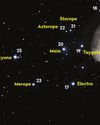
BBC Sky at Night Magazine
Lunar occultation of the Pleiades
BEST TIME TO SEE: 27 January from 20:30 UT
1 min
January 2026
BBC Sky at Night Magazine
The Universe's expansion may be slowing down
New study suggests current theories of dark energy could be wrong
1 mins
January 2026
Listen
Translate
Change font size