Denemek ALTIN - Özgür
Pets, Health and People
Scientific American
|October 2025
Only when human-pet relationships are strong, it seems, do owners get physical and mental benefits from their animals
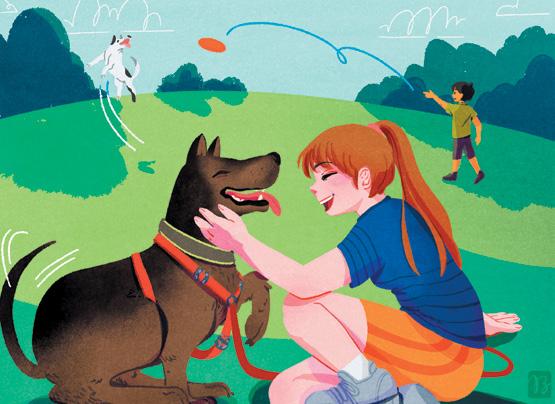
WE GOT OUR FIRST DOG when my oldest son was 10. A friend who was a teacher told me that was a perfect age for a kid to have a pet. “Jake can throw his arms around the dog when he doesn’t feel comfortable hugging you anymore,” he said.
It took a bit for me to get over his reminder that my child was growing up, but I immediately recognized my friend’s insight. A beloved animal can make everything seem better. And most of us believe strongly that our pets make us healthier.
Yet the science of human-animal interaction has found mixed results when it comes to physical and psychological health benefits from pets. Depending on the study, for example, people with pets are either less or more likely to be depressed. Experts say this seesawing probably happens because, for some owners, pets serve as a calming influence and emotional support. But in other cases, the study may include more people who are already struggling mentally and get pets to try to feel better; then such participants are counted as depressed.
Owning a dog has consistently been associated with higher levels of physical activity, no doubt because of all that walking, which has social benefits, too. One of the very first studies in the field, published in 1980, found that people who had been hospitalized for a heart attack or coronary artery disease were more likely to survive the following year if they had a pet, and the researchers suspected that physical activity from walking dogs was partly responsible, although the results held for other kinds of pets, too. A 2019 analysis of several studies, published in

Bu hikaye Scientific American dergisinin October 2025 baskısından alınmıştır.
Binlerce özenle seçilmiş premium hikayeye ve 9.000'den fazla dergi ve gazeteye erişmek için Magzter GOLD'a abone olun.
Zaten abone misiniz? Oturum aç
Scientific American'den DAHA FAZLA HİKAYE

Scientific American
Probiotic Hope and Hype
Despite their popularity, supplements with billions of \"good\" microbes help only a few illnesses, research shows

3 mins
January 2026

Scientific American
Mondays Really Are More Stressful
The start of the workweek can be a biologically measurable stressor, with consequences for long-term health that can stretch into retirement
4 mins
January 2026

Scientific American
Tiny Display
An e-paper breakthrough brings extremely high-resolution color
2 mins
January 2026
Scientific American
Fine-Feathered Snack
A bat's tracker documents a dramatic midair hunt
2 mins
January 2026

Scientific American
OUR ROBOTIC PICTURE
Will mechanical helpers ever be commonplace at home, at work and beyond?
11 mins
January 2026

Scientific American
"Use Your Words" Can Be Good for Kids' Health
Writing or expressing feelings can help adults mentally and physically. Kids are no different
5 mins
January 2026

Scientific American
Distant Diplomacy
Unrelated species “talk” and understand one another to avoid threats
2 mins
January 2026

Scientific American
Behind the Nobel
A 2025 winner reflects on the mysterious T cells that won him the prize
5 mins
January 2026

Scientific American
A Suite of Killers
Heart ailments, kidney diseases and type 2 diabetes actually may be part of just one condition. It's called CKM syndrome
10 mins
January 2026

Scientific American
Static Launch
Tiny worms leap toward their fruit fly hosts with an electric “tractor beam”
3 mins
January 2026
Listen
Translate
Change font size